
Shown: · With its frame:
 Preview

 Send
 Share
 Details
 Guide


 Download
 Similars
 X-Ray
 Diaporama
 Q&A
 Stats

- 146.0 x 114.0 cm


$ 269
Hand Made Oil Reproduction
Hand-painted oil on canvas in your size and frame, made to order by our artists. ( Switch to Print Switch to Digital Image)
Size
·Standard
custom
CM
INCH
Pick from our preset sizes that match the artwork's original proportions.
Loading sizes...

width
height
Type the width and the height you need, to fit your frame or your wall. This is hand-painted, so for a size with a different shape the artist can paint a bit more around the picture, or cut a bit — you choose. We send you a digital mockup to approve before the painting starts. The picture shown on this page does not show the real result — only the mockup does.
 Read more
Finish
·
White $1

Blurside $1

Extended $1

P118B $10

P118H $10

P118W $10

P438Z $10

P508JH $12

P508YH $12

P805H $10

P805Z $10

P919BZ $10

P919G $10

P919XJ $10

P959ZH $10

P968JZ $12

W106C $8

W218G $10

W218JH $8

W218Y $10

W307PJ $10

W316G $10

W316PJ $8

W316Y $10

W398PJ $8

W4111J $10

W500HY $15

W500JH $15

W692G $12

W849H $8

W940BG $15

W953PJ $8

H24-GOLD $30

H24-SILVER $30

H36-GOLD $45

H36-SILVER $45
Shipped in a protective tube, ready for your own framer.
Above 105 cm the frame is shipped as a kit for a professional framer — read the details.
Extras
optionalWhat do the extras include?
Examples of what can be changed: Replace face with customer photo; Add pet (e.g., replace cat with dog); Include hidden message in background; Change background landscape or elements.
After order, TopImpressionists.com team will email client for instructions and provide a mockup preview
After order, TopImpressionists.com team will email client for instructions and provide a mockup preview
Worldwide Delivery () in 3/4 weeks instead of standard 5 weeks. (3 November). No compromise on quality.
Protective Varnish
Nameplate
Engraved Bronze Plaque Details
This elegant plaque features the artist's name and the title of the artwork, finely engraved for a timeless presentation.
It is made from bronze with a refined, elegant finish. The text is precisely laser-engraved for a sharp and permanent result. Measuring 9x2 cm, the plaque is compact yet easy to read. It's built to be durable and scratch-resistant, offering a professional, museum-quality look. Mounting is simple thanks to the included adhesive backing.
Transparent Acrylic Plaque Details
The plaque includes essential engraved details such as the artist's name, the title of the artwork, the date it was created, the type of media used-like oil on canvas or watercolor-a brief description of the piece, and a QR code that links to the complete artwork information.
It is crafted from clear acrylic, offering a sleek, modern appearance. The text is UV-engraved in black to ensure strong visual contrast. With a size of 10x15 cm, it ensures optimal readability. It comes equipped with two metal hooks for secure wall mounting. The plaque is designed to be weather-resistant, making it suitable for various environments, and it includes interactive features that work seamlessly with smartphone scanning.
Black Acrylic Plaque Details
This elegant plaque includes engraved information such as the artist's name, the title of the artwork, the date it was created, the type of media used (like oil on canvas or watercolor), a short description of the artwork, and a QR code for quick access to more information.
The plaque itself is made from refined black acrylic with a premium finish. The text is laser-engraved in white for high contrast and readability. Its size is 10x15 cm, designed to be easy to read. It comes with two metal hooks for professional mounting. The design is sleek and fits any interior style. It is also weather-resistant and durable, with built-in digital integration for mobile compatibility.
Glass option is only available in size under 110 CM
 Glass option is only available in size under 110 CM
- Free Worldwide Express Shipping
- High-Quality Linen Canvas
- Full Shipping Insurance
- Customs Tax Refund Guarantee
- True Color Matching Guarantee
- 100-Day Return Policy (Defects Only)
- 100% Money-Back Guarantee
- Bulk Discount Offer


Collectible Description
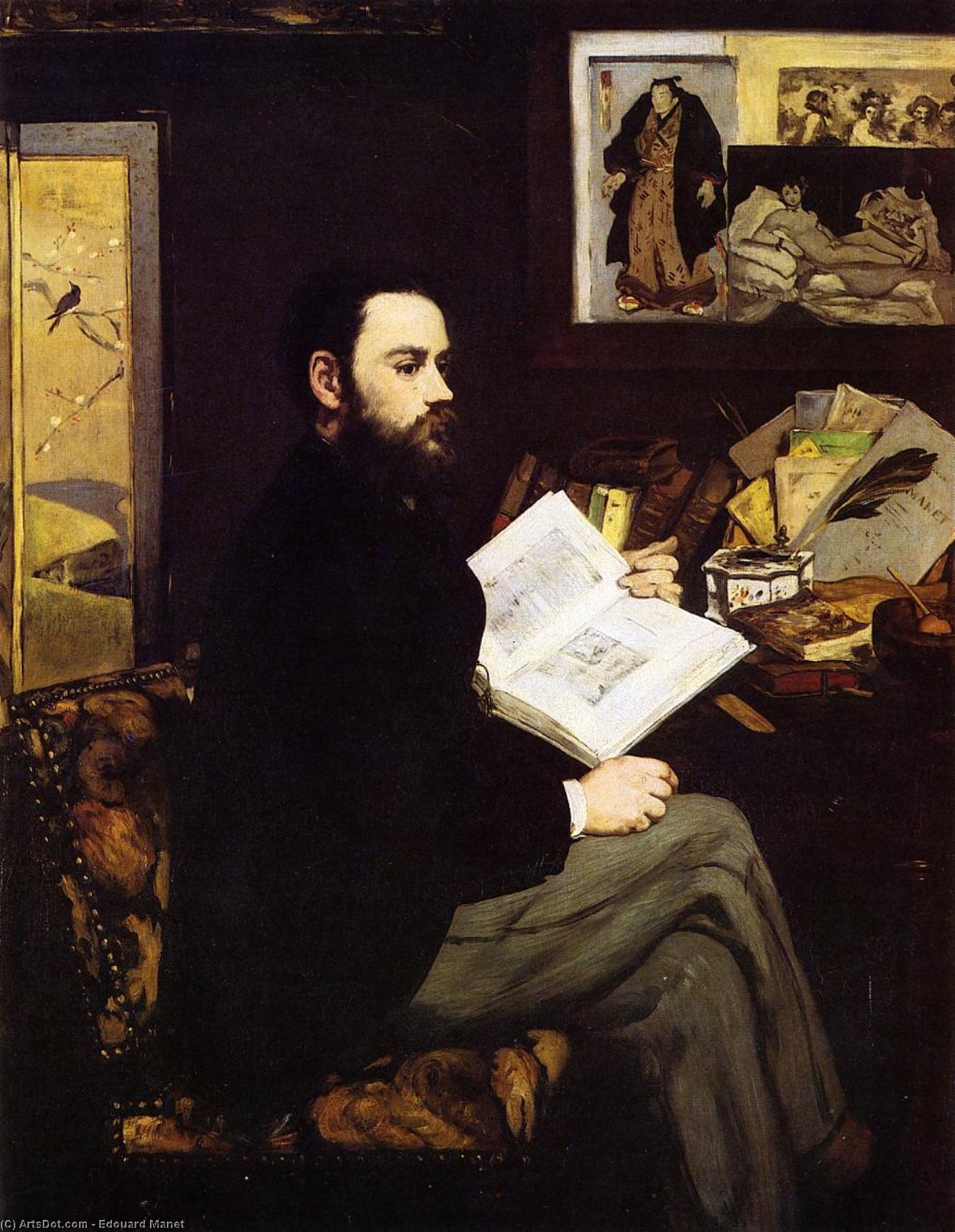
Édouard Manet's 'Portrait of Emile Zola' captures the literary figure’s intellect and engagement with art, showcasing realism & symbolism through masterful composition. Explore this iconic 1868 painting.
Artist Biography
Manet bridged Realism and Impressionism with Olympia. Discover the revolutionary works of this Parisian master.
About the painting
Portrait of Emile Zola
The Portrait of Emile Zola, painted by the renowned French artist Edouard Manet in 1868, is a seminal work that captures the essence of the literary figure Emile Zola. This oil on canvas painting, measuring 146 x 114 cm, is housed at the prestigious Musée d'Orsay in Paris, France.The Artistic Context
Edouard Manet was a pivotal figure in the transition from Realism to Impressionism. His early masterpieces, such as Portrait of Emile Zola and William Sisley, caused great controversy but were soon praised by progressive artists. These works are considered watershed paintings that mark the start of modern art. They represented a decisive break from academic conventions and ushered in an era of experimentation with light and color—a radical departure from the meticulous detail favored by earlier generations of painters.The Painting's Composition
The painting depicts Emile Zola sitting in a chair with his legs crossed, engrossed in reading a book. He is well-dressed, wearing a suit and tie, and sports a beard and mustache, giving him an intellectual appearance. In the background, several paintings are on display, including one large piece that dominates the wall behind him. Two smaller paintings are located to the right side of the room, while books are scattered around the scene, with some near Zola and others further away. A dog is seen in the lower left corner, adding a touch of warmth and companionship. Manet’s masterful composition utilizes geometric shapes—primarily rectangles—to create a sense of stability and order amidst the apparent chaos of the room. The careful placement of objects contributes to the overall narrative, inviting contemplation about Zola's intellectual pursuits and his engagement with art itself.Symbolism and Realism
The Portrait of Emile Zola reflects Manet’s blend of realism and symbolism. The detailed depiction of Zola and his surroundings showcases Manet's realist approach—observing the world with unflinching accuracy—while the inclusion of various paintings in the background symbolizes the intellectual and artistic environment that Zola inhabited. These artworks served as a visual reminder of the cultural currents shaping Zola’s life and thought, elevating the portrait beyond mere likeness to an exploration of ideas and influences.Artistic Influences
Manet's work was influenced by his trip to Spain in 1865, where he discovered the works of Diego Velázquez. This influence is evident in The Fifer, another notable painting by Manet. Velázquez’s masterful use of light and shadow—particularly in *Las Meninas*—inspired Manet to experiment with similar techniques, pushing the boundaries of artistic convention.Conclusion
The Portrait of Emile Zola is a masterpiece that encapsulates the essence of both the subject and the artist. It stands as a testament to Manet’s innovative style, which bridged realism and impressionism, paving the way for modern art. This painting continues to resonate with viewers today, prompting reflection on themes of intellectuality, artistic inspiration, and the role of art in shaping our understanding of the world. Key Points:- Portrait of Emile Zola by Edouard Manet, 1868.
- Housed at the Musée d'Orsay, Paris, France.
- Oil on canvas, measuring 146 x 114 cm.
- Reflects Manet’s blend of realism and symbolism.
- Influenced by Diego Velázquez after his trip to Spain in 1865.
Questions & Answers
How do contrast and harmony combine in "Portrait of Emile Zola"?
The color analysis of "Portrait of Emile Zola" by Édouard Manet records a statement contrast and a softly mixed palette harmony.
Can I order an oil reproduction of "Portrait of Emile Zola"?
You can order a hand-painted reproduction of "Portrait of Emile Zola" by Édouard Manet directly on its Hand-Painted Reproduction page: a hand-painted oil reproduction on linen canvas, made to order.
Is "Portrait of Emile Zola" by Édouard Manet a portrait, landscape or square composition?
"Portrait of Emile Zola" by Édouard Manet has a portrait format. The format describes the proportions of the composition.
Quick facts and art quiz
About Édouard Manet

Édouard Manet
1832 - 1883, France
Artist Biography
The Architect of Modernity
To look at a canvas by Édouard Manet is to witness the precise moment when the polished illusions of the past collapsed under the weight of contemporary reality. He did not seek to decorate the walls of the bourgeoisie; he sought to confront them. While his contemporaries often retreated into mythological safety, Manet forced the viewer to acknowledge the grit and the glare of 19th-century Paris. His work functions as a blunt instrument that dismantled the academic hierarchy of subjects. He stripped away the comfortable distance provided by historical allegory, replacing it with the unsettling directness of a woman staring back from a modern street or a café.
The impact of his technique remains visible in every brushstroke that prioritizes the physical reality of paint over the illusion of depth. He rejected the seamless, invisible finish demanded by the Salon, opting instead for facture—a visible, energetic application of pigment. By using stark contrasts and a flattened pictorial space, he reminded anyone looking at his work that they were observing a constructed image on a flat surface. This was not an error in perspective; it was a deliberate rejection of the window-like transparency that had dominated Western art since the Renaissance.
A Rebellion Rooted in Tradition
Manet’s radicalism was not born from ignorance of the past, but from a deep, analytical study of it. His time spent copying Old Masters in the Louvre provided him with a technical foundation that he would later use to subvert tradition. He drew heavily from the bold compositions and light manipulation found in the works of Caravaggio and Velázquez. From the Spanish masters, he learned how to utilize black as a positive color and how to employ fluid brushwork to suggest form without excessive detail. This was not an imitation of the past, but a dissection of it.
His early life in Paris suggested a path far removed from the studio. Born into a comfortable family, his father initially pushed for a career in the navy or law. After failing his entrance exams for the naval academy, Manet turned toward the arts under the instruction of Thomas Couture. This tension between his bourgeois origins and his revolutionary output created a unique friction in his work. He possessed the social standing to navigate Parisian intellectual circles, yet he used that access to promote an aesthetic that many found vulgar or incompetent.
The Scandal of the Real
The mid-1860s provided the stage for Manet’s most significant confrontations with the public. The 1863 Salon des Refusés became a site of intense controversy, largely due to his inclusion in the exhibition of rejected works. His painting Le Déjeuner sur l'herbe shocked audiences not merely because of its nudity, but because of its lack of mythological context. The figures were undeniably modern, stripped of the divine or the ancient, leaving only the raw presence of contemporary Parisians. This refusal to idealize his subjects was met with widespread condemnation from critics who found his realism too blunt.
This pattern of provocation continued with Olympia in 1865. By reimagining Titian’s Venus of Urbino through the lens of a contemporary prostitute, Manet stripped away the protective layer of myth. The subject did not invite a gaze of admiration for a goddess; she demanded recognition of a person. This period of his career established the fundamental shift from Realism toward the beginnings of Impressionism. His influence on the movement was structural rather than purely stylistic:
- He championed the use of alla prima painting, or wet-on-wet technique, to capture immediate atmospheric effects.
- He introduced a flattened perspective that challenged the mathematical precision of academic composition.
- He utilized strong, contrasting tones to create a sense of modern, fragmented light.
The Enduring Verdict
Manet’s career was cut short by his death in 1883, yet the trajectory of art had already been irrevocably altered. He acted as the essential bridge between the heavy, grounded themes of Realism and the fleeting, light-focused explorations of the Impressionists. While he never fully adopted the label of an Impressionist and continued to seek recognition from the official Salon, his methods provided the vocabulary for the avant-garde. He proved that the artist's duty was not to provide a beautiful escape, but to document the complexities and contradictions of the era.
Quick facts about Édouard Manet
- Full Name: Édouard Manet
- Nationality: French
- Date Of Birth: 1832
- Date Of Death: 1883
- Place Of Birth: Paris, France
- Notable Artworks:
- Le Déjeuner sur l'herbe
- Olympia
- A Bar at the Folies-Bergère
- Artistic Movement Or Style: Realism, Impressionism
- Artists Who Influenced This Artist:
- Caravaggio
- Diego Velázquez
- Gustave Courbet
- Artists Or Movements Influenced By This Artist:
- Claude Monet
- Pierre-Auguste Renoir
- Edgar Degas
- Impressionism
Related Artworks


Explore artworks organized by themes, styles, and characteristics.


Édouard Manet
Portrait of Emile Zola
() ·
With its frame: · Hand-painted in oil on linen
Total