

Shown: · With its frame:
 Preview

 Send
 Share
 Details
 Guide


 Download
 Similars
 X-Ray
 Diaporama
 Q&A
 Stats


$ 269
Hand Made Oil Reproduction
Hand-painted oil on canvas in your size and frame, made to order by our artists. ( Switch to Print Switch to Digital Image)
Size
·Standard
custom
CM
INCH
Pick from our preset sizes that match the artwork's original proportions.
Loading sizes...

width
height
Type the width and the height you need, to fit your frame or your wall. This is hand-painted, so for a size with a different shape the artist can paint a bit more around the picture, or cut a bit — you choose. We send you a digital mockup to approve before the painting starts. The picture shown on this page does not show the real result — only the mockup does.
 Read more
Finish
·
White $1

Blurside $1

Extended $1

P118B $10

P118H $10

P118W $10

P438Z $10

P508JH $12

P508YH $12

P805H $10

P805Z $10

P919BZ $10

P919G $10

P919XJ $10

P959ZH $10

P968JZ $12

W106C $8

W218G $10

W218JH $8

W218Y $10

W307PJ $10

W316G $10

W316PJ $8

W316Y $10

W398PJ $8

W4111J $10

W500HY $15

W500JH $15

W692G $12

W849H $8

W940BG $15

W953PJ $8

H24-GOLD $30

H24-SILVER $30

H36-GOLD $45

H36-SILVER $45
Shipped in a protective tube, ready for your own framer.
Above 105 cm the frame is shipped as a kit for a professional framer — read the details.
Extras
optionalWhat do the extras include?
Examples of what can be changed: Replace face with customer photo; Add pet (e.g., replace cat with dog); Include hidden message in background; Change background landscape or elements.
After order, TopImpressionists.com team will email client for instructions and provide a mockup preview
After order, TopImpressionists.com team will email client for instructions and provide a mockup preview
Worldwide Delivery () in 3/4 weeks instead of standard 5 weeks. (6 November). No compromise on quality.
Protective Varnish
Nameplate
Engraved Bronze Plaque Details
This elegant plaque features the artist's name and the title of the artwork, finely engraved for a timeless presentation.
It is made from bronze with a refined, elegant finish. The text is precisely laser-engraved for a sharp and permanent result. Measuring 9x2 cm, the plaque is compact yet easy to read. It's built to be durable and scratch-resistant, offering a professional, museum-quality look. Mounting is simple thanks to the included adhesive backing.
Transparent Acrylic Plaque Details
The plaque includes essential engraved details such as the artist's name, the title of the artwork, the date it was created, the type of media used-like oil on canvas or watercolor-a brief description of the piece, and a QR code that links to the complete artwork information.
It is crafted from clear acrylic, offering a sleek, modern appearance. The text is UV-engraved in black to ensure strong visual contrast. With a size of 10x15 cm, it ensures optimal readability. It comes equipped with two metal hooks for secure wall mounting. The plaque is designed to be weather-resistant, making it suitable for various environments, and it includes interactive features that work seamlessly with smartphone scanning.
Black Acrylic Plaque Details
This elegant plaque includes engraved information such as the artist's name, the title of the artwork, the date it was created, the type of media used (like oil on canvas or watercolor), a short description of the artwork, and a QR code for quick access to more information.
The plaque itself is made from refined black acrylic with a premium finish. The text is laser-engraved in white for high contrast and readability. Its size is 10x15 cm, designed to be easy to read. It comes with two metal hooks for professional mounting. The design is sleek and fits any interior style. It is also weather-resistant and durable, with built-in digital integration for mobile compatibility.
Glass option is only available in size under 110 CM
 Glass option is only available in size under 110 CM
- Free Worldwide Express Shipping
- High-Quality Linen Canvas
- Full Shipping Insurance
- Customs Tax Refund Guarantee
- True Color Matching Guarantee
- 100-Day Return Policy (Defects Only)
- 100% Money-Back Guarantee
- Bulk Discount Offer


Collectible Description
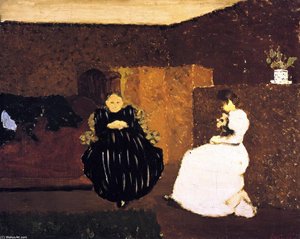
Jean Edouard Vuillard’s "La causette," painted in 1893, exemplifies Post-Impressionism—rejecting Impressionist light observation for interior explorations capturing atmosphere and familial connection. Featuring Marie Vuillard & her daughter, it employs flattened planes of color influenced by Japanese prints, showcasing muted browns & blacks amidst vibrant wallpaper details.
Artist Biography
Jean-Édouard Vuillard (1868-1940) was a French painter & Nabis member known for intimate interior scenes, decorative style, and influence on early modernism like Cubism. Explore his art!
About the painting
The Chat (also known as Mme Vuillard and Her Daughter - La Causette)
Jean Edouard Vuillard’s “La causette,” painted in 1893, stands as a quintessential example of Post-Impressionism—a movement that fiercely rejected the serene observation of light championed by Impressionists. Instead, Vuillard plunged into the interior world, capturing not just what he saw but also conveying the palpable atmosphere of domestic life and familial connection.
The painting depicts two women seated in a room bathed in soft, diffused light—Vuillard’s mother, Marie Vuillard, and her daughter, Marie Roussel. The composition is deceptively simple: a couch dominates the left side, while a chair occupies the right. However, within this apparent stillness lies a wealth of detail—several vases strategically placed around the room contribute to the overall sense of warmth and intimacy, punctuated by a potted plant on the far right.
Vuillard’s distinctive style is immediately recognizable through his masterful use of color and form. He eschewed Impressionist attempts at capturing fleeting moments of light, opting instead for flattened planes of pigment—a technique heavily influenced by Japanese prints—that create an illusion of depth without resorting to traditional perspective. The palette is muted yet rich, dominated by browns and blacks that serve as a grounding counterpoint to the vibrant hues of the wallpaper.
More than just a depiction of a scene, “La causette” embodies Vuillard’s profound exploration of psychological space. He captures not only the physical arrangement of objects but also the unspoken emotions between the figures—the quiet conversation, the subtle gestures of connection. The artist's keen eye for capturing human emotion is evident in his portrayal of Marie Roussel, who leans awkwardly against the wall, attempting to blend into the room’s background.
The painting’s symbolism resonates deeply with Vuillard’s broader artistic vision. The choice of colors—particularly the yellow of Madame Vuillard’s dress—suggests a radiant presence that commands attention and asserts dominance within the domestic sphere. Similarly, the positioning of the vases serves as a visual anchor, grounding the composition and reinforcing the sense of stability.
Ultimately, “La causette” transcends mere representation; it invites contemplation on themes of motherhood, femininity, and the complexities of human relationships—themes that continue to captivate audiences today. It’s a testament to Vuillard's ability to transform ordinary domestic scenes into canvases brimming with emotion and artistic innovation.
Artist's Background
Jean Edouard Vuillard (1868-1940) was born in Cuiseaux, France—a quiet village nestled in the Jura Mountains. From a young age, he demonstrated an exceptional talent for drawing and painting, honing his skills through self-study and experimentation.
Vuillard’s artistic journey coincided with the rise of Les Nabis—a collective of young French artists who championed a radically new approach to artmaking. Influenced by Japanese prints and seeking to liberate color from Impressionist conventions, Vuillard joined Les Nabis in 1888, forging enduring friendships with fellow visionaries like Maurice Denis and Édouard Vuillard.
Les Nabis’s aesthetic principles—characterized by flattened planes of pigment, muted palettes, and a focus on decorative elements—challenged the prevailing artistic norms of their time. Vuillard embraced these ideas wholeheartedly, developing his own distinctive style that blended observation with imagination—a hallmark of his oeuvre.
Vuillard's prolific output encompassed paintings, prints, decorative commissions, and illustrations—demonstrating his versatility as an artist and cementing his legacy as one of the most influential figures in early modernism. His work continues to inspire artists and collectors alike, securing its place among the masterpieces of French art.
Additional Research
Vuillard’s fascination with Japanese prints profoundly shaped his artistic vision—particularly his exploration of spatial illusion and decorative patterning. He meticulously studied Ukiyo-e compositions, analyzing their use of perspective and color to achieve dramatic effects.
Furthermore, Vuillard's meticulous attention to detail—evident in his depictions of interiors and portraits—reflects a commitment to capturing the nuances of human experience. He sought to convey not just what he saw but also how he felt—a characteristic that distinguishes his work from more purely objective representations.
“La causette” exemplifies Vuillard’s artistic principles—his masterful use of color and form, his exploration of psychological space, and his engagement with symbolic imagery. It stands as a beacon of innovation within the Post-Impressionist movement—a testament to Vuillard's enduring influence on subsequent generations of artists.
Notable Works
Beyond “La causette,” Vuillard produced numerous other celebrated paintings—including “Luncheon at Les Clayes,” “The Child’s Bath 2,” and “Portrait of Madame Matisse”—each showcasing his distinctive style and artistic vision. These works continue to resonate with audiences today, securing Vuillard's place among the most revered artists of the Belle Époque.
Questions & Answers
Where can I find artworks similar to "The Chat (also known as Mme Vuillard and Her Daughter - La Causette)" by Jean-Édouard Vuillard?
Artworks similar to "The Chat (also known as Mme Vuillard and Her Daughter - La Causette)" by Jean-Édouard Vuillard are gathered on the artwork's Similars page.
Can I preview "The Chat (also known as Mme Vuillard and Her Daughter - La Causette)" by Jean-Édouard Vuillard before ordering?
To preview a reproduction of "The Chat (also known as Mme Vuillard and Her Daughter - La Causette)" by Jean-Édouard Vuillard, open the artwork's Preview page.
How do I download the image of "The Chat (also known as Mme Vuillard and Her Daughter - La Causette)" by Jean-Édouard Vuillard?
A download is available for "The Chat (also known as Mme Vuillard and Her Daughter - La Causette)": the artwork's Download page offers a high-resolution digital image download.
Quick facts and art quiz
About Jean-Édouard Vuillard
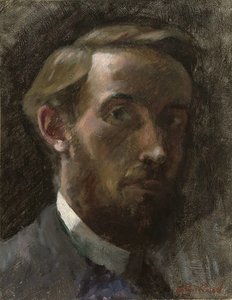
Jean-Édouard Vuillard
1868 - 1940, France
Artist Biography
**early life and artistic beginnings**
jean-édouard vuillard, a french painter, decorative artist, and printmaker, was born on november 11, 1868, in cuiseaux, france. his life's work would later become a cornerstone of the avant-garde artistic group les nabis, alongside fellow visionaries like maurice denis and édouard vuillard. this collective would revolutionize the art world with their innovative approach to color and form.**the nabis movement and its influence**
as a prominent member of les nabis, vuillard's paintings assembled areas of pure color, influenced by japanese prints. his interior scenes explored the spatial effects of flattened planes of color, pattern, and form. this approach would later influence the development of cubism, fauvism, and abstract art.- les nabis, a group of young french artists active in paris from 1888 until 1900, played a large part in the transition from impressionism and academic art to abstract art, symbolism, and the other early movements of modernism.
- their philosophy was based upon the philosophy of positivism, and the writings of auguste comte and hippolyte taine.
**vuillard's later work and legacy**
after 1900, when les nabis disbanded, vuillard adopted a more realistic style, approaching landscapes and interiors with greater detail and vivid colors. in the 1920s and 1930s, he painted portraits of prominent figures in french industry and the arts in their familiar settings. **key works and exhibitions:**- jean-édouard vuillard's paintings can be found in various museums, including the musée de la révolution française (france), which boasts a rich collection of artworks, documents, and objects related to the revolutionary period.
- some of his notable works include "la patrie en danger" by guillaume lethière and "jean de la barre" by jean clouet, which depict a young man condemned to death for blasphemy during the ancien régime.
- vuillard's later work, such as his portraits of french industry and arts figures, can be seen in various galleries, including those at intimism art movement and jean-édouard vuillard's page on TopImpressionists.
**conclusion**
jean-édouard vuillard's enigmatic world, characterized by its innovative use of color and form, has left an indelible mark on the art world. as a pioneer of modernism, his work continues to inspire artists and influence various artistic movements. discover more about intimism art movement and explore jean-édouard vuillard's works on TopImpressionists.Quick facts about Jean-Édouard Vuillard
- Full Name: Jean-Édouard Vuillard
- Nationality: French
- Date Of Birth: 1868
- Date Of Death: 1940
- Place Of Birth: Chesaux, France
- Notable Artworks:
- Woman Sweeping
- Sunlit Interior
- Artistic Movement Or Style: Nabis
- Artists Who Influenced This Artist: ['Paul Gauguin']
- Artists Or Movements Influenced By This Artist:
- Cubism
- Fauvism
Related Artworks





Explore artworks organized by themes, styles, and characteristics.

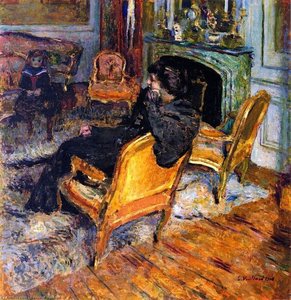







Jean-Édouard Vuillard
The Chat (also known as Mme Vuillard and Her Daughter - La Causette)
() ·
With its frame: · Hand-painted in oil on linen
Total