

Shown: · With its frame:
 Preview

 Send
 Share
 Details
 Guide


 Download
 Similars
 X-Ray
 Diaporama
 Q&A
 Stats

- 5.0 x 66.0 cm


$ 269
Hand Made Oil Reproduction
Hand-painted oil on canvas in your size and frame, made to order by our artists. ( Switch to Print Switch to Digital Image)
Size
·Standard
custom
CM
INCH
Pick from our preset sizes that match the artwork's original proportions.
Loading sizes...

width
height
Type the width and the height you need, to fit your frame or your wall. This is hand-painted, so for a size with a different shape the artist can paint a bit more around the picture, or cut a bit — you choose. We send you a digital mockup to approve before the painting starts. The picture shown on this page does not show the real result — only the mockup does.
 Read more
Finish
·
White $1

Blurside $1

Extended $1

P118B $10

P118H $10

P118W $10

P438Z $10

P508JH $12

P508YH $12

P805H $10

P805Z $10

P919BZ $10

P919G $10

P919XJ $10

P959ZH $10

P968JZ $12

W106C $8

W218G $10

W218JH $8

W218Y $10

W307PJ $10

W316G $10

W316PJ $8

W316Y $10

W398PJ $8

W4111J $10

W500HY $15

W500JH $15

W692G $12

W849H $8

W940BG $15

W953PJ $8

H24-GOLD $30

H24-SILVER $30

H36-GOLD $45

H36-SILVER $45
Shipped in a protective tube, ready for your own framer.
Above 105 cm the frame is shipped as a kit for a professional framer — read the details.
Extras
optionalWhat do the extras include?
Examples of what can be changed: Replace face with customer photo; Add pet (e.g., replace cat with dog); Include hidden message in background; Change background landscape or elements.
After order, TopImpressionists.com team will email client for instructions and provide a mockup preview
After order, TopImpressionists.com team will email client for instructions and provide a mockup preview
Worldwide Delivery () in 3/4 weeks instead of standard 5 weeks. (6 November). No compromise on quality.
Protective Varnish
Nameplate
Engraved Bronze Plaque Details
This elegant plaque features the artist's name and the title of the artwork, finely engraved for a timeless presentation.
It is made from bronze with a refined, elegant finish. The text is precisely laser-engraved for a sharp and permanent result. Measuring 9x2 cm, the plaque is compact yet easy to read. It's built to be durable and scratch-resistant, offering a professional, museum-quality look. Mounting is simple thanks to the included adhesive backing.
Transparent Acrylic Plaque Details
The plaque includes essential engraved details such as the artist's name, the title of the artwork, the date it was created, the type of media used-like oil on canvas or watercolor-a brief description of the piece, and a QR code that links to the complete artwork information.
It is crafted from clear acrylic, offering a sleek, modern appearance. The text is UV-engraved in black to ensure strong visual contrast. With a size of 10x15 cm, it ensures optimal readability. It comes equipped with two metal hooks for secure wall mounting. The plaque is designed to be weather-resistant, making it suitable for various environments, and it includes interactive features that work seamlessly with smartphone scanning.
Black Acrylic Plaque Details
This elegant plaque includes engraved information such as the artist's name, the title of the artwork, the date it was created, the type of media used (like oil on canvas or watercolor), a short description of the artwork, and a QR code for quick access to more information.
The plaque itself is made from refined black acrylic with a premium finish. The text is laser-engraved in white for high contrast and readability. Its size is 10x15 cm, designed to be easy to read. It comes with two metal hooks for professional mounting. The design is sleek and fits any interior style. It is also weather-resistant and durable, with built-in digital integration for mobile compatibility.
Glass option is only available in size under 110 CM
 Glass option is only available in size under 110 CM
- Free Worldwide Express Shipping
- High-Quality Linen Canvas
- Full Shipping Insurance
- Customs Tax Refund Guarantee
- True Color Matching Guarantee
- 100-Day Return Policy (Defects Only)
- 100% Money-Back Guarantee
- Bulk Discount Offer


Collectible Description
A serene winter scene featuring leafless trees and birds captured by Vittore Grubicy de Dragon through a refined divisionist lens, offering a tranquil moment of late 19th-century Italian beauty to bring into your collection.
Artist Biography
Vittore Grubicy de Dragon (1851-1920) was a pivotal Italian painter, critic & gallery owner who championed Divisionism and Symbolism. Influenced by Van Gogh & the Hague School, he promoted light as emotion & shaped late 19th-century Italian art.
About the painting
A Silent Symphony of Frost and Light
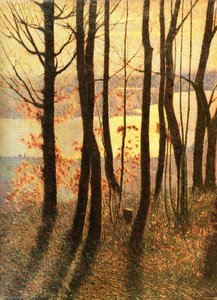
In the quietude of a winter landscape, where the breath of nature seems to hold its stillness, Vittore Grubicy de Dragon captures a moment of profound serenity in his evocative work, Winter Poem. This delicate composition, painted across a series of canvases between 1894 and 1911, serves as a masterful meditation on the ephemeral beauty of the colder months. Set within the tranquil lakeside atmosphere of Miazzina, near Verbania, the painting invites the viewer into a world where the skeletal silhouettes of leafless trees reach toward a pale, expansive sky. The absence of foliage does not signal death, but rather a rhythmic pause in the cycle of life, allowing the structural elegance of the branches to become a focal point of the visual poetry.
The scene is far from desolate; instead, it is imbued with a subtle, pulsing vitality. As the eye wanders through the wintry expanse, one discovers the graceful movement of birds navigating the crisp air, their flight adding a layer of dynamic energy to the otherwise motionless landscape. The inclusion of a solitary dog adds a touch of domestic warmth and narrative depth, grounding the ethereal atmosphere in a relatable, earthly reality. This interplay between the vast, silent sky and the small, living elements creates a sense of harmony that is both captivating and deeply restorative for the soul.
The Mastery of Divisionist Light
As a pivotal figure in the Italian Divisionism movement, Grubicy de Dragon utilized light not merely as an illumination of form, but as the very substance of emotion. In Winter Poem, his technique transcends simple representation to achieve a luminous, atmospheric effect. Through the meticulous application of color and the separation of tones, he captures the specific, biting clarity of winter light—a light that feels both cold to the touch and spiritually radiant. The way the sky interacts with the dark, intricate patterns of the foreground trees demonstrates his profound understanding of optical theory, where colors are meant to blend within the viewer's eye rather than on the palette.
For the discerning collector or interior designer, this piece offers more than just a window into the past; it provides a sophisticated focal point for modern spaces. The subtle textures and the nuanced palette of muted tones allow the artwork to integrate seamlessly into refined, contemporary interiors, offering a sense of calm and intellectual depth. Whether placed in a sunlit gallery or a cozy, private study, Winter Poem acts as an anchor of tranquility, reminding us of the quiet majesty found in nature's most dormant seasons.
Questions & Answers
Can I order an oil reproduction of "Winter Poem"?
Hand-painted copies of "Winter Poem" by Vittore Grubicy De Dragon are sold on this website: a hand-painted oil reproduction on linen canvas, ordered from its Hand-Painted Reproduction page.
What is the dominant hue of "Winter Poem" by Vittore Grubicy De Dragon?
"Winter Poem" leans toward an ochre to sepia tone.
What historical period is "Winter Poem" by Vittore Grubicy De Dragon from?
The historical period of "Winter Poem" by Vittore Grubicy De Dragon is 19th-Century. This classification situates the work in art history.
Quick facts and art quiz
About Vittore Grubicy De Dragon

Vittore Grubicy De Dragon
1851 - 1920
Artist Biography
The Visionary Architect of Light and Color
Born into the vibrant, cultured atmosphere of Milan in 1851, Vittore Grubicy de Dragon was far more than a mere painter; he was a profound catalyst for change within the Italian art world. Raised in a wealthy family where art was an essential element of daily life, his early years were steeped in the humanistic traditions that would later inform his critical intellect. Following the passing of his father in 1870, Grubicy found himself drawn into the bohemian orbit of the Scapigliatura, a movement of Milanese artists and poets dedicated to blurring the boundaries between art and existence. This period of intense cultural immersion laid the groundwork for his dual legacy as both a creator of evocative imagery and a formidable tastemaker who would reshape the trajectory of late 19th-century Italian painting.
His entrepreneurial spirit led him to establish the Galleria Fratelli Grubicy alongside his brother, Alberto. This institution was revolutionary, operating on an early modern concept of representing living artists as dedicated clients. While his brother managed the financial intricacies, Vittore acted as a wandering scout for the new, traversing the great art capitals of Europe—from London and Paris to Antwerp—to identify emerging trends. Initially, the gallery championed the soft, atmospheric aesthetics of the Scapigliatura masters like Tranquillo Cremona and Daniele Ranzoni, but Grubicy’s true genius lay in his ability to recognize the potential of a burgeoning movement that would eventually define an era.
The Dawn of Divisionism
Between 1882 and 1885, Grubicy’s travels took him to the Netherlands, where he encountered the Hague School. It was here that his encounter with Anton Mauve proved transformative; Mauve became a mentor who materially directed his approach to the brush. This European exposure, combined with an interest in the optical theories of color, allowed Grubacy to bridge the gap between international trends and Italian sensibilities. Upon his return to Italy, he began to champion Divisionism, a technique characterized by the separation of colors into individual dots or strokes that the eye then blends optically. He did not merely promote this style; he became its theoretical guide, translating complex scientific theories of light into an emotional language for painters.
Grubicy’s influence was instrumental in the careers of some of Italy's most celebrated artists. He possessed a rare, prophetic ability to recognize talent, securing contracts for masters such as:
- Giovanni Segantini, whose monumental landscapes became synonymous with the movement;
- Emilio Longoni, who brought a profound sense of realism to the divisionist technique;
- Angelo Morbelli, whose delicate touch captured the quietude of contemporary life.
Through his writings and his gallery, he convinced these artists to embrace light not just as a physical phenomenon, but as an emotional force. He famously pushed Segantini to refine his approach, ensuring that the movement possessed both technical rigor and symbolic depth.
A Legacy of Light and Symbolism
As his career progressed, Grubicy’s own painting practice became an extension of his critical theories. His work often reflected a deep connection to the landscapes of Lake Como, particularly around Lierna, where he frequently worked en plein air. In these works, one can observe the marriage of Divisionist precision with a Symbolist soul. His canvases often evoke a sense of melancholy or spiritual transcendence, using muted tones and textured impasto to create atmospheres that feel both tangible and dreamlike. Whether capturing the quietude of an evening landscape or the rugged majesty of mountain scenes, his brushwork sought to capture the very essence of luminosity.
The historical significance of Vittore Grubicy de Dragon cannot be overstated. He was the bridge between the old world of romanticism and the new era of modern optical science. By integrating the influences of the Hague School and even the burgeoning energy of Van Gogh into the Italian context, he ensured that Italian art remained at the forefront of European innovation. Though his life ended in 1920, his impact remains etched in the vibrant, fractured light of every Divisionist masterpiece, a testament to a man who saw the world not just as it appeared, but as it felt through the prism of color.
Quick facts about Vittore Grubicy De Dragon
- Full Name: Vittore Grubicy de Dragon
- Nationality: Italian
- Date Of Birth: 1851
- Date Of Death: 1920
- Place Of Birth: Milan, Italy
- Notable Artworks: ['Evening']
- Artistic Movement Or Style: Divisionism, Symbolism
- Artists Who Influenced This Artist:
- Anton Mauve
- Vincent van Gogh
- Artists Or Movements Influenced By This Artist:
- Giovanni Segantini
- Emilio Longoni
Related Artworks


Explore artworks organized by themes, styles, and characteristics.



Vittore Grubicy De Dragon
Winter Poem
() ·
With its frame: · Hand-painted in oil on linen
Total