

Shown: · With its frame:
 Preview

 Send
 Share
 Details
 Guide


 Download
 Similars
 X-Ray
 Diaporama
 Q&A
 Stats


$ 269
Hand Made Oil Reproduction
Hand-painted oil on canvas in your size and frame, made to order by our artists. ( Switch to Print Switch to Digital Image)
Size
·Standard
custom
CM
INCH
Pick from our preset sizes that match the artwork's original proportions.
Loading sizes...

width
height
Type the width and the height you need, to fit your frame or your wall. This is hand-painted, so for a size with a different shape the artist can paint a bit more around the picture, or cut a bit — you choose. We send you a digital mockup to approve before the painting starts. The picture shown on this page does not show the real result — only the mockup does.
 Read more
Finish
·
White $1

Blurside $1

Extended $1

P118B $10

P118H $10

P118W $10

P438Z $10

P508JH $12

P508YH $12

P805H $10

P805Z $10

P919BZ $10

P919G $10

P919XJ $10

P959ZH $10

P968JZ $12

W106C $8

W218G $10

W218JH $8

W218Y $10

W307PJ $10

W316G $10

W316PJ $8

W316Y $10

W398PJ $8

W4111J $10

W500HY $15

W500JH $15

W692G $12

W849H $8

W940BG $15

W953PJ $8

H24-GOLD $30

H24-SILVER $30

H36-GOLD $45

H36-SILVER $45
Shipped in a protective tube, ready for your own framer.
Above 105 cm the frame is shipped as a kit for a professional framer — read the details.
Extras
optionalWhat do the extras include?
Examples of what can be changed: Replace face with customer photo; Add pet (e.g., replace cat with dog); Include hidden message in background; Change background landscape or elements.
After order, TopImpressionists.com team will email client for instructions and provide a mockup preview
After order, TopImpressionists.com team will email client for instructions and provide a mockup preview
Worldwide Delivery () in 3/4 weeks instead of standard 5 weeks. (3 November). No compromise on quality.
Protective Varnish
Nameplate
Engraved Bronze Plaque Details
This elegant plaque features the artist's name and the title of the artwork, finely engraved for a timeless presentation.
It is made from bronze with a refined, elegant finish. The text is precisely laser-engraved for a sharp and permanent result. Measuring 9x2 cm, the plaque is compact yet easy to read. It's built to be durable and scratch-resistant, offering a professional, museum-quality look. Mounting is simple thanks to the included adhesive backing.
Transparent Acrylic Plaque Details
The plaque includes essential engraved details such as the artist's name, the title of the artwork, the date it was created, the type of media used-like oil on canvas or watercolor-a brief description of the piece, and a QR code that links to the complete artwork information.
It is crafted from clear acrylic, offering a sleek, modern appearance. The text is UV-engraved in black to ensure strong visual contrast. With a size of 10x15 cm, it ensures optimal readability. It comes equipped with two metal hooks for secure wall mounting. The plaque is designed to be weather-resistant, making it suitable for various environments, and it includes interactive features that work seamlessly with smartphone scanning.
Black Acrylic Plaque Details
This elegant plaque includes engraved information such as the artist's name, the title of the artwork, the date it was created, the type of media used (like oil on canvas or watercolor), a short description of the artwork, and a QR code for quick access to more information.
The plaque itself is made from refined black acrylic with a premium finish. The text is laser-engraved in white for high contrast and readability. Its size is 10x15 cm, designed to be easy to read. It comes with two metal hooks for professional mounting. The design is sleek and fits any interior style. It is also weather-resistant and durable, with built-in digital integration for mobile compatibility.
Glass option is only available in size under 110 CM
 Glass option is only available in size under 110 CM
- Free Worldwide Express Shipping
- High-Quality Linen Canvas
- Full Shipping Insurance
- Customs Tax Refund Guarantee
- True Color Matching Guarantee
- 100-Day Return Policy (Defects Only)
- 100% Money-Back Guarantee
- Bulk Discount Offer


Collectible Description
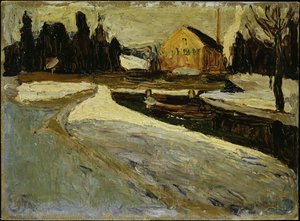
Wassily Kandinsky's "Schwabing, Wintersonne" captures a serene winter scene with snow-covered roads and boats, reflecting his pioneering abstract style & Munich’s charm.
Artist Biography
Discover Wassily Kandinsky (1866-1944), the pioneer of abstract art! Explore his vibrant expressionism, spiritual themes & Bauhaus legacy through stunning reproductions.
About the painting
A Frozen Reverie: Unpacking Kandinsky’s Schwabing, Wintersonne
Wassily Kandinsky's 1901 painting, “Schwabing, Wintersonne” (Schwabing, Winter Sun), isn’t merely a depiction of a snowy street; it’s a profound distillation of emotion and the nascent seeds of abstract art. Painted during a pivotal period in his artistic development, this work captures a fleeting moment in Munich's Schwabing district – a vibrant, bohemian neighborhood that served as a crucible for artistic innovation at the turn of the 20th century. The scene is rendered with an almost dreamlike quality, a hazy recollection filtered through Kandinsky’s intensely personal and evolving visual language.
Kandinsky, then grappling with his own burgeoning understanding of color and form, moved away from representational painting to explore the inner world of feeling. “Schwabing, Wintersonne” exemplifies this shift. The recognizable elements – a snow-covered road, trees silhouetted against a muted sky, a distant house – are subtly distorted and imbued with an emotional resonance that transcends simple observation. Notice how the forms aren’t sharply defined; instead, they bleed into one another, creating a sense of fluidity and movement within the stillness of winter.
The Language of Color: Kandinsky's Pioneering Approach
Kandinsky’s masterful use of color is central to understanding this painting. He employs a restrained palette – predominantly blues, greys, and browns – punctuated by flashes of ochre and white. These colors aren’t used to mimic reality but rather to evoke specific moods and sensations. The cool blues and greys suggest the quiet solitude of winter, while the warmer tones hint at a hidden warmth beneath the surface. Crucially, Kandinsky believed that color possessed an inherent spiritual quality, capable of directly affecting the viewer's emotions. He sought to translate these feelings into visual form, moving beyond mere depiction to create paintings that communicated directly with the soul.
The technique itself is characteristic of Kandinsky’s early work – a blend of Impressionistic color theory and nascent abstraction. He builds up layers of oil paint on board, creating textured surfaces that invite close examination. The brushstrokes are visible, yet they're not used to create detailed representations; instead, they contribute to the overall sense of atmosphere and movement. This layering technique is reminiscent of his later explorations in composition, where he would build complex arrangements of shapes and colors to achieve a desired emotional effect.
Schwabing: A Hub of Artistic Spirit
To fully appreciate “Schwabing, Wintersonne,” it’s essential to understand the context in which it was created. Schwabing was a magnet for artists, writers, and intellectuals at the turn of the 20th century – a place where bohemian ideals flourished and artistic experimentation thrived. The district's proximity to Munich’s universities and its vibrant cultural scene fostered an environment of creativity and intellectual exchange. Kandinsky himself spent considerable time in Schwabing during this period, absorbing the atmosphere and drawing inspiration from the neighborhood’s unique character.
The painting captures a specific moment within that dynamic landscape – a quiet winter afternoon in Schwabing, imbued with a sense of melancholy beauty. The empty road suggests solitude and introspection, while the distant house offers a hint of domesticity and warmth. It's a scene that invites contemplation, prompting viewers to consider their own relationship to the natural world and the emotional landscapes within themselves.
A Legacy in Abstraction
“Schwabing, Wintersonne” is more than just a beautiful winter landscape; it’s a crucial stepping stone on Kandinsky's path toward abstract art. It represents a decisive break from traditional representation and a bold exploration of the expressive potential of color and form. This painting foreshadows his later, more radical works, where he would dismantle recognizable imagery altogether to create paintings that communicated solely through their emotional impact. Reproductions of this piece offer a powerful glimpse into the genesis of modern art and the enduring legacy of one of its most visionary pioneers.
Questions & Answers
Why is the copyright status of "Schwabing, Wintersonne (Schwabing, Winter Sun)" what it is?
The copyright status of "Schwabing, Wintersonne (Schwabing, Winter Sun)" - in the public domain - its copyright has expired - follows from the artist's death in 1944.
Are the colors of "Schwabing, Wintersonne (Schwabing, Winter Sun)" by Wassily Wassilyevich Kandinsky vivid or muted?
The color of "Schwabing, Wintersonne (Schwabing, Winter Sun)" is balanced soft in saturation and balanced in intensity.
What does the 1901 date of "Schwabing, Wintersonne (Schwabing, Winter Sun)" correspond to in Wassily Wassilyevich Kandinsky's career?
Given its 1901 date, "Schwabing, Wintersonne (Schwabing, Winter Sun)" falls in Wassily Wassilyevich Kandinsky's Early Abstraction.
Quick facts and art quiz
About Wassily Wassilyevich Kandinsky

Wassily Wassilyevich Kandinsky
1866 - 1944, Russia
Artist Biography
A Life Immersed in Color and Spirit
Wassily Wassilyevich Kandinsky, born in Moscow in 1866, was a revolutionary figure who irrevocably altered the course of modern art. His journey wasn’t one of immediate artistic calling; initially destined for a career in law and economics at the University of Moscow, it was a profound encounter with Impressionist painting – specifically Claude Monet's “Haystacks” – and a deeply moving experience witnessing Wagner’s opera "Lohengrin" that ignited within him an irrepressible desire to pursue art. This pivotal moment, occurring around age thirty, marked not merely a career change but a complete transformation of perspective, setting him on a path toward pioneering abstraction. He soon relocated to Munich, enrolling at the prestigious Academy of Fine Arts and studying under Franz von Stuck, though even within formal training, Kandinsky’s spirit yearned for exploration beyond conventional boundaries.
Early influences included Russian folk art, gleaned from an ethnographic expedition to the Vologda region in 1889, which instilled a fascination with vibrant color palettes and symbolic imagery. This foundation would prove crucial as he began to develop his unique artistic language. These early explorations weren’t simply about aesthetic preference; they were rooted in a deep cultural connection and a burgeoning understanding of how art could communicate beyond the literal.
The Dawn of Abstraction: From Expressionism to Inner Necessity
Kandinsky’s early works reveal a strong expressionistic bent, characterized by bold colors and emotional intensity – pieces like “Papeln (Poplars)” from 1902 exemplify this period. However, he wasn't content with merely representing the external world; he sought to express inner realities, spiritual truths that transcended mere visual depiction. This quest led him gradually away from representational art and toward a revolutionary exploration of color, form, and their emotional resonance.
He began to believe that colors possessed inherent psychological effects, capable of evoking specific feelings and sensations in the viewer. This conviction was deeply intertwined with his burgeoning interest in Theosophy, a spiritual movement emphasizing esoteric knowledge and universal brotherhood. As he delved deeper into these ideas, Kandinsky’s paintings became increasingly non-objective, shedding recognizable forms in favor of abstract compositions driven by an “inner necessity.” This wasn't simply about abandoning representation; it was about discovering a new visual language capable of expressing the intangible realms of emotion and spirituality. He sought to create a visual equivalent of music, where color and form harmonized to evoke profound emotional responses.
Geometric Harmony and Spiritual Resonance
The period following his involvement with the influential artist group Der Blaue Reiter (The Blue Rider), which he co-founded in Munich in 1911, saw a further evolution in Kandinsky’s style. While earlier works often featured fluid, organic shapes, he began to explore geometric abstraction, focusing on the interplay of circles, triangles, and squares. “Several Circles” (140 x 140 cm) stands as a prime example of this phase – a dynamic composition where color and form interact in a harmonious yet energetic dance.
This wasn't cold or sterile geometry; rather, it was imbued with spiritual significance. Kandinsky believed that geometric shapes possessed inherent symbolic meaning, and their arrangement within the canvas could evoke specific emotional responses. His theoretical writings, most notably “Concerning the Spiritual in Art” (1911), articulated these beliefs, laying the groundwork for a new understanding of abstract art as a vehicle for expressing profound spiritual truths. He argued that art should not aim to imitate nature but rather to reveal the artist’s inner world and connect with the viewer on a deeper, more intuitive level.
Bauhaus Influence and Lasting Legacy
The outbreak of World War I forced Kandinsky's return to Russia in 1914, but following the Russian Revolution, he found himself increasingly at odds with the prevailing artistic climate. In 1920, he accepted a teaching position at the Bauhaus school in Germany, where he profoundly influenced generations of artists with his theories on color, form, and abstraction. The Bauhaus provided an ideal environment for Kandinsky to further develop his ideas and explore new creative avenues.
He continued to experiment with geometric forms and vibrant colors, often incorporating layered impasto techniques to create textured surfaces that added depth and complexity to his compositions – as seen in later works like “An Intimate Party” (1942). After the closure of the Bauhaus by the Nazi regime in 1933, Kandinsky moved to France, where he remained for the rest of his life. His impact on modern art is immeasurable; he is widely recognized as a pioneer of abstract expressionism and a key figure in the development of non-representational painting. His works are held in major museums worldwide, including the Tretyakov Gallery in Moscow, which houses his monumental “Composition VII,” a testament to his artistic vision and enduring legacy.
Kandinsky’s exploration of color, form, and spirituality continues to inspire artists today, solidifying his place as one of the most important figures in 20th-century art history. He didn't just paint pictures; he painted emotions, ideas, and the very essence of the human spirit.
Quick facts about Wassily Wassilyevich Kandinsky
- Artistic Movement Or Style: Abstract art, Expressionism
- Artists Or Movements Influenced By This Artist: ['Abstract Expressionism']
- Artists Who Influenced This Artist:
- Claude Monet
- Richard Wagner
- Date Of Birth: 1866
- Date Of Death: 1944
- Full Name: Wassily Wassilyevich Kandinsky
- Nationality: Russian, French
- Notable Artworks:
- Murnau with Rainbow
- Tempered Elan
- An Intimate Party
- Several Circles
- Place Of Birth: Moscow, Russia
Explore artworks organized by themes, styles, and characteristics.




Wassily Wassilyevich Kandinsky
Schwabing, Wintersonne (Schwabing, Winter Sun)
() ·
With its frame: · Hand-painted in oil on linen
Total