Early Life, Family and Artistic Training
Jean-Édouard Vuillard was born on 11 November 1868 in Cuiseaux, France. His upbringing was shaped by the quiet, industrious rhythms of his household. His father, a retired naval captain, had transitioned into the role of a tax collector, while his mother, Marie Vuillard, worked as a seamstress. This domestic environment, defined by the textures of fabric and the focused labor of needlework, would later inform the intimate nature of his visual observations.
The path to professional artistry was not a sudden realization but a series of persistent efforts. After leaving the Lycée, he sought to escape a potential military career to pursue the life of a painter. He joined the studio of Diogène Maillart, located in the former workspace of Eugène Delacroix on Place Fürstenberg. This period of study was marked by a rigorous engagement with the academic traditions of the time. In 1885, he began taking courses at the Académie Julian, and he frequently frequented the studios of William-Adolphe Bouguereau and Robert-Fleury to refine his technique.
His formal training was characterized by both struggle and eventual success. He faced setbacks when he failed to enter the École des Beaux-Arts in both 1886 and 1887. However, his persistence eventually bore fruit when he passed the entrance exam in July 1887. This academic foundation provided the technical discipline that would eventually allow him to move beyond traditionalism into more experimental territories.
The Nabis Movement and Artistic Style
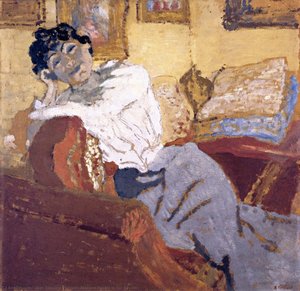
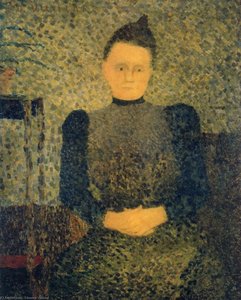
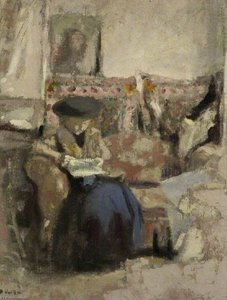
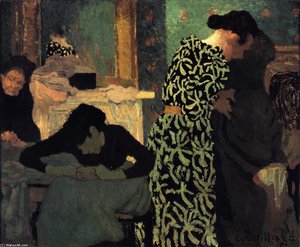
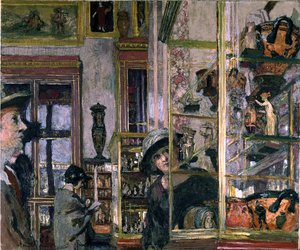
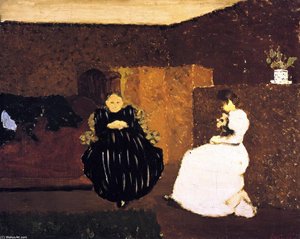
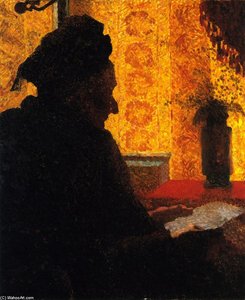
Between 1891 and 1900, Vuillard moved within the avant-garde circles of Les Nabis, a group of young painters seeking to redefine the visual language of their era. Within this collective, he was known by the nickname "Zouave." His work during this period moved away from traditional naturalism, favoring instead the assembly of areas of pure color. This approach allowed him to explore the spatial effects of flattened planes, where pattern and form often merged to create a sense of quiet, domestic intimacy.
His aesthetic was deeply shaped by the influence of Japanese prints and the post-impressionist ideas of Paul Gauguin. Rather than focusing on the grand spectacle of public life, Vuillard turned his attention to the muffled quiet of the interior. He sought to capture the textures of private existence, often using techniques such as peinture à la colle (distemper) or a la collie sur toile to achieve specific matte effects. In these scenes, figures often seemed to blend into their surroundings, becoming part of the very patterns of the wallpaper or the fabric of the furniture.
Later Career and Portraiture
Following the disbanding of Les Nabis after 1900, Vuillard’s aesthetic underwent a notable transition. He moved away from the flattened, decorative abstractions of his youth, adopting a more realistic style that sought to capture the nuances of his subjects. This shift saw him approaching both landscapes and interior scenes with a newfound attention to detail and a preference for vivid colors. The quiet, patterned spaces of his earlier work remained, but they were now rendered with a sharper clarity.
During the 1920s and 1930s, his focus turned toward the people who shaped French industry and the arts. Rather than painting formal, isolated figures, he preferred to place these prominent individuals within their familiar, lived-in settings. These portraits maintained a sense of intimacy, capturing the subjects amidst the objects and environments that defined their daily lives. This period of his life was marked by significant institutional recognition, as he was elected to the Institut de France in 1937 and subsequently to the Académie des Beaux Arts in February 1938.
Key Works and Notable Paintings
The evolution of Vuillard's vision is visible through the shifting textures of his subjects. In 1899, he produced Misia et Vallotton à Villeneuve, a work that captures the specific social and personal circles of his era. By 1905, his ability to translate the essence of everyday life was evident in Chez Maxime. This period saw him refining the way figures inhabit their environments, often blending them into the surrounding patterns of domesticity.
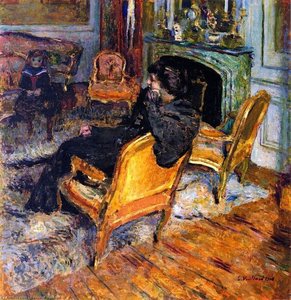
His later years brought a shift toward a more naturalistic approach, where the quietude of the interior met a more detailed observation of the world. The Salon of Madame Aron, painted in 1904 and later reworked in 1934, reflects this ongoing dialogue with his own compositions. Even in his final years, the artist remained focused on the human presence; he completed his last two portraits in 1940, just before his death.
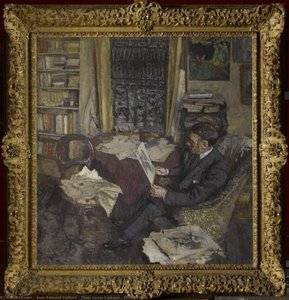
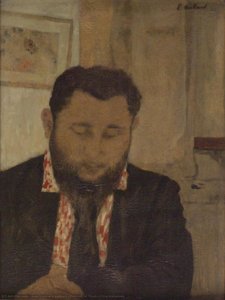
Other significant compositions highlight his interest in the intersection of person and place. Theodore Duret presents a man seated within his office, a scene composed of books, vases, and a clock. This work exemplifies his capacity to transform a functional space into a psychological landscape. His output remains a record of the subtle shifts in French life, from the patterned fabrics of a sewing room to the formal settings of his later subjects.
- Misia et Vallotton à Villeneuve (1899)
- The Salon of Madame Aron (1904, reworked 1934)
- Chez Maxime (1905)
- Theodore Duret
Legacy and Artistic Influence
As a pioneer of modernism, Jean-Édouard Vuillard helped dismantle the rigid boundaries of academic tradition. His tenure as a prominent member of the Nabis, a group of post-impressionist artists, allowed him to experiment with a visual language that prioritized subjective experience over mere imitation. By assembling areas of pure color and exploring the spatial effects of flattened planes, he moved art toward a more symbolic and decorative direction. This departure from naturalism provided a necessary bridge between the nineteenth-century traditions and the radical shifts of the twentieth century.
The structural innovations found in his work had a profound effect on the trajectory of modern art. His specific approach to color and form would later influence the development of cubism, fauvism, and abstract art. He demonstrated how pattern and texture could be used to integrate a figure into its environment, creating a sense of psychological depth through the very way a subject was embedded in its surroundings. This ability to use abstraction to communicate complex human experiences ensured his relevance long after the Nabis disbanded.
His influence remains visible in the way subsequent movements handled the relationship between domestic space and the human form. By transforming the quiet, patterned textures of private life into a subject of serious inquiry, he expanded the possibilities of what a painter could capture. His work continues to inspire artists who seek to balance the decorative with the deeply personal.
Where to See His Works Today
The quiet, patterned interiors that defined his career are preserved in several major international collections. In Paris, his presence is felt within the Musée d'Orsay, where his explorations of domestic space remain central to the French collection. His reach extends to the Musée des impressionnismes in Giverny, a site that holds significant examples of his visual language. These works offer a glimpse into the textures and flattened planes that characterized his most influential years.
Across the Atlantic, his influence is maintained through several prominent American institutions. The Metropolitan Museum of Art in New York houses his paintings, while the National Gallery of Art in Washington holds pieces that reflect his evolving style. In the Midwest, the Art Institute of Chicago also maintains a collection of his work. These holdings allow for a continued study of how he transitioned from the decorative experiments of his youth toward a more detailed, realistic approach in his later years.
Beyond these major hubs, his paintings can be found in the Walker Art Gallery in Liverpool. Visitors to these various locations may encounter different stages of his development, from the early, color-focused compositions of the Nabis period to the more naturalistic portraits of the 1920s and 1930s. His presence in these galleries ensures that his specific method of blending figures into their environments remains accessible to those studying the evolution of modernism.
Questions & Answers
What are the birth city and country of Édouard Vuillard?
Édouard Vuillard was born in Cuiseaux, in France.
Can I browse Édouard Vuillard's works by movement?
Édouard Vuillard's works can be browsed by movement on the artist's All Movements page.
Can I browse Édouard Vuillard's works by color palette?
Édouard Vuillard's works can be browsed by color palette on the artist's By Palettes page.