Atelier — Complimentary worldwide shipping — Delivery 2–6 weeks

      Thomas Hart Benton

      1889 - 1975

      Thomas Hart Benton (1889–1975) painted City Building, the best-known canvas of a catalogue of 322 works.

      At a glance

      • Creative periods: mature period
      • Mediums: oil on canvas
      • Nationality: United States
      • Also known as:
        • Tom Benton
        • Thomas H. Benton
        • Benton
        • T. H. Benton
        • توماس هارت بنتون
      • Topics explored:
        • countryside
        • study
        • men
        • rural america
        • usa
      • Born: 1889, Neosho, United States
      • Top 3 works:
        • City Building (Study for America Today)
        • She's Off
        • The Arts of Life in America: Unemployment, Radical Protest, Speed
      • Emotional tone:
        • energetic
        • tranquil

      What is Thomas Hart Benton's most famous painting?

      City Building is the painting most linked to Thomas Hart Benton; also well known: Trail Riders.

      A Midwestern Voice: The Life and Art of Thomas Hart Benton

      Born in Neosho, Missouri, in 1889, Thomas Hart Benton emerged as a pivotal figure in American art, a painter who dedicated his life to capturing the essence of the nation’s spirit—particularly that of its heartland. His story is one of rebellion against societal expectations and a passionate embrace of distinctly American themes. Unlike many artists of his generation drawn to European modernism, Benton resolutely turned inward, seeking inspiration in the landscapes, people, and stories of the United States. This commitment placed him at the forefront of the Regionalist movement, alongside Grant Wood and John Steuart Curry, shaping a uniquely American artistic identity during a period of profound social and economic change. His father, Maecenas Benton, was a lawyer and congressman, intending for his son to follow a path in politics; however, young Thomas possessed an irrepressible creative spirit that led him away from the halls of power and toward the world of art. This divergence began with work as a cartoonist for the *Joplin American* newspaper, a formative experience that honed his observational skills and instilled a love for visual storytelling.

      From Paris to Regionalism: The Development of a Style

      Benton’s formal artistic education took him first to the Art Institute of Chicago and then to Paris in 1909, where he studied at the Académie Julian. While exposed to European artistic traditions, he found himself increasingly disillusioned with their detachment from American life. A period of experimentation followed his return to the United States, marked by a search for a visual language that could authentically express his connection to the land and its people. This quest led him through various styles—from impressionism to synchromism—before culminating in the distinctive Regionalist aesthetic he would become known for. His figures became fluid and sculpted, imbued with a sense of dynamism and vitality. He wasn’t merely depicting scenes; he was conveying the energy and rhythm of American life. This stylistic evolution wasn't simply an artistic choice but a deliberate rejection of European dominance and an assertion of American cultural independence. He embraced naturalistic representation, focusing on everyday subjects—farmers, laborers, families—and portraying them with honesty and empathy.

      Murals and Masterpieces: Benton’s Artistic Achievements

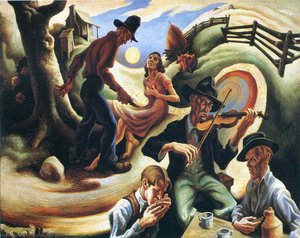
      Benton's artistic output was prolific and diverse, encompassing paintings, murals, prints, and illustrations. He is perhaps best known for his large-scale mural projects, which brought art directly into public spaces and made it accessible to a wider audience. The *America Today* murals, commissioned for the New School for Social Research in New York City (1930-31), stand as a monumental achievement—a sweeping panorama of American life during the Great Depression. These panels, now housed at the Metropolitan Museum of Art, depict scenes from across the country, capturing both the hardships and resilience of the American people. Beyond murals, his easel paintings like *The Sheepherder* and *Prodigal Son* demonstrate a mastery of composition, color, and narrative. He possessed an exceptional ability to imbue biblical or historical stories with contemporary relevance, grounding them in the realities of American experience. His work *City Building (Study for America Today)* exemplifies his dynamic style and raw energy. He wasn’t afraid to tackle complex social issues through his art, using it as a platform for commentary and critique.

      A Legacy of American Identity

      Thomas Hart Benton's influence on American art is undeniable. He helped define a distinctly American artistic voice, one that celebrated the nation’s unique character and challenged prevailing European aesthetic norms. His Regionalist approach paved the way for future generations of artists to explore their own regional identities and cultural heritage. He was also a dedicated educator, teaching at institutions like the Art Students League of New York and the Kansas City Art Institute, mentoring numerous aspiring artists—including Jackson Pollock. Benton’s commitment to social realism and his willingness to engage with contemporary issues continue to resonate today. He left behind a body of work that serves as a powerful testament to the enduring spirit of America, its people, and its landscapes. His legacy extends beyond the canvas, inspiring artists to find their own voices and tell their own stories—rooted in the places they call home. He died in 1975, leaving behind a rich artistic heritage that continues to captivate and inspire audiences worldwide.

      A little quiz

      There is only one correct answer for each question.

      Question 1:
      Thomas Hart Benton was a leading figure in which art movement?
      Question 2:
      Where did Thomas Hart Benton study art after leaving the Art Institute of Chicago?
      Question 3:
      What was a recurring theme in Thomas Hart Benton's artwork?
      Question 4:
      Benton’s father held what profession, initially hoping his son would follow in his footsteps?
      Question 5:
      What was the name of Benton's wife who played a key role in securing him early commissions?

      Questions & Answers

      How long did Thomas Hart Benton live?

      Thomas Hart Benton lived about 86 years, from 1889 to 1975.

      What are the best-known paintings by Thomas Hart Benton?

      What other names is Thomas Hart Benton known by?

      Thomas Hart Benton appears under the alternate names Tom Benton, Thomas H. Benton, Benton, T. H. Benton, توماس هارت بنتون.

      What are the birthplace and birth year of Thomas Hart Benton?

      Thomas Hart Benton was born in Neosho in 1889.

      What art movement did Thomas Hart Benton belong to?

      Thomas Hart Benton is associated with the Regionalism movement.

      What subjects did Thomas Hart Benton paint most?

      The most frequent subjects in Thomas Hart Benton's artworks listed here are countryside, study and men. See the subjects Thomas Hart Benton painted.

      In which historical period did Thomas Hart Benton work?

      Thomas Hart Benton worked in the Modern period. The period situates the artist's activity in history.

      Is Thomas Hart Benton's work in the public domain?

      No. Works by Thomas Hart Benton are still under copyright.

      How popular are Thomas Hart Benton's artworks?

      See Thomas Hart Benton's most popular paintings, ranked by the visits they receive on this website.