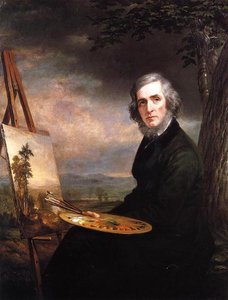
John Frederick Kensett: The Luminist Visionary
Born in Cheshire, Connecticut, in 1816, John Frederick Kensett’s artistic journey was one of persistent refinement and a profound shift towards capturing the ephemeral beauty of light and atmosphere. Initially apprenticed to his father's engraving firm, he briefly explored that craft before recognizing his true calling lay within landscape painting – a path illuminated by the burgeoning Luminist movement. His early years were marked by a restless pursuit of artistic knowledge, beginning with a stint in New York City where he encountered figures like Asher B. Durand and began to develop his distinctive style. A pivotal moment arrived in 1840 when, alongside Casilear and Rossiter, Kensett embarked on a transformative European sojourn, seeking inspiration from the masters of Düsseldorf and Paris.
This extended period abroad proved crucial to Kensett’s artistic evolution. He immersed himself in the ateliers of the École Préparation des Beaux-Arts in Paris, studying under established artists and absorbing the techniques of drawing from life and antique casts. Crucially, he spent time in Rome, Florence, and Venice, meticulously sketching the Italian landscape – a region that would profoundly influence his later work. His travels weren’t merely observational; Kensett sought to understand the interplay of light on water, the subtle shifts of color in foliage, and the overall mood of the natural world. He was particularly drawn to the works of Titian and Michelangelo, absorbing their mastery of color and composition.
Returning to America in 1847, Kensett quickly established himself as a leading figure within the Hudson River School, though he consciously distanced himself from the more overtly dramatic narratives often associated with that group. Instead, he focused on capturing the quiet dignity and serene beauty of American landscapes – scenes of lakes, forests, and riverbanks bathed in soft, diffused light. His paintings are characterized by a delicate brushwork, an almost photographic realism combined with an atmospheric sensitivity rarely seen before. He meticulously rendered reflections on water surfaces, creating a sense of depth and tranquility that was revolutionary for its time.
Kensett’s influence extended beyond his own artistic output. He became a mentor to younger artists, including Thomas Hicks and George W. Curtis, fostering a community of painters dedicated to capturing the essence of American landscapes. His work helped establish Luminism as a distinct style, emphasizing light, atmosphere, and subtle detail over grand narratives or heroic figures. His paintings are not simply depictions of scenery; they are invitations to contemplate the beauty and serenity of the natural world – a legacy that continues to resonate with viewers today.
The Düsseldorf Influence & Early Training
Kensett’s artistic development was significantly shaped by his early training in New Haven, Connecticut. Initially apprenticed to his father's engraving firm, he gained valuable technical skills but quickly realized that his passion lay elsewhere. His brief foray into engraving under Peter Maverick in New York exposed him to the commercial side of art production, a stark contrast to the artistic freedom he craved. The death of his father in 1829 forced him back to New Haven, where he continued working for Alfred Daggett until 1835, a period marked by professional friction and ultimately, a departure.
A crucial turning point came when Kensett encountered Asher B. Durand in New York City around 1829. Durand, a prominent figure in the Hudson River School, recognized Kensett’s potential and encouraged him to pursue landscape painting. This encounter proved pivotal, providing Kensett with invaluable guidance and introducing him to the broader artistic community. The influence of Düsseldorf is particularly evident in Kensett's early work – a style characterized by meticulous detail, precise rendering, and an emphasis on capturing the nuances of light and shadow. The Düsseldorf School’s focus on tonal values and atmospheric perspective profoundly impacted his approach to landscape painting.
European Sojourn & Artistic Transformation
The 1840 journey to England marked a watershed moment in Kensett's artistic life. Alongside Casilear, Rossiter, and other American artists, he sought inspiration from the renowned collections of the National Gallery and Dulwich College in London. However, his time in Europe extended beyond mere observation; he actively engaged with the Parisian art scene, studying at the École Préparation des Beaux-Arts and immersing himself in the artistic culture of the city. He spent over two years absorbing techniques and styles from a diverse range of artists – including those influenced by the Barbizon School.
His travels continued to Rome, Florence, and Venice, where he meticulously sketched the Italian landscape, studying the works of Titian and Michelangelo. This period was instrumental in developing his unique Luminist style, characterized by an emphasis on capturing the subtle effects of light and atmosphere. He returned to America via Switzerland, France, and England in 1847, bringing with him a wealth of artistic knowledge and experience that would profoundly shape his future work. The Italian sojourn solidified his commitment to capturing the essence of American landscapes, not through grand narratives or heroic figures, but through the quiet beauty of nature itself.
Major Works & Historical Significance
Kensett’s most celebrated works include *Saukeetook*, a depiction of a Native American family in a serene woodland setting; *The First Landing of Columbus*, a meticulously rendered scene capturing the arrival of Christopher Columbus in America (though it has been debated for its historical accuracy); and numerous landscapes depicting scenes from the Hudson River Valley, including *Mount Ida*. These paintings are characterized by their atmospheric sensitivity, delicate brushwork, and subtle use of color. They represent a departure from the more dramatic narratives often associated with the Hudson River School, focusing instead on capturing the quiet dignity and serene beauty of American landscapes.
Kensett’s contribution to American art is significant for several reasons. He helped establish Luminism as a distinct style, emphasizing light, atmosphere, and subtle detail over grand narratives or heroic figures. His paintings are not simply depictions of scenery; they are invitations to contemplate the beauty and serenity of the natural world. He also played a crucial role in fostering a community of artists dedicated to capturing the essence of American landscapes, mentoring younger painters and shaping the course of American art history. His legacy continues to inspire artists today with his dedication to capturing the subtle nuances of light and atmosphere.



 Buy print
 Send
Send Share
Share
 Details

 Download
 Similars
 X-Ray
X-Ray Diaporama
 Read More






































 Glass option is only available in size under 110 CM