Showing 24 artworks out of more than 240+
Two large rocks dominate the landscape amidst the falling snow: look closely at the long blue shadows.
Can you trace the rhythmic lines of the vines to the horse pulling the cart through the harvest in Arles in 1888?
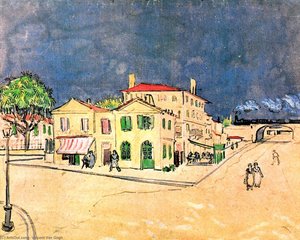
Created in 1888, it stands as a record of the residence where the artist hoped to establish a utopian colony with Paul Gauguin.
Stolen on 21 August 1911 by Vincenzo Peruggia, it vanished from the Louvre until it was finally recovered in 1914.
Born from the 26 April 1937 bombing of a Basque town, it was held at New York's Museum of Modern Art for several decades.
Painted in 1889 during a period of significant personal struggle, it was created while staying at the Saint-Paul-de-Mausole asylum in France.
Commissioned by Ludovico Sforza for the refectory of the Santa Maria delle Grazie monastery in Milan, it was painted between 1495 and 1498.
Clamped over the ears rather than the mouth, the hands of the figure react to an infinite scream of nature heard during a sunset in 1893.
Two precise brushstrokes create the illusion of a heavy, teardrop-shaped gem that anchors the entire composition.
Look closely at the scattered rose petals falling through the air as Zephyrus and Chloris blow toward the shore of Cyprus.
A giant strawberry clings to a human hand in this sprawling landscape: check out the tiny details.
A mirror in the background reflects the images of King Philip IV and Queen Mariana, blurring the lines between art and reality.
What is the meaning of the orange watch at the bottom left that is covered in ants and does not melt?
Scan the picture for the small, snow-capped peak of Mount Fuji that remains steady in the background while the ocean rises in a towering force.
A young boy with pistols leads the charge alongside a man in a top hat amidst the smoke and wreckage of the July Revolution in Paris.
Zoom in on the small gap between the two index fingers where the spark of life is about to pass from God to Adam.
Zoom in on Heraclitus sitting on the steps with his head resting on his hand, a figure depicted with the face of Michelangelo.
A dead chicken with visible claws is carried by a young girl positioned amidst the men to serve as an emblem for the militia.
Observe gold leaf patterns where the man's dark geometric robe contrasts with the woman's soft floral motifs in this intimate embrace.
Hunt for the monkey on a leash among the Parisians on the banks of the Seine in this 1886 work from the Art Institute of Chicago.
A convex mirror on the back wall reflects two additional figures and scenes from the Passion of Christ: trace the hidden witnesses.
Often mistaken for a married couple, the figures are actually the artist's sister and his family dentist from 1930.
Thick impasto strokes create shimmering highlights on the water's surface: do not miss the texture of 1916.
Measuring an imposing 244 x 234 cm, its fragmented forms and mask-like faces represent a radical break from centuries of artistic tradition.

 Refine