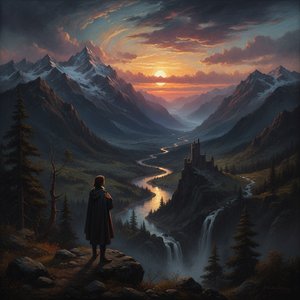
A Life Bridging Worlds: The Enigmatic Baron László Mednyánszky
Baron László Mednyánszky, a figure shrouded in an intriguing blend of aristocratic heritage and profound artistic sensitivity, stands as one of the most compelling and often overlooked artists of late 19th-century Hungary and Slovakia. Born into a declining noble family amidst the shifting political landscape of the Austro-Hungarian Empire, he navigated a life characterized by both privilege and a deep connection to the lives of ordinary people – peasants, laborers, and those marginalized by society. His artistic journey wasn’t one of rigid adherence to established schools; instead, it was a process of absorbing influences from diverse cultures and experiences, culminating in a unique style that blended Impressionism with Symbolism and a keen awareness of philosophical themes. Mednyánszky's legacy lies not just in his captivating landscapes and poignant portraits, but also in his ability to capture the essence of human existence – its beauty, its sorrow, and its enduring search for meaning.
Early Years and Artistic Foundations
László Mednyánszky was born on April 23, 1852, in Beckó (present-day Slovakia), a small village within the Kingdom of Hungary. He hailed from a family with deep roots in Hungarian nobility – his lineage traced back to generations of landowners and administrators. Despite this aristocratic background, Mednyánszky’s early life was marked by a constant movement between family estates and travels across Europe. This itinerant existence proved crucial to his artistic development, exposing him to a wide range of cultures, landscapes, and social conditions. He received some formal training in Munich and Paris, studying under renowned artists like Thomas Ender, but ultimately rejected the constraints of academic art, forging his own distinctive path. His early exposure to the vibrant colors and loose brushwork of Impressionism, combined with his travels through the Carpathian Mountains and Hungarian plains, profoundly shaped his artistic vision. He was particularly drawn to the stark beauty of the Slovak countryside, which would become a recurring motif in his work – not merely as picturesque scenery, but as a symbol of belonging, loss, and the enduring connection between humanity and nature.
The Influence of Travel and Observation
Mednyánszky’s artistic development wasn't solely shaped by formal training; it was fundamentally driven by observation and immersion. His travels weren’t simply geographical excursions; they were intellectual and emotional voyages that profoundly altered his perspective. He spent considerable time in Paris, absorbing the latest artistic trends while simultaneously maintaining a deep connection to his Hungarian roots. However, it was during his period as a war correspondent for the Austro-Hungarian army that he truly honed his ability to capture the essence of human experience. Serving on the front lines during World War I, he witnessed firsthand the horrors of conflict and the resilience of the human spirit – experiences that deeply influenced his artistic output. His paintings from this era are characterized by their stark realism and emotional intensity, offering a powerful commentary on the realities of war and its devastating impact on individuals and communities. He wasn’t interested in glorifying warfare; instead, he sought to expose its brutality and the profound suffering it inflicted upon those caught in its crosshairs.
A Palette of Emotion: Style and Technique
The art of Baron László Mednyánszky is immediately recognizable for its distinctive blend of styles and subject matter. While undeniably influenced by Impressionism – particularly in his use of light, color, and loose brushwork – he also incorporated elements of Symbolism and a deeply personal artistic vision. His landscapes are not simply depictions of natural beauty; they are imbued with symbolic meaning, reflecting themes of loss, nostalgia, and the enduring connection between humanity and the land. Portraits often capture not just physical likeness but also the inner lives and emotional states of his subjects – revealing their vulnerabilities, hopes, and dreams. A key characteristic of Mednyánszky’s work is his masterful use of color – he frequently employed muted palettes dominated by grays, browns, and ochres, creating a mood of quiet contemplation and melancholy. However, he wasn't afraid to inject bursts of vibrant color into his paintings, particularly in scenes depicting dramatic landscapes or moments of intense emotion. His brushwork ranges from delicate and precise to loose and gestural, reflecting the emotional weight of his subject matter. Works like *Flaming Landscape* demonstrate his ability to convey a sense of turmoil through dynamic composition and fiery hues, while others, such as *End of Life. Elderly Couple at Night*, reveal his profound empathy for human vulnerability and mortality.
Legacy and Rediscovery
Despite not achieving widespread fame during his lifetime – largely due to his unconventional lifestyle and refusal to conform to prevailing artistic norms – Baron László Mednyánszky is now recognized as a significant figure in Hungarian art history. His unique vision, blending philosophical depth with artistic skill, set him apart from his contemporaries. He challenged conventional expectations by focusing on the lives of ordinary people and confronting difficult social issues. His paintings offer invaluable insights into the cultural and societal landscape of late 19th-century Hungary and Slovakia – a period marked by profound change and uncertainty. Today, Mednyánszky’s work is celebrated in museums across Hungary and Slovakia, including the Slovak National Gallery in Bratislava and the Hungarian National Gallery in Budapest. His legacy continues to grow as scholars and art enthusiasts increasingly recognize the power and beauty of his paintings, ensuring that this enigmatic artist will be remembered for generations to come.
Notable Works
- The River Poprad at Strážky: A quintessential example of his landscape painting, capturing the serene beauty and tranquility of his homeland.
- Flaming Landscape: Demonstrates Mednyánszky’s ability to convey intense emotion through vibrant color and dynamic composition.
- End of Life. Elderly Couple at Night: A poignant and deeply moving depiction of human vulnerability, mortality, and the quiet dignity of aging.
- Winter Night. Figure on the Bridge: Evokes a sense of solitude and contemplation through its atmospheric rendering of a winter landscape.
- Landscape with a Castle before a Storm: A dramatic portrayal of nature’s power, rendered in a Romantic and Symbolist style with rich impasto.



 Представи си го
 Купете принт
 Изпрати
 Сподели
 Детайли

 Изтегляне
 Подобни
 Рентгенова снимка
 Слайдшоу

 Прочетете повече






































 Стъклото е налично само в размери под 110 см