Ателие — Безплатна доставка по целия свят — Срок на доставка: 2–6 седмици
      Jerzy Faczynski, 1917 – 1943

      69-те най-известни картини на Jerzy Faczynski, подредени по популярност

      Най-обичаната картина на Jerzy Faczynski е Ballerina. Abstract Woman и Shepherd следват след тях сред най-познатите картини на читателите. Нашият каталог съдържа 69 произведения на Jerzy Faczynski: ето 69-те най-известни, всяко с неговата година, неговия музей и това, което го прави незабравимо.

      Класирани според нашия коефициент за популярност, който съчетава търсенията, посещенията и поръчките за всяко произведение. Обновено Ноември 2026. Всяка картина на тази страница може да бъде поръчана като ръчно рисувано маслено репродукция върху ленен хол или като висококачествен арт принт, изработен според избран от Вас размер.

      Портрет на Jerzy Faczynski
      Jerzy Faczynski · 1917 – 1943
      Роден · починал
      1917 – 1943
      Работи в нашия каталог
      69
      Най-известни
      Ballerina

      Топ 10 картини на Jerzy Faczynski: шедьоври, които всеки познава

      Още платно от Jerzy Faczynski, от 11 до 69

      Най-често рисувано от Jerzy Faczynski

      Четирите найчесто срещани сюжета на тези платна, всеки с най-обичания си пример.

      Относно платното на Jerzy Faczynski: отговори на вашите въпроси

      Коя е най-известната картина на Jerzy Faczynski?Прочетете отговора

      Ballerina, последван от Abstract Woman и Shepherd.

      Кои са 10-те най-известни картини на Jerzy Faczynski?Прочетете отговора

      Ballerina, Abstract Woman, Shepherd, Faces, Nude, Nude, Nude, Ballerina, Woman и The Madonna And Child. Всяко платно в горната класация е придружено с годината на създаване и музея, в който се намира.

      Колко произведения е създала общо Jerzy Faczynski?Прочетете отговора

      В нашия каталог има 69 произведения на Jerzy Faczynski.

      Какво най-често е рисувал Jerzy Faczynski?Прочетете отговора

      Women (11), Nudes (7) и Buildings (6), разпределени в 69 произведения на тази страница.

      Мога ли да купя репродукция на платно от Jerzy Faczynski?Прочетете отговора

      Да. Всяка картина на тази страница може да бъде поръчана от нейната собствена страница като ръчно рисувано маслено репродукция или като висококачествен арт-принт в избран от Вас размер.

      Jerzy Faczynski: живот в боядисване

      A Life Forged in Conflict and Creation


      The life of Jerzy Faczynski was a profound testament to the resilience of the human spirit amidst the wreckage of the twentieth century. Born in 1917 in Yenakiieve, Ukraine, to Polish parents, his early years were steeped in an atmosphere of artistic appreciation, nurtured by his mother, Marian, a dedicated artist and teacher. This foundational connection to beauty would later become his sanctuary during the darkest chapters of his life. When the shadows of World War II descended upon Europe, Faczynaryski’s path took a dramatic turn from the studio to the cockpit, as he enlisted in the Polish Air Force. His journey was marked by the harrowing realities of war, including capture by Nazi forces and a daring, resolute escape that mirrored the very strength found in his later architectural designs. As a refugee in Britain, he did not merely survive; he sought to rebuild the cultural identity of a displaced nation, joining the Polish School of Architecture in Liverpool—a vital beacon of intellectual life for the Polish diaspora.

      The Architecture of Faith and Modernity


      Faczynski’s architectural legacy is defined by a singular mission: to translate the eternal essence of the Catholic faith into the language of modern form. His work represents a masterful intersection of Art Deco elegance and the rigorous, functional principles of Modernism. Drawing deep inspiration from the Bauhaus movement, he sought to strip away the superfluous, focusing instead on how light, space, and structure could evoke spiritual transcendence. This pursuit led him to design more than fifty churches, works that stand as monuments to both his technical precision and his liturgical devotion. His architectural vocabulary was not merely about stone and mortar but about creating sacred spaces that resonated with the contemporary era, blending historical reverence with an innovative, forward-looking aesthetic that sought to capture the very soul of the liturgy.

      A Versatile Hand: From Ink to Expressionism


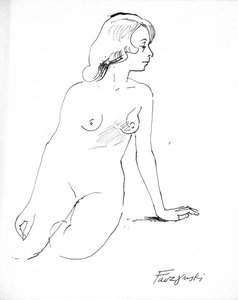
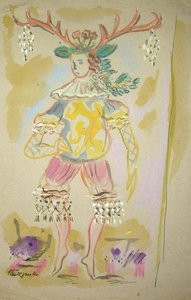
      While his architectural achievements provided a structural legacy, his graphic works offered a window into his emotional landscape. Faczynski’s artistry was remarkably diverse, ranging from the delicate precision of monochrome sketches to the raw, emotive power of watercolor and ink. In pieces such as Manor House, one observes a captivating, almost nostalgic exploration of historical themes through impressionistic detail. Conversely, his more experimental works reveal a fascination with the psychological depths of the human condition. His haunting watercolor, Man With A Cigarette, utilizes expressive distortion and vibrant color to evoke profound feelings of isolation and vulnerability, bordering on the realms of Surrealism. Similarly, his ink drawings, such as the Reclining Woman, utilize the dynamic, fragmented lines of Abstract Expressionism to capture raw emotion. Through these varied mediums, Faczynski remained a lifelong witness to the beauty and the turbulence of the world, leaving behind a body of work that continues to resonate with historical depth and artistic brilliance.