Ателие — Безплатна доставка по целия свят — Срок на доставка: 2–6 седмици
      Теодор Робинсън, 1852 – 1896

      100-те най-известни картини на Теодор Робинсън

      The Layette (1892) е картината, с която Теодор Робинсън е най-известен; тя се намира в Национална галерия на изкуствата, Уокшънтън. Capri (1890) и In a Daisy Field (1884) допълват трио от най-обичаните платна. В нашия каталог са включени 260 произведения на Теодор Робинсън. Ето 100-те най-известни, с годината, музея и историята на всяко платно.

      Класирани според нашия коефициент за популярност, който съчетава търсенията, посещенията и поръчките за всяко произведение. Обновено Октомври 2026. Всяка картина на тази страница може да бъде поръчана като ръчно рисувано маслено репродукция върху ленен хол или като висококачествен арт принт, изработен според избран от Вас размер.

      Портрет на Теодор Робинсън
      Теодор Робинсън · 1852 – 1896
      Роден · починал
      1852 – 1896, Ираسبург
      Движение
      Impressionism
      Работи в нашия каталог
      260
      Най-известни
      The Layette (1892)
      Най-много творби в
      Музей Конде

      Десетте най-обичани картини на Теодор Робинсън

      The Layette (1892) на Теодор Робинсън
      1

      The Layette

      1892 · Oil On Canvas · Национална галерия на изкуствата, Уокшънтън

      There is a profound stillness in this scene, a moment captured where the rush of the world seems to pause. We find a woman seated in a wooden chair, her attention entirely absorbed by the delicate task of needlework. She is positioned slightly to the right, framed by the organic weight of a large tree trunk and the soft, dappled patterns of sunlight filtering through a leafy canopy. The light…

      Capri (1890) на Теодор Робинсън
      2

      Capri

      1890 · Acrylic On Canvas · Музей Тисен-Борнемица, Мадрид

      The Enchanting Capri by Theodore Robinson The painting “Capri” by Theodore Robinson stands as a testament to Impressionist vision blended with American Romanticism—a captivating glimpse into the Italian island’s ethereal beauty captured in 1890. More than just a scenic depiction, it embodies Robinson's profound engagement with light and color, reflecting his belief that art should convey emotion rather than merely represent reality. Executed on canvas using oil paints, “Capri” showcases…

      In the Grove (1888) на Теодор Робинсън
      5

      In the Grove

      1888 · Oil On Canvas · Baltimore Museum of Art, Балтимор

      In the quietude of a sun-drenched woodland, Theodore Robinson’s “In the Grove” invites the viewer into a moment of profound stillness. Painted in 1888, this masterpiece serves as a cornerstone of American Impressionism, capturing not just a landscape, but an emotional atmosphere that feels both fleeting and eternal. The scene unfolds with a delicate grace, centered around a woman positioned amidst towering, ancient trees. As she gazes downward, perhaps lost…

      Теодор Робинсън: платна от 11 до 100 в класирането

      Най-често рисувано от Теодор Робинсън

      Четирите найчесто срещани сюжета на тези платна, всеки с най-обичания си пример.

      Къде са изложени картините на Теодор Робинсън

      8 музея, които притежават най-голям брой от картините на тази страница.

      Музеи Град Творения на Теодор Робинсън Картини от този списък
      Музей Конде, ШантилиМузей Конде Шантили 3 Normandy farms, Twilight in Sologne
      Музей Тисен-Борнемица, МадридМузей Тисен-Борнемица Мадрид 2 Capri, The Old Bridge
      Baltimore Museum of Art, БалтиморBaltimore Museum of Art Балтимор 5 In the Grove
      Метрополитън Музей на изкуствата, Ню ЙоркМетрополитън Музей на изкуствата Ню Йорк 5 Self Portrait
      Национална галерия на изкуствата, УокшънтънНационална галерия на изкуствата Уокшънтън 3 The Layette
      Художественият музей в Сейнт Луис, Сейнт ЛуисХудожественият музей в Сейнт Луис Сейнт Луис 2 The Large Oak Tree, Forest of Fontainebleau
      Columbia Museum of Art, ColumbusColumbia Museum of Art Columbus 1 Nantucket
      Музей на изкуствата в Толедо, ТоледоМузей на изкуствата в Толедо Толедо 1 Girl at Piano

      Най-известното платно на Теодор Робинсън, десетилетие след десетилетие

      1. 1860s
        Normandy farms (1867) на Теодор Робинсън
        Платно 35 от 100

        Normandy farms

        Възраст 8 – 17 · Музей Конде
      2. 1870s
      3. 1880s
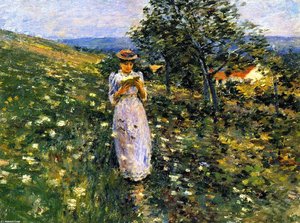
        In a Daisy Field (1884) на Теодор Робинсън
        Платно 3 от 100

        In a Daisy Field

        Възраст 28 – 37

        Theodore Robinson executed In a Daisy Field as an oil on canvas. While the work is dated 1884, the lower right corner bears the signature and inscription 'Th.…

      4. 1890s
        The Layette (1892) на Теодор Робинсън
        Платно 1 от 100

        The Layette

        Възраст 38 – 44 · Национална галерия на изкуствата

        There is a profound stillness in this scene, a moment captured where the rush of the world seems to pause. We find a woman seated in a wooden…

      Картините на Теодор Робинсън, въпрос по въпрос

      С кое платно е най-известен Теодор Робинсън?Прочетете отговора

      The Layette (1892), Национална галерия на изкуствата, Уокшънтън. Следват Capri (1890) и In a Daisy Field (1884).

      The Layette: на каква възраст беше Теодор Робинсън, когато е нарисувана?Прочетете отговора

      Теодор Робинсън, роден в 1852, е на 40 години: The Layette е от 1892 г.

      Кои са десетте най-известни картини на Теодор Робинсън?Прочетете отговора

      The Layette, Capri, In a Daisy Field, Pere Trognon and His Daughter at the Bridge, In the Grove, Study in the forest of Fontainebleau, View of the belfry of Orleans, Nantucket, Flower of Memory и Plain. Всяко платно в горната класация е придружено с годината на създаване и музея, в който се намира.

      Колко картини е създал Теодор Робинсън?Прочетете отговора

      В нашия каталог са включени 260 произведения на Теодор Робинсън, датирани от 1866 до 1892.

      Къде се намират най-известните платна на Теодор Робинсън днес?Прочетете отговора

      Предимно в Музей Конде (Шантили), Музей Тисен-Борнемица (Мадрид) и Baltimore Museum of Art (Балтимор); списъкът по-горе изброява всеки музей и неговите платна.

      Кога Теодор Робинсън е създал най-известните си картини?Прочетете отговора

      В 1880s, който включва 34 от 100 произведения на тази страница, In a Daisy Field сред тях.

      Кое е най-ранното и кое е най-късното платно на известния Теодор Робинсън?Прочетете отговора

      Най-старото платно тук е от Sunset in the forest (1866); най-новото е от The Layette (1892).

      Кои са най-често изобразяваните сюжети на Теодор Робинсън?Прочетете отговора

      Forests (20), Landscape (10) и Lakes (9), разпределени в 100 произведения на тази страница.

      Коя техника е най-представена в картините на Теодор Робинсън?Прочетете отговора

      Oil On Canvas, използван в 5 от 100 произведения на тази страница.

      С кое художествено направление е свързан(а) Теодор Робинсън?Прочетете отговора

      Impressionism и Realism, както показват картините на тази страница.

      Кои картини на Теодор Робинсън се съхраняват в Музей Конде?Прочетете отговора

      В Музей Конде, Шантили се съхраняват 2 от произведенията на тази страница, сред които са Normandy farms и Twilight in Sologne.

      Къде мога да купя репродукция от картина на Теодор Робинсън?Прочетете отговора

      Да. Всяка картина на тази страница може да бъде поръчана от нейната собствена страница като ръчно рисувано маслено репродукция или като висококачествен арт-принт в избран от Вас размер.

      Запознайте се с художника: Теодор Робинсън

      A Pioneer of American Light: The Life and Art of Theodore Robinson

      Theodore Robinson, a name perhaps less immediately recognizable than those of Monet or Renoir, nevertheless occupies a pivotal position in the story of American art. Born in rural Vermont in 1852, his journey was one of persistent artistic seeking, culminating in a unique synthesis of European Impressionism and distinctly American sensibilities. His life, though tragically cut short at the age of forty-four, left an enduring legacy as a key figure in bringing the shimmering light and broken color of France to a new generation of American painters. Robinson’s early years were marked by frequent relocation; his family moved to Wisconsin when he was just three years old, and he briefly studied art in Chicago before venturing east to New York City in 1874. There, he enrolled at the National Academy of Design and the Art Students League, laying a foundation in traditional techniques that would later be brilliantly transformed by his experiences abroad. These formative years were also shaped by practical necessity; Robinson often supplemented his artistic pursuits with teaching positions, a task he found draining due to chronic asthma which plagued him throughout his life.

      From Realism to the Allure of Giverny

      Robinson’s initial artistic inclinations leaned towards realism, mirroring the prevailing tastes of the time. He favored scenes of quiet domesticity and agrarian life, depicting figures engaged in everyday activities with a meticulous attention to detail. These early works—images of solitary women tending gardens or children playing in fields—were rendered with a careful observation of form and a restrained palette. However, a turning point arrived in 1884 when he embarked on an extended stay in France. It was here, in the idyllic countryside surrounding Paris, that his artistic vision underwent a profound shift. He settled in Giverny, becoming intimately acquainted with Claude Monet and absorbing the principles of Impressionism firsthand. This wasn’t merely a stylistic adoption; it was a complete reimagining of how light, color, and atmosphere could be captured on canvas. Monet's guidance proved invaluable, encouraging Robinson to embrace a more spontaneous approach, focusing on the fleeting effects of light and shadow rather than precise representation. The influence is palpable in works like *Giverny 1*, *Giverny 2*, and *Giverny 3*, where dappled sunlight filters through trees, creating an ethereal quality that transcends mere depiction. He didn’t simply copy Monet; he filtered the Impressionist aesthetic through his own American lens, retaining a sense of structure and form that distinguished his work from its French counterparts.

      A Bridge Between Worlds: Sharing the Vision

      Robinson's significance extends beyond his individual paintings; he served as a crucial conduit between the European avant-garde and the burgeoning American art scene. His position in Giverny placed him at the center of an American artistic colony, allowing him to share his newfound knowledge and enthusiasm with fellow painters like Julian Alden Weir and John Henry Twachtman. He became a passionate advocate for Impressionism, tirelessly demonstrating its techniques and principles to those who sought his guidance. This role as a mentor and interpreter was particularly important in a time when American art was still largely dominated by academic traditions. His influence is evident in the work of many artists who visited Giverny, helping to establish an American Impressionist style that was both indebted to French innovations and uniquely its own. He brought back not just techniques but also a philosophy – a way of seeing and responding to the world around him.

      Major Achievements and Artistic Style

      Robinson’s mature work is characterized by a masterful manipulation of light and color, often employing broken brushstrokes and subtle gradations to evoke a sense of atmosphere and mood. His landscapes—particularly those depicting the French countryside—are imbued with a quiet beauty and an almost spiritual quality. He was adept at capturing the fleeting effects of sunlight on water, foliage, and stone, creating images that are both visually stunning and emotionally resonant. His most celebrated works include *La Débâcle* (1892), a powerful depiction of a storm-tossed ship, and numerous scenes of Giverny’s gardens and surrounding countryside. Robinson's style can be described as a synthesis of Impressionism and American Realism – he retained the structure and form of traditional landscape painting while embracing the vibrant colors and atmospheric effects championed by Monet and his contemporaries. He was a true innovator, forging a unique artistic identity that bridged the gap between Europe and America.

      A Lasting Legacy

      Robinson’s contribution to American art lies not only in the beauty of his paintings but also in his role as a catalyst for change. He was a bridge between cultures, a passionate advocate for innovation, and a gifted artist who helped shape the course of American Impressionism. His work embodies a delicate balance between observation and interpretation, realism and abstraction, European influence and American identity. He demonstrated that it was possible to embrace the radical innovations of Impressionism without sacrificing one’s artistic voice or cultural heritage. His paintings continue to captivate viewers with their luminous quality and evocative atmosphere, reminding us of the power of art to transform our perception of the world around us. Robinson's legacy is a testament to the enduring appeal of light, color, and the pursuit of artistic truth.
      • Notable Works: Giverny 1, Giverny 2, Giverny 3, La débâcle (1892)
      • Influences: Claude Monet, John La Farge, Carolus-Duran, Jean-Léon Gérôme
      • Artistic Movement: American Impressionism

      Всички 260 произведения на Теодор Робинсън →