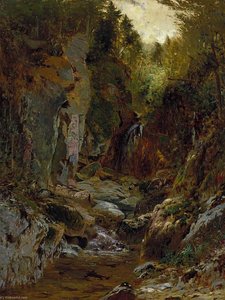
Alexander Helwig Wyant - A Poet of Atmospheric Landscapes
Alexander Helwig Wyant, born in Port Washington, Ohio (1836), stands as a pivotal figure bridging the stylistic currents of the Hudson River School and Tonalism—a testament to American art’s capacity for innovation while retaining its connection to European traditions. He wasn't merely a painter *of* landscapes; he possessed an almost poetic sensibility, translating the subtle moods of nature onto canvas with remarkable sensitivity and precision. His artistic journey began modestly, sketching along the Ohio River near Cincinnati, yet swiftly ascended into a vocation fueled by formative encounters and transformative experiences that would reshape his creative vision.
Early Influences and Artistic Formation
Wyant’s initial artistic endeavors bore the unmistakable imprint of the Hudson River School, characterized by meticulous depictions of natural scenes imbued with narrative grandeur—a stylistic choice reflecting the prevailing aesthetic sensibilities of mid-century America. However, even within these early canvases, glimpses of his future trajectory emerge: a burgeoning preoccupation with atmospheric effects and a preference for palettes subdued in color. This inclination intensified over time, propelling him away from purely representational painting toward the nascent movement known as Tonalism—a stylistic paradigm championed by artists like George Inness who prioritized mood, atmosphere, and poetic interpretation above exhaustive detail. Crucially, Wyant’s artistic development was profoundly shaped by his encounter with George Inness in Cincinnati (1857). This meeting served as a catalyst for relocation to New York City, where he sought mentorship at the National Academy of Design—a move generously supported by the patronage of Nicholas Longworth—establishing himself within one of America's most influential artistic institutions.
European Travels and Artistic Synthesis
A subsequent voyage to Europe in 1860 broadened Wyant’s intellectual horizons, exposing him to diverse artistic traditions originating in Germany and brief visits to England and Ireland. These formative experiences instilled in him a deep appreciation for the techniques of German landscape painters like Hans Gude and Karlsruhe—artists who championed *plein air* painting and prioritized capturing the ephemeral qualities of light and atmosphere. This exposure fueled his stylistic evolution, blending Hudson River School conventions with Barbizon influences—a synthesis that resulted in canvases imbued with both meticulous observation and profound emotional resonance. He diligently studied under Hans Gude in Düsseldorf and Karlsruhe, absorbing lessons from masters who championed a similar aesthetic approach.
Mature Style and Artistic Legacy
Following the stroke which paralyzed his right arm in 1873 – an adversity that forced him to adapt—Wyant honed his artistic technique with his left hand, achieving remarkable dexterity despite physical limitations. From 1867 onward, he exhibited watercolors annually, demonstrating unwavering dedication to his craft and establishing himself as a prominent figure within the American Watercolor Society (founded in 1878). His landscapes became renowned for their ethereal beauty—characterized by hazy skies, muted colors, and an almost dreamlike quality—reflecting Wyant’s profound understanding of atmospheric perception. Notable works like *Mohawk Valley*, now housed at the Metropolitan Museum of Art, exemplify his mature style—a harmonious blend of detailed observation and evocative tonalism. His final painting, *Arkville Autumn Landscape*, stands as a poignant testament to his enduring passion for landscape art and embodies the spirit of American Barbizon painters.
Wyant’s artistic legacy transcends mere technical proficiency; it resides in his ability to convey emotion through visual language—to invite viewers into contemplation and to capture the sublime beauty of the natural world. He wasn't merely imitating earlier styles; he actively transforming them, prioritizing mood and atmosphere over strict realism—a courageous step toward forging a distinctly American artistic voice. His enduring influence continues to inspire artists today, securing his place as one of the most significant landscape painters of the late nineteenth century.