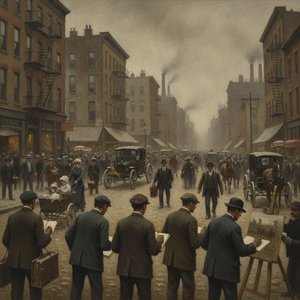
Hannah's by the Window Binding Shoes (3rd version)
The Charge of the Fifth Regulars at Gaines' Mill, 27th of June, 1862
Also known as:
Уилям Б.Т. Трего
Уилям Брук Томас Трего
Topics explored: study
Creative periods: mature period
Works on APS: 33
Още…
Lifespan: 51 years
Museums on APS: Museum of Arts and Sciences
Nationality: Съединени американски щати
Art period: XIX век
Copyright status: Public domain
Died: 1909
Color intensity: ярък
A Life Forged in Resilience: The Story of William Trego
Born in the quiet Pennsylvania countryside of Yardley in 1858, William Brooke Thomas Trego’s life was a testament to the power of artistic dedication overcoming immense physical adversity. Son of the accomplished portrait and animal painter Jonathan Kirkbridge Trego, young William inherited not only his father's talent but also a challenging fate. At just two years old, he contracted an illness – possibly polio or a severe reaction to medical treatment – that left his hands and feet nearly paralyzed. This early struggle would profoundly shape his artistic journey, forcing him to develop unconventional techniques and fueling a determination that resonated throughout his career. The family’s move to Detroit when William was sixteen brought another incident—a harrowing accident with a gas jet that cost him his hair—further isolating him within the familial studio where he received most of his formative training. It was there, guided by his father's instruction, that Trego learned to paint, famously maneuvering a brush jammed into his right hand while controlling it with the left, a method born of necessity and refined through sheer willpower. This unique approach became a hallmark of his distinctive style, showcasing both ingenuity and resilience.
Early Influences and Artistic Beginnings
Trego’s artistic foundation was deeply rooted in his family's legacy. His father, Jonathan Trego, was a respected portraitist and animal painter known for his vibrant colors and meticulous detail. William absorbed these techniques from an early age, benefiting from his father’s extensive experience and guidance within the familial studio. However, the physical limitations imposed by his childhood illness significantly altered his approach to painting. He had to develop innovative strategies to compensate for the loss of dexterity in his hands, ultimately pioneering a distinctive method of brush control that became synonymous with his work. This early struggle instilled in him a profound appreciation for the challenges faced by artists and a determination to overcome obstacles through creative problem-solving. The move to Detroit provided further opportunities for artistic development, exposing him to new influences and broadening his horizons.
Breakthrough at the Michigan State Fair
Trego’s career gained momentum with *The Charge of Custer at Winchester*, a dramatic depiction of George Armstrong Custer's final stand that captivated audiences at the Michigan State Fair in 1879. The painting, rendered with remarkable dynamism and vividness, immediately garnered significant acclaim. Critics praised its composition, capturing the intensity of the battle and the bravery of the soldiers involved. This success provided Trego with the financial means to pursue his artistic ambitions more seriously, leading him to enroll at the prestigious Pennsylvania Academy of the Fine Arts (PAFA) in Philadelphia. The decision to attend PAFA was a pivotal moment in his development, offering access to renowned instructors like Thomas Eakins and exposing him to a wider range of artistic styles and techniques.
Training Under Thomas Eakins
At PAFA, Trego studied under the exacting tutelage of Thomas Eakins, immersing himself in anatomical study and rigorous figure drawing. While benefiting from Eakin’s emphasis on realism and anatomical accuracy, Trego found the instructor's austere approach somewhat challenging. He appreciated Eakins’ dedication to technical skill but sought a more expressive and emotionally resonant style. Despite these differences, Trego diligently honed his skills under Eakins’ guidance, developing a strong foundation in drawing and composition that would serve as the basis for his future work. The Academy provided him with invaluable experience and exposure to the broader art world, shaping his artistic vision and preparing him for a career as a professional painter.
Historical Military Scenes and Lasting Legacy
William Trego quickly established himself as a master of historical military scenes, particularly those depicting the American Revolution and Civil War. His canvases are characterized by an almost obsessive attention to detail, meticulously recreating uniforms, weaponry, and battlefield landscapes with remarkable accuracy. He wasn’t merely illustrating events; he was reconstructing them, striving for authenticity and honoring the sacrifices made during these tumultuous periods in American history. This commitment stemmed from a deep fascination with military history and a desire to capture the spirit of courage and conflict. His paintings are not just historical records but also powerful expressions of human drama and heroism. Notable works like *Quartermaster's Department: Train of Pack Mules Attacked by Mexican Cavalry, 1847* showcase his ability to convey both the grandeur and the harsh realities of military life. Despite facing challenges and setbacks throughout his career, Trego’s legacy endures as a significant figure in American art history, a testament to the enduring power of artistic vision forged in the crucible of adversity. His unique style, born from physical limitations, continues to captivate viewers with its meticulous detail and poignant portrayal of human experience.
От редакционния екип на TopImpressionists.com
Квиз за изкуство
За всеки въпрос има само един верен отговор.
Въпрос 1:
Каква значителна физическа трудност срещна Уилям Трего в ранните си години?
Въпрос 2:
Кой художник оказа значително влияние върху Трего по време на обучението му в Пенсилванската академия за изкуства?
Въпрос 3:
Каква беше основната тема, заради която Уилям Трего стана известен?
Въпрос 4:
Какъв беше резултатът от съдебното дело на Трего срещу Пенсилванската академия?
Въпрос 5:
Каква беше основната причина за нежеланото признание на Трего в по-късните години от кариерата му?
Discover the raw beauty of the Ashcan School. Explore how masters like Bellows and Henri captured the gritty, vibrant soul of early 20th-century New York through profound American Realism and evocative urban landscapes.
Explore the profound beauty of American Realism. From the Ashcan School's urban grit to intimate portraits, discover how artists captured the authentic soul of a nation through unvarnished truth and masterful observation.
TIАтелие КонсиержНа линия · отговаря в рамките на минута
Здравейте! Мога да ви помогна с избора на произведение на изкуството, проследяването на поръчка или отговори на въпроси относно гаранцията. С какво мога да ви бъда полезен?