

1
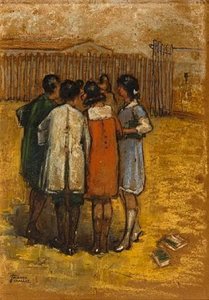
Nannies in the National Garden
Ručně malovaná olejná reprodukce od $178 34 × 29 cm
Velikost jako originál $461 110 × 94 cm Objednat v originální velikosti →
Nejoblíbenějším dílem autora Theophrastos Triantafyllidis je Nannies in the National Garden (1940). Následují Bathers on the boat (1930) a Boats in calm water z platen, která čtenáři znají nejlépe. Náš katalog obsahuje 33 děl umělce Theophrastos Triantafyllidis: zde je 33 nejznámějších, z nichž každé uvádí svůj rok vzniku, muzeum a důvod, proč je nezapomenutelné.
Seřazeno podle našeho skóre popularity, které kombinuje počet vyhledávání, návštěv a objednávek u každého díla. Aktualizováno říjen 2026. Každý obraz na této stránce lze objednat jako ručně malovanou olejovou reprodukci na lněném plátně, nebo jako umělecký tisk vyrobený v požadovaném rozměru.


Čtyři témata, která se na těchto plátnech nejčastěji objevují, každé s jedním z jejich nejoblíbenějších příkladů.


Nannies in the National Garden (1940), následovaný dílem Bathers on the boat (1930) a Boats in calm water.
Theophrastos Triantafyllidis, narozen 1881, měl 59 let: dílo Nannies in the National Garden pochází z roku 1940.
Nannies in the National Garden, Bathers on the boat, Boats in calm water, Masks, Photographer, Two Children on the Beach, Harvesting, Vase with flowers, Flea Market a Self-Portrait. U každého plátna v uvedeném žebříčku je uveden rok jeho vzniku a muzeum, ve kterém se nachází.
V našem katalogu je 33 děl umělce Theophrastos Triantafyllidis, datovaných od 1919 do 1952.
V období 1930s, které tvoří 3 z 33 děl na této stránce, mezi nimi i Bathers on the boat.
Nejstarší plátno se zde datuje do Two Children on the Beach (1919); nejnovější je z Self-Portrait (1952).
Gardens and parks (4), Reflection (2) a Children (2) napříč 33 díly na této stránce.
Impressionism a Post-impressionism, jak dokazují plátna na této stránce.
Ano. Každý obraz na této stránce lze objednat z jeho vlastní stránky jako ručně malovanou olejovou reprodukci nebo jako umělecký tisk v požadovaném rozměru.
Theophrastos Triantafyllidis (1881-1955) stands as a pivotal figure in the history of Greek art, particularly recognized for his contribution to Impressionism and Post-Impressionism. Born in Izmir, Ottoman Greece – now Turkey – Triantafyllidis’s artistic journey began amidst the burgeoning cultural landscape of the early 20th century, shaping him into an artist deeply attuned to both European avant-garde trends and the unique spirit of his homeland.
His formative years were spent studying at Athens School of Fine Arts, where he absorbed the teachings of prominent instructors who championed classical ideals alongside modern experimentation. This dual influence proved crucial in establishing Triantafyllidis’s distinctive artistic style – one characterized by a masterful blend of Impressionistic luminosity and expressive distortions reminiscent of Post-Impressionists like Cézanne and Gauguin.
Early works demonstrate a clear affinity with Impressionist principles, prioritizing fleeting moments of light and color to capture the essence of everyday life. Subjects such as landscapes—particularly scenes from Mykonos—and portraits are rendered with delicate brushstrokes and vibrant hues, reflecting Triantafyllidis’s fascination with capturing atmospheric conditions and conveying emotion through visual representation.
However, Triantafyllidis swiftly moved beyond mere imitation of established masters. As he matured as an artist, his style evolved towards a more personal expressionism, incorporating bolder colors and fractured forms to convey psychological depth and emotional intensity. This stylistic shift cemented his reputation as a visionary innovator who pushed the boundaries of artistic convention.
Notable achievements include numerous exhibitions showcasing his paintings across Greece and internationally, establishing him as one of the foremost proponents of Greek Impressionism. His oeuvre continues to inspire admiration for its lyrical beauty and profound exploration of human experience—a testament to Triantafyllidis’s enduring legacy as a transformative force in the artistic panorama of his era.
Triantafyllidis’s artistic vision was profoundly shaped by the Impressionist movement, spearheaded by artists like Monet and Renoir. He embraced their emphasis on capturing fleeting impressions of light and color—a technique he skillfully applied to landscapes and portraits alike.
However, Triantafyllidis transcended mere stylistic imitation, forging his own distinctive path toward expressionism. His canvases pulsate with emotional intensity, achieved through bold brushstrokes and distorted forms that convey psychological states rather than literal representations of reality. This approach aligns him with artists like Edvard Munch and Vincent van Gogh—figures who championed subjective experience as paramount to artistic endeavor.
Theophrastos Triantafyllidis’s contribution to Greek art remains significant, securing his place among the foremost proponents of Impressionism and Post-Impressionism. His enduring influence can be observed in subsequent generations of artists who embraced similar stylistic innovations—a testament to his pioneering spirit and unwavering commitment to artistic experimentation.
