


The Language of Symbols: Defining Allegory in Art History
 Allegory
As a literary device or artistic form, an allegory is a narrative or visual representation in which a character, place, or event can be interpreted to represent a meaning with moral or political significance. Authors have used allegory throughout his...
To step before a great canvas is to enter into a silent conversation, one that transcends the mere application of pigment upon cloth. For those of us who have spent decades wandering through the hallowed halls of the Musée d'Orsay or the National Gallery, we know that a painting is rarely just a window; it is often a veil. This is the essence of allegory—a profound artistic form where characters, landscapes, and even the subtle play of light serve as vessels for deeper moral, political, or spiritual truths. The very etymology of the word, rooted in the Greek allegoria, suggests a way of speaking about something else, a veiled language that invites the viewer to look beneath the surface.
In its most classical sense, allegory functions as a bridge between the visible and the invisible. It allows an artist to take an abstract concept—such as Justice, Time, or even Death—and personify it through a tangible figure. When we observe these works, we are not merely looking at a portrait; we are reading a narrative. This tradition has allowed masters throughout the centuries to communicate complex human experiences in ways that are both striking and universally comprehensible, turning a single image into an enduring lesson on the human condition.
Whispers of the Soul: Decoding Spiritual and Moral Narratives
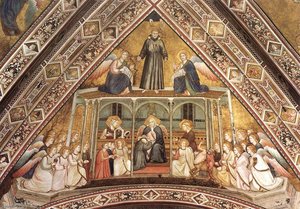 Franciscan Allegories: Allegory of Obedience
The Heart of Obedience: Giotto's "Allegory of Obedience" Giotto di Bondone’s “Franciscan Allegories: Allegory of Obedience,” painted in 1330, isn’t merely a fresco; it’s a profound meditation on faith rendered with an unprecedented sensitivity to hum...
There is a certain sanctity found in the early Renaissance works that still resonates within our souls today. Consider the profound meditations of Giotto di Bondone. In his 1330 fresco, the Allegory of Obedience, we find a watershed moment where the rigid, stylized conventions of Byzantine art began to soften into a breathtaking realism. Here, the painting is not a dramatic spectacle but an intimate tableau. Through the quiet intensity of a central figure draped in black, Gionotto invites us to contemplate the very essence of faith and devotion.
This spiritual layering extends into the much later, more dreamlike realms of Symbolism. As the 19th century drew to a close, artists moved away from the objective descriptions of Realism to embrace the subjective, the occult, and the irrational. Influenced by the evocative poetry of Baudelaire, painters sought to represent absolute truths through metaphorical imagery. In these works, every color choice and every brushstroke becomes a rhythmic pulse of meaning, much like the cadence of a poem, designed to evoke the mysteries of the subconscious and the divine.
The Human Condition: Time, Age, and Wisdom in Classical Allegories
 Allegory of Prudence
The Allegory of Prudence (c. 1550–1565) is an oil-on-canvas painting attributed to the Italian artist Titian and his assistants. The painting portrays three human heads, each facing in a different direction, above three animal heads (from left to rig...
One of the most poignant uses of allegory is its ability to map the trajectory of a human life. The great Titian, a master of the Venetian tradition, achieved this with unparalleled sophistication in his Allegory of Prudence. In this mesmerizing oil on canvas, we see three human heads representing the stages of man: youth, maturity, and old age. By directing these faces in different directions, Titian captures the very movement of time itself—the past, the present, and the future—all converging in a single, contemplative moment.
This complexity is further deepened by the inclusion of animal imagery, where the wolf, the lion, and the dog mirror the human experience. The painting serves as a visual counsel, reminding us that through the experience of the past, the present may act with wisdom to protect our future. It is this intellectual depth that makes such masterpieces so much more than mere decoration; they are mirrors held up to our own mortality, urging us toward a life of reflection and foresight.
From Myth to Moment: The Evolution of Symbolism into Impressionist Light
 “Allegory of fire”; “Allegory of water”
A Celestial Dance of Elements In the grand tradition of Italian Romanticism, Eugenio Agneni’s “Allegory of Fire” and “Allegory of Water” stand as breathtaking testaments to the power of mythic storytelling. This monumental oil on canvas invites the v...
As we transition from the structured allegories of the Renaissance to the luminous era of Impressionism, the nature of symbolism undergoes a beautiful metamorphosis. While the Impressionists like Monet, Renoir, and Pissarro moved away from overt personifications of virtue, they did not abandon meaning; rather, they found it in the ephemeral. The "symbol" was no longer a figure draped in classical robes, but the fleeting flicker of a sunbeam upon a lily pond or the soft, blue haze of a morning mist.
In the works of Eugenio Agneni, we see a breathtaking bridge between these worlds. His Allegories of Fire and Water utilize the grand tradition of Romanticism to depict a celestial dance of elements. Here, the boundaries between the physical and the divine dissolve through the use of vibrant color and masterful light. Even in the most purely sensory Impressionist landscapes, there is an underlying allegory of change and transience—a reminder that beauty exists in the breathless moment before the light shifts and the shadows lengthen.
A Collector's Eye: How to Interpret Hidden Meanings in Your Own Gallery
 10 Iconic Impressionist Masterpieces That Changed Art History
Introduction To step into the world of Impressionism is to witness a revolution of light and perception. Emerging from the vibrant, shifting landscapes of 19th-century France, this movement broke the rigid shackles of academic tradition to capture so...
For the dedicated collector, owning a piece of art is an act of preservation—not just of beauty, but of history. Whether you cherish a hand-painted reproduction that captures the thick, tactile impasto of Van Gogh or a custom commission that reimagines a personal memory through the light-drenched lens of Monet, you are curating a library of symbols. To truly appreciate these works, one must learn to observe the subtle gradations in tone and the intentionality behind every stroke.
As you build your collection, remember that the most profound meanings often reside in the details: the way a shadow falls across a face or the specific choice of a warm, golden hue. At TopImpressionists.com, we believe that art should be an immersive experience. We invite you to explore the textures and depths of these historical narratives through our bespoke oil paintings, where every canvas is a labor of passion, designed to bring the profound wisdom of the masters into the intimate sanctuary of your own home.


