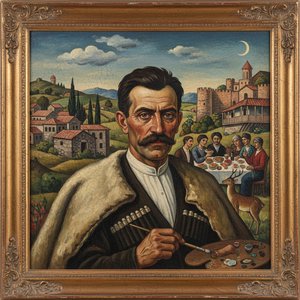
A Life Immersed in Artistic Transformation: Alexander Osmerkin
Alexander Alexandrovich Osmerkin, born in the Russian town of Fergana in 1892, was a figure deeply embedded within the tumultuous currents of early 20th-century Russian art. His journey reflects not merely a personal evolution as an artist but also the broader shifts and upheavals that defined the nation’s cultural landscape. From his formative years steeped in traditional training to his embrace of avant-garde experimentation, and ultimately, his navigation of the complexities of Soviet realism, Osmerkin's life was one dedicated to the pursuit of artistic expression amidst changing ideologies. He wasn’t simply a painter; he was a stage designer, a graphic artist, and, crucially, an educator who profoundly influenced generations of Russian artists.
Early Influences and Forging a Path in Moscow
Osmerkin's initial artistic grounding came through lessons with Feodosy Kozachinskiy at the Elisavetgrad Regional Professional School. This early exposure to traditional techniques provided a foundation, but it was his move to Kiev in 1911 that truly ignited his passion for modern art. There, he encountered Alexandra Exter and other pioneering figures who introduced him to the radical ideas sweeping Europe – Cubism, Fauvism, and the burgeoning spirit of abstraction. While acknowledging Paul Cézanne as a key influence, Osmerkin didn’t simply imitate; he absorbed these diverse styles, synthesizing them into his own unique visual language. The pivotal moment came with his relocation to Moscow in 1913 and entry into Ilya Mashkov's studio, followed by participation in the exhibitions of “The Jack of Diamonds” (Bubnovy Valet) group. This association placed him at the heart of Russia’s avant-garde movement, a collective known for its bold rejection of academic conventions and embrace of expressive color and form.
Navigating Revolution and Artistic Identity
The Russian Revolution dramatically altered the course of Osmerkin's life and work. He transitioned into teaching in 1918 at VKhUTEMAS, Moscow’s Higher Art and Technical Studios, initially alongside luminaries like Wassily Kandinsky. This period saw him establish his own workshop, fostering a new generation of artists while continuing to explore his personal style. His canvases from the 1920s reflect this era's revolutionary fervor, yet they remained imbued with a distinctive lyricism. Works such as “Red Guards at the Winter Palace” (1927), later acquired by the State Russian Museum in Leningrad, exemplify this balance – a thematic engagement with Soviet subject matter rendered with a personal sensitivity and nuanced approach to form. He was also an active member of several artistic societies including Moscow Painters and Genesis, constantly seeking platforms for his work and engaging in dialogue with fellow artists.
Leningrad Years and the Shadow of Formalism
The 1930s found Osmerkin in Leningrad, where he taught at Isaac Brodsky’s workshop at the Academy of Arts. This period was marked by a growing tension between artistic freedom and the demands of Socialist Realism. While continuing to exhibit and contribute to stage design for theaters in Leningrad and Kazan, his work increasingly came under scrutiny. In 1947, Osmerkin faced accusations of “formalism” – a damning critique that condemned non-conformist styles as decadent and bourgeois. This led to his dismissal from teaching positions and exclusion from official exhibitions, effectively silencing his artistic voice for several years. Despite this repression, he continued to work, driven by an unwavering dedication to art until his death near Moscow in 1953.
Legacy of a Balanced Vision
Alexander Osmerkin’s significance lies not only in the breadth of his artistic output – encompassing painting, graphic art, and stage design – but also in his profound impact as an educator. He mentored numerous artists who would become prominent figures in Soviet art, instilling in them a balanced approach that valued both formal experimentation and meaningful content. His work represents a fascinating intersection of avant-garde innovation and accessible subject matter, bridging the gap between radical artistic expression and the demands of a changing society. Though overshadowed by the ideological constraints of his later years, Osmerkin’s enduring legacy continues to resonate in the museum collections that preserve his oeuvre, offering a poignant testament to the power of artistic vision amidst adversity. His paintings stand as lyrical reflections on a turbulent era, imbued with a quiet dignity and unwavering commitment to beauty.