A Life of Stone and Sea
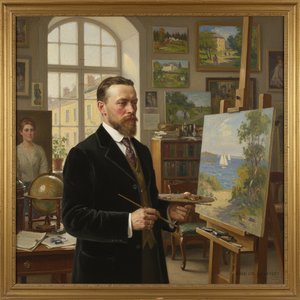
Augustin Ehrensvärd lived a life defined by the heavy demands of empire and the precise geometry of defense. Born in Fullerö Castle, Barkarö, he was a man of many titles—a Swedish military officer, an architect, and a field marshal. While his hand moved to the brush in moments of personal interest, his true imprint was left upon the landscape of the Baltic. He was not merely a painter, but a builder of fortifications and a commander of fleets.
In 1747, King Frederick I of Sweden entrusted him with a monumental task: the design and construction of a maritime fortress near Helsinki. This project, which would become his life's work, required a mind capable of blending military necessity with the natural world. He envisioned a low-profile, bastion-type fortress that followed the irregular contours of the islands to remain hidden from enemy eyes. Through this architectural labor, he shaped the very identity of the region.
The Architect of Suomenlinna
The creation of the Suomenlinna, then known as Sveaborg, was an exercise in endurance and strategic vision. Ehrensvärd expanded the island fortress steadily until his death in 1772. His work extended beyond stone walls to the very waters surrounding them; he was also the creator of the Svartholm fortress and the Swedish archipelago fleet. His command of the fleet between 1756 and 1766 reflected a man deeply integrated into the naval defense of the realm.
His interests were broad, reaching into botany, educational psychology, and the fine arts. He was elected to the Royal Swedish Academy of Sciences in 1739, the same year it was founded. This intellectual breadth informed his approach to fortification, treating the landscape not as a blank slate, but as a complex element to be mastered. Even his burial reflects this connection to his work; King Gustav III designed a memorial for him that sits at the heart of the fortress he built.
A Final Resting Place
The end of his life saw him rise to the rank of field marshal, a final recognition of his service to the Swedish crown. He passed away in the village of Saris, Mynämäki. His remains were eventually moved to the Linnanpiha yard on the island of Susisaari within Suomenlinna. The memorial that marks his grave is a heavy, granite presence, featuring bronze ornaments cast from Russian cannons taken during the Battle of Svensksund in 1790.
The monument contains symbols of his varied duties: a shield, a sword, a helmet, and a chain of the Order of the Seraphim. It is a somber, metallic tribute to a man whose life was spent fortifying borders. Through his architecture and his naval leadership, Ehrensvärd left behind a physical legacy that remains visible in the islands of Finland today.