The Life and Artistic Evolution of Hans Fuglsang
Born in Haderslev, Denmark, Hans Fuglsang was a painter and etcher whose artistic journey took him from the studios of Dresden to the academies of Munich. After studying at the private art school of Georg Erler, he gained admission to the Munich Academy of Fine Arts, where he studied under Hugo von Habermann. His travels were extensive, including visits to the Gardasee, Venice, Sylt, and various locations in Northern Germany and the Alps. His work often focused on figures, particularly dancers and scenes from coffeehouses, as well as landscapes, portraits, and cemeteries. He also produced works depicting ancient mythology and various cycles such as Penthesilea, Salome, Passion, and Fasching.
Technique and Artistic Style
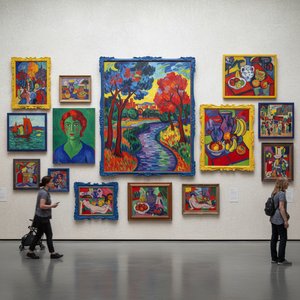
Fuglsang's style underwent a significant transformation throughout his career. His early oil paintings were characterized by a late impressionist approach, often appearing atmospheric, tonal, and color-intensive. In his graphic work, he utilized a combination of brush and pen to depict mythological themes, moving from the graceful curves and clear proportions of late Jugendstil toward a more modern, expressionistic language. His later works were noted for their fantastic qualities, featuring wild figures rendered with nervous, unstructured lines. His diverse body of work includes: