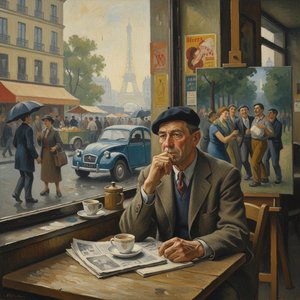
The Life and Intellectual Journey of Maurice Grosser
Maurice Grosser was an American painter, art critic, and writer. Born in Huntsville, Alabama, his academic foundation began at Harvard University, where he studied mathematics and graduated with honors. His artistic path was shaped by life drawing classes at the Boston Architectural School and the South Boston Art School, alongside painting instruction from Denman Ross. A Sheldon Fellowship allowed him to pursue his studies in France, a period that coincided with a lifelong relationship with Virgil Thomson. The two met at The Liberal Club at Harvard and later encountered one another at Les Deux Magots in Paris, forming a bond that lasted through their lives as lovers and best friends.
Beyond the canvas, Grosser was a prolific writer and critic. He authored several books, including Painting in Public/Painting in Our Time, The Painter's Eye, Critic's Eye, and Painter's Progress. His critical voice was further established during his tenure as an art critic for The Nation from 1956 to 1967. His intellectual reach extended globally, including a period as a Visiting Professor of Art at the University of Ife, Nigeria.
Exhibitions and Artistic Legacy
Grosser's work has been featured in numerous prestigious venues and collections. His exhibitions spanned from the early 1920s in Cambridge, Massachusetts, to galleries in Paris, New York, Chicago, and The Hague. Notable exhibitions included showcases at the Julien Levy Gallery, the Knoedler Gallery, and the Museum of Modern Art. His artistic output also included designing scenarios for two operas by Virgil Thomson: Four Saints in Three Acts and The Mother of Us All. In 1985, he created 18 Portraits, which were accompanied by musical portraits composed by Thomson.
The legacy of his work is preserved in several significant institutions, including:
- The Museum of Modern Art
- The Brooklyn Museum
- The Smithsonian American Art Museum
- The Boston Museum of Fine Arts
- The Huntsville Museum of Art