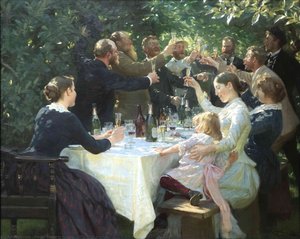
Peder Severin Krøyer, a name perhaps less instantly recognizable than some of his Impressionist contemporaries, nevertheless occupies a pivotal position within Scandinavian art. Born in Stavanger, Norway (1851), Krøyer’s early life was marked by an unusual upbringing; raised not by his biological mother but by her sister and brother-in-law, the Danish zoologist Henrik Nikolai Krøyer, he found himself transplanted to Copenhagen and immersed in a world of scientific inquiry alongside artistic cultivation. This unique foundation – a blend of observation, precision, and aesthetic sensibility – would profoundly shape his approach to painting. While details of his earliest years remain somewhat elusive, it’s clear that an aptitude for art was nurtured from a young age, leading to enrollment at the Royal Danish Academy of Art at just fourteen. He quickly distinguished himself, demonstrating a natural talent that promised a successful career.
From Realism to the Shifting Sands of Impressionism
Krøyer’s artistic journey began firmly rooted in realism, particularly portraiture – a genre highly esteemed and financially viable during his formative years. He excelled at capturing likenesses, securing commissions that established him as a sought-after artist within Danish society. However, the winds of change were blowing across Europe, carrying with them the revolutionary ideas of Impressionism. Krøyer was not immune to their allure. Several trips to Paris exposed him to the groundbreaking work of Monet, Renoir, Degas, and others, artists who dared to abandon traditional techniques in favor of capturing fleeting moments of light and atmosphere. He absorbed these influences, gradually incorporating them into his own style. This wasn’t a wholesale adoption, however; Krøyer didn't simply replicate Impressionism. Instead, he synthesized it with his existing realist training, creating a distinctive aesthetic that balanced meticulous observation with an evocative sense of mood and transience. His canvases often depict serene landscapes bathed in the golden hues of dawn or dusk—a testament to his fascination with capturing the ephemeral beauty of nature. The subtle gradations of color and brushstrokes characteristic of Impressionism allowed him to convey not just what he saw but also how he felt, a feat that cemented his place among the foremost artists of his time.
Skagen: A Colony of Light and Inspiration
The turning point in Krøyer’s career – and arguably the period for which he is most celebrated – came with his discovery of Skagen, a remote fishing village on the northern tip of Denmark. He first arrived there in 1882, drawn by the dramatic coastal landscapes and the unique quality of light that bathed the region. Skagen quickly became more than just a location; it was an artistic haven, attracting a vibrant colony of painters, writers, and intellectuals. Krøyer became central to this community, forging close friendships with artists like Michael and Anna Ancher, and writer Holger Drachmann. He married Marie Triepcke in 1889, who herself was a talented painter and frequent subject in his work. It was at Skagen that Krøyer truly found his voice, producing some of his most iconic paintings – scenes of beach life, fishermen at work, and intimate portraits of his fellow artists. Summer Evening on Skagen’s Southern Beach, perhaps his most famous work, exemplifies this period; it's a masterful depiction of light, atmosphere, and the camaraderie of the artistic circle. The painting is not merely a representation of a scene but an evocation of a feeling – a sense of peace, belonging, and the ephemeral beauty of summer. He meticulously rendered the textures of sand, sea spray, and twilight sky, capturing the very essence of Skagen’s atmosphere. His canvases pulsate with warmth and luminosity, reflecting his unwavering devotion to portraying this extraordinary place and its inhabitants.
Later Years and Enduring Legacy
The final years of Krøyer’s life were marked by personal tragedy and declining health. His marriage to Marie deteriorated, culminating in divorce in 1905. Simultaneously, he began to suffer from failing eyesight, a devastating blow for any artist but particularly poignant for one so dedicated to capturing the nuances of light. Despite these challenges, Krøyer continued to paint, demonstrating remarkable resilience and determination. He adapted his technique to accommodate his diminishing vision, even joking that losing an eye had somehow improved the sight in his remaining one. His unwavering commitment to artistic expression persisted until his death in 1909 at Skagen—a poignant reminder of the artist’s profound connection to his surroundings and his enduring legacy as a pioneer of Impressionistic landscape painting. Krøyer's work continues to inspire admiration for its beauty, sensitivity, and masterful execution, securing his place among the most beloved figures in Scandinavian art history.
## Museums and Collections
The Hirschsprung Collection (Copenhagen): Holds a significant number of Krøyer’s works, reflecting the long-standing patronage of Heinrich Hirschsprung.
Skagens Museum: Boasts the world's largest collection of paintings by Peder Severin Krøyer, offering an unparalleled insight into his artistic development and connection to Skagen.
National Gallery of Denmark (Copenhagen): Features selected works representing Krøyer’s contribution to Danish art history.
Redakce TopImpressionists.com
Krátký kvíz
U každé otázky je pouze jedna správná odpověď.
Otázka 1:
Kde se narodil Peder Severin Krøyer?
Otázka 2:
Krøyerův umělecký styl je charakterizován kombinací dvou směrů?
Otázka 3:
Co byla významná témata často zobrazovaná Krøyerovým obrazům po návratu do Skagen?
Otázka 4:
Které muzeum vlastní největší sbírku Krøyerových obrazů, včetně některých jeho nejvýznamnějších děl?
Otázka 5:
Jaký byl výsledek ztráty Krøyerovým zrakem v pozdních letech jeho života?