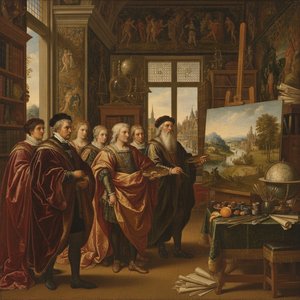
A Legacy of Line and Light: The Life of Richard van Orley
In the vibrant artistic landscape of late seventeenth-century Brussels, few names carried the weight of tradition quite like van Orley. Born in 1663 into a distinguished Flemish dynasty of creators, Richard van Orley was more than just a painter; he was a custodian of a multi-generational legacy that stretched back to the Renaissance masters. Trained under the watchful eye of his father, Pieter, also known as Siret—a skilled landscape artist and miniaturist—Richard inherited a profound understanding of delicate detail and atmospheric depth. His early years were steeped in the technical rigors of the Flemish tradition, yet there was an unmistakable restlessness in his spirit that suggested a desire to look beyond the borders of his native city.
It is widely believed by historians that Richard’s artistic horizons were expanded by a transformative period spent in Italy. While no definitive records confirm the exact duration of his sojourn, the evidence remains etched in his work. His series of drawings documenting the Development of Rome, now held within the Royal Library of Belgium, reveals an artist captivated by classical grandeur and the architectural evolution of the Eternal City. This exposure to Italianate sensibilities allowed him to infuse his Flemish roots with a sense of classical poise, creating a unique stylistic bridge between the northern preoccupation with meticulous detail and the southern mastery of monumental composition.
The Versatile Hand: Mastery Across Mediums
Richard van Orley was a true polymath of the graphic arts, possessing a versatility that allowed him to navigate the demanding worlds of painting, draughtsmanship, and printmaking with equal grace. His oeuvre is remarkably diverse, comprising an extensive collection of approximately five hundred drawings, seventy original engravings, and thirty exquisite miniatures. This breadth of output speaks to a creator who found inspiration in every stroke of the pen and every bite of the etching needle. He was particularly renowned as an accomplished engraver, possessing the rare ability to translate complex imagery into the stark, powerful language of print.
One of his most significant historical contributions lies in his role as a visual chronicler. Through his masterful prints, created after the drawings of Augustin Coppens, Richard provided a hauntingly beautiful yet devastating record of the Bombardment of Brussels in 1695. As French troops rained destruction upon the city, leaving much of its religious and civic heart in ashes, van Orley’s work captured the smoke, the ruin, and the profound loss experienced by the citizenry. In doing so, his art transcended mere decoration, becoming a vital historical document that preserved the memory of a city's darkest hour.
Themes of Myth and Spirit
Beyond his role as a chronicler of tragedy, van Orley’s creative mind wandered through the realms of the divine and the legendary. His subject matter was deeply rooted in the cultural zeitgeist of his era, drawing heavily from the Bible, classical mythology, and the romanticized tales found in contemporary novels. He possessed a singular talent for weaving together threads of spiritual meditation with the dramatic tension of ancient legends. Whether depicting a scene of biblical gravity or a moment of mythological intrigue, his work was characterized by a narrative depth that invited viewers to contemplate the eternal struggles of the human condition.
Working alongside his brother, Jan van Orley—a titan of Flemish tapestry design—Richard contributed to an era where art was woven into the very fabric of social and religious life. While their specific collaborations as tapestry designers remain a subject of scholarly debate, the shared artistic DNA of the brothers helped sustain Brussels as a premier center for European art. When Richard passed away in 1732, he left behind more than just a collection of works; he left a testament to the enduring power of the Flemish tradition, refined by classical influence and a profound sensitivity to the shifting tides of history.