Ateliér — Doprava po celém světě zdarma — Dodání za 2–6 týdnů
      Fernand Léger, 1881 – 1955

      Fernand Léger: The 100 Best-Known Paintings

      Of all Fernand Léger's paintings, Město (1919) is the most famous. Close behind come Mechanik (1920) and Tři ženy (1921). Among the 834 works by Fernand Léger in our catalogue, these 100 are the most celebrated, each shown with its date, its museum and its story.

      Seřazeno podle našeho skóre popularity, které kombinuje počet vyhledávání, návštěv a objednávek u každého díla. Aktualizováno říjen 2026. Each painting on this page can be ordered as an oil reproduction painted by hand on linen canvas, or as a fine art print, made to the size you choose.

      Portrét Fernand Léger
      Fernand Léger · 1881 – 1955
      Narozen · zemřel
      1881 – 1955, Argentan
      Směr
      Návrat kubismu
      Díla v našem katalogu
      834
      Nejslavnější
      Město (1919)
      Nejvíce děl v
      MoMA - Museum of Modern Art

      Fernand Léger's 10 most celebrated paintings

      Město (1919) od Fernand Léger
      1

      Město

      1919 · Olej na plátně

      Fernand Légerovo dílo „Město“ z roku 1919 je mnohem víc než jen obraz panoramatického města. Je to monumentální vyjádření jeho dospělého uměleckého stylu, hluboká reflexe moderny a dynamická interpretace formy, barvy a samotné podstaty městského života. Představuje nám Légerův pohled na svět, který se dramaticky mění, svět strojů, továren a rostoucí urbanizace – svět, který se snaží pochopit a zobrazit s novým, kubistickým přístupem.

      Mechanik (1920) od Fernand Léger
      2

      Mechanik

      1920 · Olej na plátně · Národní galerie Kanady, Ottawa

      Fernand Léger’s “The Mechanic”: A Vision of Modernity in Steel and Color Fernand Légerova “Mechanik” z roku 1920 je fascinující průzkum tvaru a moderny, který v sobě nese ducha raného dvacátého století. Tato působivá kompozice bezchybně spojuje lidské postavy s abstraktními geometrickými tvary, čímž vytváří dynamickou interakci odrážející umělcovu fascinaci průmyslem a mechanickými estetickými prvky. Léger zde ne jen zobrazuje mechanika, ale i celou éru, definovanou rychlým technologickým pokrokem a…

      Tři ženy (1921) od Fernand Léger
      3

      Tři ženy

      1921 · Olej na plátně · MoMA - Museum of Modern Art, New York

      Úvod Dílo „Tři ženy“ (1921) od Fernanda Légera představuje skutečné mistrovské dílo moderního umění, které v sobě bez námahy spojuje vlivy kubismu a estetiky Art Deco. Tato živá a dynamická kompozice zachycuje samotnou podstatu moderní éry počátku dvacátého století, díky čemuž se stává fascinujícím doplňkem jak pro jakoukoli současnou sbírku umění, tak pro sofistikovaný interiérový prostor. Motiv a kompozice V srdci tohoto obrazu jsou tři ženské postavy zapřísněné do volných,…

      Nudy ve Výšinném lese (1910) od Fernand Léger
      4

      Nudy ve Výšinném lese

      1910 · Olej na plátně · Kröller-Müllerův Muzeum, Otterlo

      Dílo Nahé postavy v lese (1909–1910) od Fernanda Légera představuje klíčový milník, který definoval zásadní fázi rozvoje kubismu. Nejde jen o prostou zobrazení postav mezi stromy; je to odvážná dekonstrukce tvaru a perspektivy, která i po více než století fascinuje diváky. Tento obraz není o tom, co je zobrazeno, ale o tom, jak – což je radikální přístup, který zcela předefinoval moderní umění.

      Velká paráda (1954) od Fernand Léger
      5

      Velká paráda

      1954 · Olej na plátně

      V srdci umění 20. století se nachází dílo, které okamžitě zaujme svou dynamickou energií a neotřelým pohledem na modernitu: "The Great Parade" (Velký průvod) od Fernanda Légera. Tato obrazová symfonie, vytvořená v roce 1954, není pouhý popis karnevalu nebo festivalu; je to ztělesnění pulzujícího života města, sjednocené v chaotické harmonii mechanických a organických prvků. Léger, průkopník svého času, se odvážil propojit kubismus s fauvizmem, čímž vytvořil unikátní vizuální jazyk, který…

      Svatba od Fernand Léger
      6

      Svatba

      Olej na plátně

      Fernand Léger: A Pioneer of Cubism – Capturing the Rhythm of Modernity Fernand Léger, narozony Joseph Fernand Henri Léger w 1881 roku wśród krajobrazów Normandii, Argentan, stanowi kluczową osobę w rozwoju sztuki nowoczesnej. Jego podróż od pól rolniczych młodości do centrum paryskiej awangardy jest świadectwem niezachwiałej wizji artystycznej i nieustannego poszukiwania uchwycenia ducha ery maszyny – epoki, która wyznaczyła nowy język obrazowy, łączący siłę abstrakcji z obserwacją świata rzeczywistego. Jego…

      Snídaně (1921) od Fernand Léger
      7

      Snídaně

      1921 · Olej na plátně · MoMA - Museum of Modern Art, New York

      V živutném krajině raného 20. století modernismu má málo děl zachytit rytmický puls měnící se éry takásky živě, jako je Snídaně od Fernanda Légera. Toto dílo namalované v roce 1921 slouží jako okno do světa, kde se domácí a průmyslový aspekt začaly prolínat v jednu jedinou, dynamickou vizi. Scéna představuje skupinu tří žen zgromaděných kolem jídelního stolu, avšak nejsou to jen obyčejné postavy v tichém portrétu. Místo toho, skrze revoluční…

      Žena s kyticí květin (1920) od Fernand Léger
      8

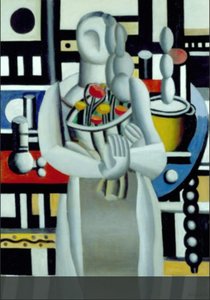
      Žena s kyticí květin

      1920 · Olej na plátně · Staatsgalerie Stuttgart, Stuttgart

      Z mřížky těžkých černých linií se vynošuje žena, jejíž postava je sestavena z válců a sfér. Drží kytici, ale její květy nejsou měkkými okvětními lístky, nýbrž fragmenty červené, žluté a modré. Každý tvar působí vážně, jako by byl vyřezán ze oceli nebo odlit z železa. Silné obrysy definují tělo, které se pohybuje s rytmickou přesností stroje. Zde neexistuje žádný stín, který by změkčil hrany; jsou tu pouze ploché plány barev…

      Composition in Blue od Fernand Léger
      9

      Composition in Blue

      Olej na plátně · Art Institute of Chicago, Chicago

      Fernand Léger’s "Composition in Blue" is a quintessential example of modernist art, showcasing his unique blend of Cubism and Futurism. The painting features a striking composition dominated by shades of blue, with a central figure – seemingly a woman or humanoid form – rendered in various hues of the color. This figure is partially obscured by a large blue headpiece, creating an enigmatic and somewhat mechanical appearance. The artwork incorporates…

      Most (1923) od Fernand Léger
      10

      Most

      1923 · Olej na plátně · Thyssen-Bornemisza Museum, Madrid

      Přibližte se a pozorujte, jak je prostor rozvrstven. V díle Most, vytvořeném v roce 1923, neexistuje žádná jediná perspektiva, na kterou by se oko mohlo opřít. Místo toho zde nacházíme kompozici rozdělenou do jasných horizontálních a vertikálních zón, které naznačují roztříštěnou architektonickou realitu. Dva silné, smaragdově zelené sloupy kotví v horní střední části a působí jako strukturální pilíře celého uspořádání. Za nimi se pozadí rozprostírá skrze ploché plány červené, černé…

      Fernand Léger paintings ranked 11 to 100

      smokers - - ) (1912) od Fernand Léger
      #11

      smokers - - )

      1912

      Fernand Léger's "Smokers," painted in 1912, isn’t merely a depiction of men enjoying a cigarette; it’s a vibrant manifesto of early Cubism and a bold assertion of modernity.…

      Bring this light home →
      Mural (1951) od Fernand Léger
      #12

      Mural

      1951

      Fernand Léger’s "Mural," completed in 1951, stands as an arresting embodiment of Cubist principles interwoven with a palpable fascination for the burgeoning machine age. This masterpiece does not…

      Have it painted by hand →
      Město (Fragment, třetí stav) (1919) od Fernand Léger
      #14

      Město (Fragment, třetí stav)

      1919 · Philadelphia Museum of Art

      Pulzující ocel a primární barvy Plátno vibruje rytmickým, kovovým hučením městské krajiny v pohybu. Geometrické tvary – válce, obdélníky a ostré oblouky – se překrývají v husté, fragmentované…

      Order this canvas →
      Reading (1924) od Fernand Léger
      #15

      Reading

      1924

      In the quietude of an ambiguous interior, two figures sit side-by-side, lost in the profound intimacy of shared silence and individual discovery. Fernand Léger’s 1924 masterpiece, Reading, is…

      Order this canvas →
      Tanec (1942) od Fernand Léger
      #16

      Tanec

      1942

      Rytmická oslava tvaru a barvy Fernand Légerův Tanec je mnohem víc než jen pouhým ztvárněním pohybu; je to živá, pulzující symfonie barev a geometrie, která zachycuje samotnou esenci…

      Order this canvas →
      Disk (1910) od Fernand Léger
      #17

      Disk

      1910 · Los Angeles County Museum of Art

      Série překrývajících se kruhů se vznáší po plátně jako těžká, namalovaná signál. Tyto disky, vyjádřené v tlustých vrstvách oleje, se protínají s ostrými obdélníky a diagonálními pásy barev.…

      Order this canvas →
      The Bather (1932) od Fernand Léger
      #18

      The Bather

      1932

      In the quiet intersection of Surrealist dreamscapes and the rigid precision of Cubism lies Fernand Léger’s 1932 masterpiece, The Bather. This is not merely a painting of a…

      Order this canvas →
      Three musicians (1930) od Fernand Léger
      #19

      Three musicians

      1930

      In the pantheon of twentieth-century modernism, few works capture the pulse of the machine age with as much vibrant vitality as Fernand Léger’s "Three Musicians." Completed in 1930,…

      Order this canvas →
      The Man with the Pipe (1920) od Fernand Léger
      #20

      The Man with the Pipe

      1920 · Musée d’Art Moderne de la Ville de Paris

      The man sits within a grid of sharp edges and heavy lines. His body is not composed of soft skin, but of cylinders and metallic volumes that suggest…

      Have it painted by hand →
      Contrast of Forms (1918) od Fernand Léger
      #21

      Contrast of Forms

      1918

      The canvas breathes with an energy that transcends mere pigment; it pulsates with the rhythm of industrial progress, captured in the bold strokes and vibrant hues of Fernand…

      Have it painted by hand →
      Dance (1929) od Fernand Léger
      #22

      Dance

      1929

      Two nude female figures move through a landscape of interlocking shapes, their bodies caught in a moment of dynamic instability. The scene unfolds with a flattened perspective, where…

      Order this canvas →
      Žena s vázou (1924) od Fernand Léger
      #23

      Žena s vázou

      1924 · Statens Museum for Kunst

      V tomto olejomalbě z roku 1924 narážíme na postavu, která působí neuvěřitelně pevně, v konstrukci téměř sochařsky. Žena je zobrazena frontálně, její forma je definována těžkými, nepřetržitými obrysy,…

      Bring this light home →
      The Builders (1920) od Fernand Léger
      #24

      The Builders

      1920 · Metropolitan Museum of Art

      Fernand Léger’s “The Builders,” completed in 1920, stands as a cornerstone of Cubist aesthetics and embodies the fervent optimism surrounding technological advancement during the tumultuous years of World…

      Order this canvas →
      Chůze květiny (La fleur qui marche) (1952) od Fernand Léger
      #25

      Chůze květiny (La fleur qui marche)

      1952 · Kimbell Art Museum

      Légerova „Chůze květiny“: Symfonie barvy a formy na pozadí průmyslové éry Keramická socha „Chůze květiny (La fleur qui marche)“ od Fernanda Légera, dokončená v roce 1952, stojí jako…

      Plungers II (1942) od Fernand Léger
      #26

      Plungers II

      1942

      Symfonie tvaru a fragmentované identity V srdci roku 1942, uprostřed hlubokých stínů kladených druhou světovou válkou, představil Fernand Léger dílo Plungers II, které slouží jako mnohem více než…

      Bring this light home →
      Woman with Mirror (1920) od Fernand Léger
      #27

      Woman with Mirror

      1920 · Musée d’Art Moderne de la Ville de Paris

      The painting Woman with Mirror, created in 1920, presents a configuration of geometric shapes that deconstruct the human figure and its surroundings. The composition relies on an arrangement…

      Have it painted by hand →
      The man with the pipe (1918) od Fernand Léger
      #29

      The man with the pipe

      1918

      In the transformative landscape of early twentieth-century modernism, few works capture the rhythmic pulse of a changing world as vibrantly as Fernand Léger’s “The Man with the Pipe.”…

      Have it painted by hand →
      Project for a mural (1952) od Fernand Léger
      #30

      Project for a mural

      1952 · Cincinnati Art Museum

      In the vast landscape of twentieth-century modernism, few works capture the rhythmic pulse of the machine age as vibrantly as Fernand Léger’s "Project for a mural." Completed in…

      Order this canvas →
      Mechanical Elements od Fernand Léger
      #31

      Mechanical Elements

      Metropolitan Museum of Art

      Fernand Léger’s “Mechanical Elements,” painted in 1924, stands as a striking testament to the burgeoning fascination with technology during the interwar period. More than just a depiction of…

      Bring this light home →
      The City (1919) od Fernand Léger
      #32

      The City

      1919 · MoMA - Museum of Modern Art

      Step closer and observe how the canvas seems to move even when you remain still. In 1919, Fernand Léger captured something far more visceral than a mere urban…

      Bring this light home →
      Le Petit Djeuner (1919) od Fernand Léger
      #33

      Le Petit Djeuner

      1919 · Minneapolis Institute of Art

      In the 1919 painting Le Petit Djeuner, Fernand Léger presents a breakfast scene through a fragmented, Cubist lens. Two stylized human figures occupy a space that merges with…

      Have it painted by hand →
      The Dance - 1st Stage (1929) od Fernand Léger
      #34

      The Dance - 1st Stage

      1929 · Hiroshima Museum of Art

      The oil painting titled The Dance - 1st Stage presents two stylized female figures positioned in an intertwined pose. These figures are rendered with thick, continuous lines that…

      Bring this light home →
      Contrast of Forms (1910) od Fernand Léger
      #35

      Contrast of Forms

      1910 · Philadelphia Museum of Art

      Step closer to observe how the canvas begins to pulse with a rhythmic, mechanical energy. In Contrast of Forms, we find ourselves looking at a fragmented landscape where…

      Have it painted by hand →
      Komposition (1920) od Fernand Léger
      #36

      Komposition

      1920

      A heavy red rectangle anchors the center, pressed against thick black lines that slice through white and yellow planes. Circles overlap like the interlocking teeth of a gear,…

      Have it painted by hand →
      Sunflowers (1953) od Fernand Léger
      #37

      Sunflowers

      1953

      This striking black and white drawing of sunflowers by Fernand Léger, created in 1953, offers a compelling glimpse into the artist's unique vision – a synthesis of observed…

      Order this canvas →
      Reclining Woman od Fernand Léger
      #39

      Reclining Woman

      Art Institute of Chicago

      The painting is a Cubist artwork by Fernand Léger featuring a woman lying on her side with a yellow snake wrapped around her body. The snake appears to…

      Have it painted by hand →
      The man in the blue hat (1937) od Fernand Léger
      #40

      The man in the blue hat

      1937

      A Portrait of Quiet Contemplation Amidst Mechanical Forms Fernand Léger’s “The Man in the Blue Hat,” painted in 1937, stands as a striking embodiment of Purism – an…

      Order this canvas →
      Reading (1948) od Fernand Léger
      #41

      Reading

      1948

      Created in 1948, Reading is a portrait that captures a moment within an interior space. The painting features a woman sitting on the floor with her legs crossed,…

      Have it painted by hand →
      Skokani (1943) od Fernand Léger
      #42

      Skokani

      1943 · Harvard Art Museums

      Přejděte o krok blíž a pozorujte, jak postavy vystupují z čistého bílého prostoru. V díle Skokani se setkáváme se skupinou jedinců zachycených v půli letu, jak provádějí akrobatické…

      Bring this light home →
      Two Profiles (1928) od Fernand Léger
      #43

      Two Profiles

      1928 · Albertina

      Two profiles occupy the center of this 1928 composition. These two faces are rendered in stark black and white shapes, positioned so they face one another across the…

      Have it painted by hand →
      Mechanical Element (1920) od Fernand Léger
      #44

      Mechanical Element

      1920 · Kröller-Müllerův Muzeum

      Step closer and observe how the canvas seems to hum with a quiet, industrial energy. In Mechanical Element, created in 1920, there is no attempt to depict a…

      Have it painted by hand →
      Dancer Blue (1930) od Fernand Léger
      #45

      Dancer Blue

      1930

      To encounter Fernand Léger's "Dancer Blue" is to step directly into the rhythmic, metallic heartbeat of the twentieth century. Created in 1930, this masterpiece serves as a crystallized…

      Bring this light home →
      Adam and Eve (1937) od Fernand Léger
      #46

      Adam and Eve

      1937 · Kunstsammlung Nordrhein-Westfalen

      To stand before this work is to witness a moment of profound, unformed energy. Completed in 1939, Adam and Eve presents a landscape that feels less like a…

      Have it painted by hand →
      Žena s kočkou (1921) od Fernand Léger
      #48

      Žena s kočkou

      1921 · Hamburger Kunsthalle

      Žena sedí, její postava je složena ze sfér a tubusů. V náklonu si drží černou kočku, temnou váhu kontrastující k jasně žlutým a hlubokým modrým plochám jejího těla.…

      Order this canvas →
      Popluh (První stav) (1919) od Fernand Léger
      #49

      Popluh (První stav)

      1919 · Philadelphia Museum of Art

      Metalický válec prolíná plochu čisté barvy. V roce 1919 byl Paříž městem rekonstrukce a náměstí Place de Clichy bylo zahaleno kostrou průmyslových konstrukcí. Tento obraz zachycuje právě ten…

      Order this canvas →
      Umbrella and Bowler (1926) od Fernand Léger
      #50

      Umbrella and Bowler

      1926 · MoMA - Museum of Modern Art

      A deconstructed arrangement of everyday objects defines this 1926 composition. An open umbrella and parts of a chair are integrated into a complex grid of shapes, utilizing strong…

      Have it painted by hand →
      Two Women and still life 1st state (1920) od Fernand Léger
      #51

      Two Women and still life 1st state

      1920 · Building of the Winterthur Museum of Art

      Fernand Léger's “Two Women & Still Life” stands as a cornerstone of Cubist aesthetics and a testament to the artist’s unwavering commitment to capturing the dynamism of the…

      Bring this light home →
      Composition (Definitive State) (1925) od Fernand Léger
      #52

      Composition (Definitive State)

      1925

      A large, dark reddish-brown oval anchors the center of the canvas, acting as a heavy weight amidst a sea of shifting planes. Around this central anchor, thick black…

      Kolo (1930) od Fernand Léger
      #53

      Kolo

      1930 · Art Gallery of New South Wales

      A central white polygon holds a deep blue, fluid shape like a pool of oil. Within this blue space, thin white lines trace skeletal, wheel-like structures that suggest…

      Order this canvas →
      Zátiš (1928) od Fernand Léger
      #54

      Zátiš

      1928 · Art Institute of Chicago

      Přibližte se a pozorujte, jak se známé prvky uspořádání na stole mění skrze čočku strukturní přesnosti. V tomto díle z roku 1928 se umělec vzdal tradiční reprezentace a…

      Order this canvas →
      The three musicians od Fernand Léger
      #56

      The three musicians

      In the vibrant tapestry of early twentieth-century modernism, few works resonate with as much structural vitality as Fernand Léger’s "The Three Musicians." This masterpiece is far more than…

      Have it painted by hand →
      Ballet mécanique (1924) od Fernand Léger
      #58

      Ballet mécanique

      1924

      Fernand Léger's "Ballet Mécanique," painted in 1924, isn’t merely a depiction of a scene; it’s a vibrant, pulsating embodiment of the machine age and its impact on human…

      Have it painted by hand →
      Still Life (1927) od Fernand Léger
      #59

      Still Life

      1927 · Národní muzeum umění, architektury a designu

      Step closer to observe how the familiar objects on this table have been transformed. In this 1927 composition, we find a quiet arrangement that rejects the soft edges…

      Have it painted by hand →
      The Mechanic (1918) od Fernand Léger
      #60

      The Mechanic

      1918 · Munson-Williams-Proctor Arts Institute

      A rhythmic energy surges through the canvas as geometric shapes collide and overlap in a dense, industrial dance. Cylinders, cones, and flat planes interlock, creating a landscape where…

      Order this canvas →
      Nude Model in the Studio od Fernand Léger
      #61

      Nude Model in the Studio

      Fernand Léger's "Nude Model in the Studio," painted in 1912-13, stands as a cornerstone of Cubist art and embodies the movement’s radical departure from traditional artistic conventions. More…

      Have it painted by hand →
      Head constructor (1950) od Fernand Léger
      #62

      Head constructor

      1950

      Fernand Léger’s “Head Constructor,” painted in 1950, isn't merely a portrait; it’s a distilled essence of the burgeoning modernity that gripped Europe after World War I. This striking…

      Bring this light home →
      Machine elements (1920) od Fernand Léger
      #63

      Machine elements

      1920

      A Symphony of Steel and Geometry The year 1920 marked a profound shift in the visual language of modernity, and few works capture this seismic transition as vibrantly…

      Order this canvas →
      Three Characters (1924) od Fernand Léger
      #64

      Three Characters

      1924

      A Symphony of Form and Feeling: Exploring Fernand Léger’s “Three Characters” Fernand Léger's 1924 painting, *“Three Characters,”* is a pivotal work exemplifying his distinctive contribution to Cubism –…

      Order this canvas →
      Characters in the City (1919) od Fernand Léger
      #66

      Characters in the City

      1919 · Solomon R. Guggenheim Museum

      The Rhythms of an Urban Symphony Fernand Léger’s 1919 masterpiece, Characters in the City, is far more than a mere depiction of metropolitan life; it is a vibrant…

      Have it painted by hand →
      Contrast of Forms (1913) od Fernand Léger
      #67

      Contrast of Forms

      1913

      A fragmented landscape emerges through a complex vocabulary of cones, cylinders, cubes, and planes. The composition deconstructs reality into overlapping geometric shapes that intersect across a shallow, flattened…

      Have it painted by hand →
      Zátiší (1922) od Fernand Léger
      #68

      Zátiší

      1922

      Symfonie tvaru a průmyslové elegance Rok 1922 znamenal transformativní éru v pařížské avantgardě a Fernand Légerovo Zátiší s svícnou stojí jako hluboký svědectví této doby radikální proměny. Odstupující…

      Have it painted by hand →
      Mural Painting (1920) od Fernand Léger
      #69

      Mural Painting

      1920 · Solomon R. Guggenheim Museum

      To stand before this 1924 canvas is to encounter the very pulse of a changing era. There is a certain structural honesty in how the composition unfolds, utilizing…

      Bring this light home →
      Smoke (1912) od Fernand Léger
      #70

      Smoke

      1912

      Created in 1912 by Fernand Léger, Smoke is an oil on canvas painting that belongs to the Cubism style. This cityscape features various buildings and structures characterized by…

      Bring this light home →
      The rider acrobat juggler (1921) od Fernand Léger
      #71

      The rider acrobat juggler

      1921

      A Dynamic Synthesis: Fernand Léger’s “The Rider Acrobat Juggler” (1921) Subject & Composition: This captivating work presents a stylized figure – a synthesis of rider, acrobat, and juggler…

      Order this canvas →
      Smoke on the Roofs (1911) od Fernand Léger
      #73

      Smoke on the Roofs

      1911

      The composition deconstructs an urban landscape into a rhythmic arrangement of overlapping planes and intersecting lines. Through a Cubist lens, the city is stripped of its traditional perspective,…

      Bring this light home →
      Contrast of form (1914) od Fernand Léger
      #74

      Contrast of form

      1914

      In the heart of the early twentieth century, as the gears of industry began to turn with an unstoppable rhythm, Fernand Léger captured the very pulse of modernity…

      Order this canvas →
      Untitled od Fernand Léger
      #75

      Untitled

      A Life Forged in Form: The World of Fernand Léger Fernand Léger, born Joseph Fernand Henri Léger in 1881 amidst the rural landscapes of Argentan, Normandy, stands as…

      Have it painted by hand →
      Woman with a Book (1923) od Fernand Léger
      #77

      Woman with a Book

      1923 · MoMA - Museum of Modern Art

      Fernand Léger: A Pioneer of Mechanistic Cubism Fernand Léger stands as one of the most distinctive figures in twentieth-century art, a painter who relentlessly pursued his own vision…

      Order this canvas →
      Sacred Heart of Audincourt (1951) od Fernand Léger
      #78

      Sacred Heart of Audincourt

      1951

      In the quiet, hallowed atmosphere of the Saint-Joseph Chapel in Audincourt, France, lies a masterpiece that defies the traditional boundaries between the sacred and the industrial. Fernand Léger’s…

      Transport forces (1937) od Fernand Léger
      #79

      Transport forces

      1937

      Fernand Léger's "Transport Forces," completed in 1937, stands as a cornerstone of Purism – an artistic movement that vehemently rejected Impressionism’s fleeting effects and embraced instead the bold…

      Bring this light home →
      The King of Cards (1927) od Fernand Léger
      #80

      The King of Cards

      1927

      A Glimpse into Modernity’s Rhythm: Deconstructing Léger's “The King of Cards” Fernand Léger’s 1927 painting, “The King of Cards,” is not merely a depiction of an interior scene;…

      Bring this light home →
      'The album ''Circus''' (17) (1950) od Fernand Léger
      #81

      'The album ''Circus''' (17)

      1950

      In the landscape of twentieth-century modernism, few works capture the rhythmic pulse of life with as much structural integrity and vibrant energy as Fernand Léger's 1950 masterpiece, 'The…

      Order this canvas →
      Still Life with Arm od Fernand Léger
      #82

      Still Life with Arm

      Geometric Fragments and Industrial Logic A vase brimming with apples occupies the center of this 1916 composition, though the fruit has been stripped of its organic softness. In…

      Have it painted by hand →
      Study for the (1954) od Fernand Léger
      #83

      Study for the

      1954 · Museu do Caramulo

      A Symphony of Form and Feeling: Exploring Fernand Léger’s “Study for Breakfast” Fernand Léger's "Study for Breakfast," completed in 1954, transcends mere representation; it embodies the very spirit…

      Have it painted by hand →
      Two Women Holding Flowers od Fernand Léger
      #84

      Two Women Holding Flowers

      Fernand Léger: Capturing the Rhythm of Industry Through Geometric Abstraction Fernand Léger’s artistic legacy rests upon a singular achievement – transforming the anxieties and exhilarations of the burgeoning…

      Bring this light home →
      The three companions (1920) od Fernand Léger
      #85

      The three companions

      1920

      A Geometric Echo of Modernity: Delving into Léger’s “The Three Companions” Fernand Léger's 1920 painting, *The Three Companions*, isn’t merely a depiction of figures; it is a bold…

      Bring this light home →
      The Sacred Heart of audincourt (1950) od Fernand Léger
      #86

      The Sacred Heart of audincourt

      1950

      In the quiet, hallowed spaces of Audincourt, France, there exists a window that does not merely permit light to pass through, but rather transforms it into a rhythmic…

      The Sacred Heart of audincourt (1950) od Fernand Léger
      #87

      The Sacred Heart of audincourt

      1950

      In the quiet, hallowed atmosphere of Audincourt, France, light does not merely illuminate; it transforms. Fernand Léger’s The Sacred Heart of Audincourt, completed around 1950-1951, stands as a…

      Sacred Heart of Audincourt (1951) od Fernand Léger
      #88

      Sacred Heart of Audincourt

      1951

      In the quiet, hallowed atmosphere of post-war Europe, Fernand Léger’s "Sacred Heart of Audincourt" emerged not merely as a religious ornament, but as a profound philosophical manifesto. Completed…

      Opera od Fernand Léger
      #89

      Opera

      The painting is a colorful depiction of people in various positions. There are three main figures in the scene, with one person standing on top of another figure…

      Bring this light home →
      Factories (1918) od Fernand Léger
      #90

      Factories

      1918

      In the wake of the First World War, as Europe grappled with the profound tremors of a changing era, Fernand Léger captured something far more enduring than mere…

      Bring this light home →
      Abstract Composition (1952) od Fernand Léger
      #91

      Abstract Composition

      1952

      In the vast landscape of twentieth-century modernism, few artists captured the rhythmic heartbeat of the industrial age as vibrantly as Fernand Léger. His 1952 masterpiece, Composition, serves as…

      Have it painted by hand →
      untitled (8601) od Fernand Léger
      #92

      untitled (8601)

      The Geometry of Sustenance A monochrome human face occupies the center of this composition, captured in the act of consuming an apple, a banana, and grapes. These organic…

      Have it painted by hand →
      Contrast of Forms (1918) od Fernand Léger
      #94

      Contrast of Forms

      1918

      The canvas breathes with an energy that defies stillness—a palpable pulse emanating from Fernand Léger’s 1918 masterpiece, "Contrast of Forms." More than just a depiction of a man…

      Bring this light home →
      The Sacred Heart of audincourt (1950) od Fernand Léger
      #95

      The Sacred Heart of audincourt

      1950

      In the quiet aftermath of a world reshaped by conflict, Fernand Léger’s "The Sacred Heart of Audincourt" emerges as a luminous testament to resilience and renewal. Completed around…

      Three Musicians (1930) od Fernand Léger
      #96

      Three Musicians

      1930

      In the pantheon of modernist masterpieces, few works capture the rhythmic pulse of the machine age as vibrantly as Fernand Léger’s “Three Musicians.” Created in 1930, this iconic…

      Have it painted by hand →
      The wedding (1910) od Fernand Léger
      #97

      The wedding

      1910

      Fernand Léger's "The Wedding," painted in 1911, isn’t merely a depiction of a social event; it’s a vibrant manifesto of the burgeoning modern age. Born amidst the rural…

      Have it painted by hand →
      The staircase (1913) od Fernand Léger
      #98

      The staircase

      1913

      In the vibrant landscape of early twentieth-century modernism, few works capture the pulse of a changing world as electrifyingly as Fernand Léger’s “The Staircase.” Painted in 1913, this…

      Order this canvas →
      Red Pot (1926) od Fernand Léger
      #99

      Red Pot

      1926

      In the vibrant landscape of early twentieth-century modernism, few works capture the rhythmic pulse of the machine age as elegantly as Fernand Léger’s Red Pot. Created in 1926,…

      Have it painted by hand →

      Fernand Léger's canvases, period by period

      What Fernand Léger painted most

      The four subjects that return most often on these canvases, each with its best-loved example.

      Where Fernand Léger's canvases hang

      8 muzea, v nichž je umístěno nejvíce obrazů z této stránky.

      Muzea Město Díla autora Fernand Léger Obrazy z tohoto seznamu
      MoMA - Museum of Modern Art, New YorkMoMA - Museum of Modern Art New York 14 Tři ženy, Snídaně, The City
      Philadelphia Museum of Art, PhiladelphiaPhiladelphia Museum of Art Philadelphia 8 Město (Fragment, třetí stav), Contrast of Forms, Popluh (První stav)
      Art Institute of Chicago, ChicagoArt Institute of Chicago Chicago 6 Composition in Blue, Reclining Woman, Zátiš
      Metropolitan Museum of Art, New YorkMetropolitan Museum of Art New York 6 The Builders, Mechanical Elements
      Musée d’Art Moderne de la Ville de Paris, PařížMusée d’Art Moderne de la Ville de Paris Paříž 5 The Man with the Pipe, Woman with Mirror
      Kröller-Müllerův Muzeum, OtterloKröller-Müllerův Muzeum Otterlo 4 Nudy ve Výšinném lese, Mechanical Element
      Solomon R. Guggenheim Museum, New YorkSolomon R. Guggenheim Museum New York 4 Characters in the City, Mural Painting
      Thyssen-Bornemisza Museum, MadridThyssen-Bornemisza Museum Madrid 3 Most

      Decade by decade: Fernand Léger's most celebrated canvas

      1. 1910s
        Město (1919) od Fernand Léger
        Canvas 1 of 100

        Město

        Věk 29 – 38

        Fernand Légerovo dílo „Město“ z roku 1919 je mnohem víc než jen obraz panoramatického města. Je to monumentální vyjádření jeho dospělého uměleckého stylu, hluboká reflexe moderny a dynamická…

      2. 1920s
        Mechanik (1920) od Fernand Léger
        Ranked 2 of 100

        Mechanik

        Věk 39 – 48 · Národní galerie Kanady

        Fernand Léger’s “The Mechanic”: A Vision of Modernity in Steel and Color Fernand Légerova “Mechanik” z roku 1920 je fascinující průzkum tvaru a moderny, který v sobě nese…

      3. 1930s
        The Bather (1932) od Fernand Léger
        18 of 100

        The Bather

        Věk 49 – 58

        In the quiet intersection of Surrealist dreamscapes and the rigid precision of Cubism lies Fernand Léger’s 1932 masterpiece, The Bather. This is not merely a painting of a…

      4. 1940s
        Tanec (1942) od Fernand Léger
        16 of 100

        Tanec

        Věk 59 – 68

        Rytmická oslava tvaru a barvy Fernand Légerův Tanec je mnohem víc než jen pouhým ztvárněním pohybu; je to živá, pulzující symfonie barev a geometrie, která zachycuje samotnou esenci…

      5. 1950s
        Velká paráda (1954) od Fernand Léger
        5 of 100

        Velká paráda

        Věk 69 – 74

        V srdci umění 20. století se nachází dílo, které okamžitě zaujme svou dynamickou energií a neotřelým pohledem na modernitu: "The Great Parade" (Velký průvod) od Fernanda Légera. Tato…

      Your questions on Fernand Léger's paintings, answered

      Which is the most celebrated painting by Fernand Léger?Read the answer

      Město (1919), followed by Mechanik (1920) and Tři ženy (1921).

      How old was Fernand Léger at the time of Město?Read the answer

      Fernand Léger, born in 1881, was 38 years old: Město dates from 1919.

      Which ten paintings is Fernand Léger most famous for?Read the answer

      Město, Mechanik, Tři ženy, Nudy ve Výšinném lese, Velká paráda, Svatba, Snídaně, Žena s kyticí květin, Composition in Blue a Most. Each canvas in the ranking above comes with its year and its museum.

      How many paintings by Fernand Léger are known?Read the answer

      834 works by Fernand Léger are in our catalogue, dated 1910 to 1954.

      Which museums hold Fernand Léger's best-known canvases?Read the answer

      Mostly in MoMA - Museum of Modern Art (New York), Philadelphia Museum of Art (Philadelphia) a Art Institute of Chicago (Chicago); the list above names each museum and its canvases.

      In which years did Fernand Léger paint the most celebrated canvases?Read the answer

      In 1920s, which gave 36 of the 100 works on this page, Mechanik among them.

      What are the first and the last of Fernand Léger's famous canvases?Read the answer

      The earliest canvas here is Nudy ve Výšinném lese (1910); the latest is Velká paráda (1954).

      Which subjects return most often in Fernand Léger's paintings?Read the answer

      Geometric shapes (29), Geometric forms (16) a Modernity (11), across the 100 works on this page.

      What did Fernand Léger usually paint with?Read the answer

      Oil On Canvas, used in 45 of the 100 works on this page.

      To which art movement does Fernand Léger belong?Read the answer

      Návrat kubismu, as the canvases on this page show.

      What can I see by Fernand Léger at the MoMA - Museum of Modern Art?Read the answer

      The MoMA - Museum of Modern Art, New York holds 5 of the works on this page, among them Tři ženy, Snídaně a The City.

      Can I order a hand-painted copy of a painting by Fernand Léger?Read the answer

      Yes. Every painting on this page can be ordered from its own page as an oil reproduction painted by hand, or as a fine art print, in the size you choose.

      Fernand Léger: the painter's story

      Život Fernanda Légera

      Příběh Fernanda Légera začíná v obci Argentan, která leží v departementu Orne v Dolní Normandii. Na svět přišel 4. února 1881 jako jediný syn. Jeho raná léta byla formována klidem francouzského venkova a přítomností jeho matky, Marie-Adèle Daunou. Jeho otec, muž živící se obchodováním s dobytek, zemřel, když byl Fernand ještě malým chlapcem, čímž byl dítě ponecháno na výchovu matce v domácnosti poznačené její zbožností a určitou skromností.

      Toto vychovávání v venkovské krajině Normandie vytvořilo kontrast k životu, který bude později prožívat v rušných centrech francouzské kultury. Zatímco jeho kořeny byly pevně spjaty se zemí a fyzickou náročností zemědělského života, jeho duch byl neustále přitahován k komplexitám moderní éry. Postupem času rozšířil svůj působnost daleko za hranice Argentanu a stal se mužem mnoha disciplín. Nespokojil se pouze s plátnem, ale místo toho se snažil vyjádřit svou vizi prostřednictvím sochařství a pohybových obrazů filmu.

      Jeho život byl neustálým pohybem mezi organickými texturami jeho mládí a strukturovanými, mechanickými rytmy měst. Tato dualita definovala jeho samotnou existenci, zatímco procházel proměnami měnícího se století. Jeho cesta nebyla nikdy jednoduchá, byla poznamenána napětím mezi tradičním světem jeho dětství a rychlým, průmyslovým pulsem budoucnosti, kterou on sám pomůže skrze své umění definovat.

      Rané roky, rodina a vzdělání

      Kořeny jeho vize byly zaseny v venkovské krajině Argentanu v departementu Orne v Dolní Normandii ve Francii. Narodil se ve světě chovu dobytka, jehož raná léta byla formována fyzickou prací na zemi a neustálým rytmem zemědělského života. Toto zakotvení v hmatatelném, pracujícím světě zůstalo tichou přítomností pod povrchem jeho pozdějších, složitějších explorací. Jako jediný syn byl vychováván matkou, která byla jak pobožná, tak skromná, a jeho cesta byla původně vedena k disciplinovanému řádu architektury. V letech 1897 až 1899 se věnoval tomuto technickému řemeslu a učil se logice prostoru i nezbytnosti přesného vykreslování.

      K roku 1900 se však lákadlo města stalo příliš silným na to, aby jej nešel ignorovat, a on se přestěhoval do Paříže. Žil tím, že pracoval jako architektonický krejčí, což byla role vyžadující bysté oko pro linii a proporce. Ačkoliv mu formální architekttonické vzdělání poskytlo základy strukturního chápání, jeho srdce se začalo sklánět k plátnu. Snažil se o vstup do prestižní školy École des Beaux-Arts, ale instituce mu neudělila oficiální status studenta. Neochvětně však navštěvoval školu jako neformální student, pohlcoval lekce mistrů a zároveň se pohyboval na okraji akademického establishmentu. Toto období studia, ačkoliv je někdy popisováno jako období hledání, bylo klíčové pro zdokonalení technických dovedností, které později použil k tomu, aby svět rozložil a znovu sestrojil podle svého vlastního obrazu.

      Vliv Cézanne a kubismu

      Hluboká transformace nastala v roce 1907, kdy se umělec setkal s retrospektivou Cézanneho na Salonu d'Automne. Tento moment se stal katalyzátorem, který ho odtrhl od jemných impresí jeho mládí a posunul směrem k hlubšímu, strukturálnímu vnímání reality. Začal se dívat pod povrch věcí a hledat tu podstatnou geometrii, která definuje svět. Do roku 1909 se jeho přítomnost v tvůrčích kruzích Paříže dále prohlubovala, když se setkával s postavami jako Alexander Archipenko, Jacques Lipchitz, Marc Chagall a Robert Delaunay. Tyto setkání nebyla pouze společenskými událostmi; byla to střetnutí nových myšlenek, která pomáhala formovat směr jeho vyvíjející se vize.

      Jak roky plynula, našel se pohyboval v orbitě skupiny Puteaux, kroužku umělců známého také jako Section d'Or. Společně s Jean Metzinger a Henriem Le Fauconnierem zkoumal matematické a strukturální možnosti tohoto nového jazyka. Nebyl však spokojen s pouhým následováním cest vytyčených ostatními; místo toho se snažil najít vlastní cestu skrze roztříštěné roviny a překrývající se tvary, jež definovaly celou éru. Tato éra intenzivního experimentování vedla k jeho první velké výstavě na Salonu des indépendants v roce 1911, kde představil dílo Nudes in the Forest.

      • Nudes in the Forest (1911)

      Válka a mechanické období

      Chaos Velké války vytrhlo umělce z pařížských ateliérů přímo do drsné reality frontové linie. V letech 1914 až 1917 sloužil v francouzské armádě a strávil dva vyčerpávající roky v oblasti Argonne. Tento konflikt nebyl pro něj pouze pouhým pozadím života, ale transformativní silou, která zásadně změnila jeho vnímání formy. V roce 1916 ho téměř nezabil útok hořčičného plynu, což ho přinutilo k rekonvalescenci v době, kdy svět kolem něj byl přetvářen neuvěřitelnou ničivou silou průmyslové destrukce. Dokonce i během krátké dovolené ve stejném roce pocítil neodtržitelnou potřebu malovat, což vedlo k vytvoření díla Soldier with a Pipe. Tato práce zachytila esenci nové reality, v níž lidská postava začínala nabývat rys strojů dominujících bojišti.

      Do roku 1917 se v jeho tvůrčím duchu odehrál zásadní posun, který znamenal začátek období, kterému se později říkalo jeho mechanické období. V nástrojích a technologiích moderní války i průmyslu našel zvláštní, rytmickou krásu. Elegantní, tubulární tvary a preciznost mechanických součástek se staly jeho novým vizuálním jazykem. Tyto objekty nevnímal jako chladné či neosobní; naopak, přijal jejich sílu a schopnost organizovat chaos moderní existence. Válka ometla měkké okraje jeho rané tvorby a nahradila je ostrou, strukturální jasností, která zrcadlila ocel a písty rychle se měnící éry.

      Technika a styl

      Jego štětec se pohyboval s rytmickou, téměř průmyslovou přesností a snažil se zachytit puls měnící se éry. Odbourával měkké, prolité stíny minulosti a místo toho se rozhodl budovat své kompozice prostřednictvím jazyka robustní, geometrické síly. To vedlo k vyvinutí jeho vlastní, unikátní formy kubismu, kterou kritici označili jako „tubismus“. V tomto stylu byl svět přetvořen skrze tubulární, kuželovité a kubické tvary, což vytvářelo pocit objemu, který působil zároveň pevně i dynamicky. Fernand Léger nepainted pouze objekty; hledal jejich podstatnou, strukturální logiku.

      Barvy, které si vybíral, byly stejně asertivní jako tvary, které vyplňovaly. Preferoval paletu dominovanou primárními barvami, často přerušenou ostrou černou a bílou, což pomáhalo definovat jasné hranice jeho témat. Místo aby se spoléhal na tradiční iluzionismus, nanášel barvu do odvážných, plochých barevných plachet. Často používal husté impasto, techniku, která zdůrazňovala fyzickou přítomnost materiálu na plátně. Tento texturovaný přístup zajistil, že jeho dílo působilo zakotveně a materiálně, což odráželo právě ty stroje a městské struktury, které tak obdivoval. Jeho postavy často nabývaly hladkých, mechanicky vyhlížejících tvarů, které stíraly hranici mezi organickou lidskou formou a inženýrskou precizností moderní éry.

      • Nude v lese (1910)
      • Žena v modré (1912)
      • Voják s dýmkou (1916)
      • Mechanik (1920)

      Pozdní léta a odchod

      Bouřlivé vlny globálních konfliktů nakonec odtrhly umělce z jeho pařížských kruhů a zavedly ho přes Atlantik do neznáma. V letech 1940 až 1945 žil v USA, což byla éra, která mu nabídla zcela odlišnou perspektivu na moderní svět, který se tak dlouho snažil přenést na plátno. Tento čas strávený v zahraničí představoval jakési zastávku v jeho dlouhé evoluci, okamžik přechodu před jeho konečným návratem na rodnou půdu Francie.

      Po návratu do vlasti prošel jeho osobní život zásadní proměnou. V únoru 1952 se vdoučil Nadii Chodasevič. Toto spojení znamenalo poslední kapitolu jeho života, kterou prožil uprostřed neustálé tvorby svých rozmanitých děl, od monumentálních muralů až po jemné skleněné mozaiky. I v pokročilém věku zůstával jeho význam na mezinárodní scéně neochvějný. V roce 1955 získal Grand Prix na Bienále v São Paulu, prestižní ocenění, které přišlo ve stejném roce, jako jeho odchod z tohoto světa. Fernand Léger zemřel 17. srpna 1955 ve Gif-sur-Yvette ve Francii.

      Odkaz a vliv

      Fernand Léger zanechal stopu, která sahala daleko za hranice avantgardních kroužků jeho vlastní doby. Propojením propasti mezi abstraktním uměním a figurativní reprezentací nabídl umělcům cestu, jak se zapojit do moderního světa, aniž by zcela opustili lidské téma. Jeho přístup umožnil dialog mezi strukturální logikou geometrie a rozpoznatelnou přítomností lidí a objektů. Tato schopnost nalézt společný jmenovatel mezi čistě konceptuálním a hmatatelným pomohla formovat směr mnoha uměleckých směrů, které následovaly.

      Jeho odvážná zjednodušování forem a fascinace estetikou masové výroby sloužily jako předchůdce hnutí pop art. V repetitivní, funkční povaze strojové éry viděl určitou krásu – perspektivu, která později zarezonovala u nové generace tvůrců. Umělci jako Roy Lichtenstein a Andy Warhol vytvořili jasnou linii od jeho experimentů s výraznými kontury a mechanickou obrazovostí až po jejich vlastní zkoumání populární kultury. Pomohl připravit vizuální jazyk pro éru, která nakonec oslavovala právě ty průmyslové a komerční prvky, které se on sám kdysi snažil přenést na plátno.

      Kde dnes spatřit jeho díla

      Pokud chcete pocítit fyzickou přítomnost jeho vize, je třeba vyrazit na jih Francie, konkrétně do městečka Biot v departementu Alpes-Maritimes. Právě zde sídlí Musée national Fernand Léger, místo zcela zasvěcené studiu a zachování jeho tvůrčího dědictví. Muzeum sídlí v Mas Saint-André, vile, která kdysi patřila samotnému umělci. V těchto stěnách a v okolních zahradách nacházejí jeho polychromické keramické sochy své přirozené prostředí, což umožňuje divákovi pozorovat, jak jeho tvary interagují se světlem a prostorem středomořské krajiny.

      Kromě tohoto specializovaného útočiště jsou jeho plátna a soby zastoupeny v řadě významných institucí. Musée d'Art et d'Histoire ve Francii spravuje sbírku jeho děl, čímž zajišťuje jeho trvalou přítomnost v širším narativu francouzského umění. Tyto sbírky umožňují pokračovat v poznávání toho, jak dokázal přeložit energii strojové éry do statických, a přesto pulzujících vizuálních forem. Cestovatelé hledající jeho specifickou estetiku mohou dohledat jeho stopy v několika významných kolekcích, mezi nimiž patří:

      Jeho vliv se zrcadlí i v dílech jiných tvůrců, avšak primární cestou, jak se můžete dotknout jeho přímé tvorby, jsou právě tato uznávaná sbírková pracoviště. Ať už pozorováváte odvážné, cylindrické tvary v muzeální expozici, nebo se díváte na jeho sochy v tichu zahrady, setkáváte se se stejnou strukturální jasností, která definovala celý jeho životní tvorbu. Jeho odkaz zůstává ukotven v těchto konkrétních místech, kde jsou těžké, mechanické rytmy jeho malby uchovány pro všechny, kteří hledají pravdu v jeho geometrii.

      Všechna díla od Fernand Léger: 834 →