Ateliér — Doprava po celém světě zdarma — Dodání za 2–6 týdnů
      Georges Rouault, 1871 – 1958

      Georges Rouault: 100 nejznámějších obrazů

      Z všech obrazů autora Georges Rouault je nejznámější dílo Head of Christ. Hned za nimi následují Head of Christ 1 a The Breton Wedding (1937). Z 268 děl umělce Georges Rouault v našem katalogu je těchto 100 nejuznávanějších, z nichž každé je uvedeno s datem vzniku, muzeem a příběhem.

      Seřazeno podle našeho skóre popularity, které kombinuje počet vyhledávání, návštěv a objednávek u každého díla. Aktualizováno říjen 2026.

      Portrét Georges Rouault
      Georges Rouault · 1871 – 1958
      Narozen · zemřel
      1871 – 1958, 19. obvod
      Směr
      Fauvism
      Díla v našem katalogu
      268
      Nejslavnější
      Head of Christ
      Nejvíce děl v
      Art Institute of Chicago

      10 nejslavnějších obrazů autora Georges Rouault

      Head of Christ od Georges Rouault
      1

      Head of Christ

      Oil On Panel

      The face emerges from a deep, saturated blue background. It is a man's countenance, fixed with an intense and focused gaze that meets the viewer directly. His eyes are wide, open, and heavy with a quiet, introspective weight. A beard provides a rough texture to his features, grounding the ethereal color of the backdrop in something physical and tactile. On the left side of the face, a small bird rests,…

      Head of Christ 1 od Georges Rouault
      2

      Head of Christ 1

      Oil On Panel

      In this portrait, the face of Christ emerges from a profound, saturated blue, a space that offers no horizon and no sense of physical depth. The subject's countenance is fixed with an intense, focused gaze that meets the viewer directly, creating an immediate sense of intimacy and confrontation. There is a heavy, introspective weight in the eyes, which appear wide and open, as if carrying the gravity of existence itself.…

      The Breton Wedding (1937) od Georges Rouault
      3

      The Breton Wedding

      1937 · Oil On Canvas

      Georges Rouault’s “The Breton Wedding” is not merely a depiction of a rural ceremony; it's a profound meditation on faith, community, and the quiet dignity of everyday life. Painted in 1937, this canvas pulsates with an intensely personal vision, born from Rouault’s own devout Catholic beliefs and his deep empathy for the marginalized. The scene unfolds within a church or cathedral – a space traditionally imbued with solemnity – yet…

      The old king (1937) od Georges Rouault
      4

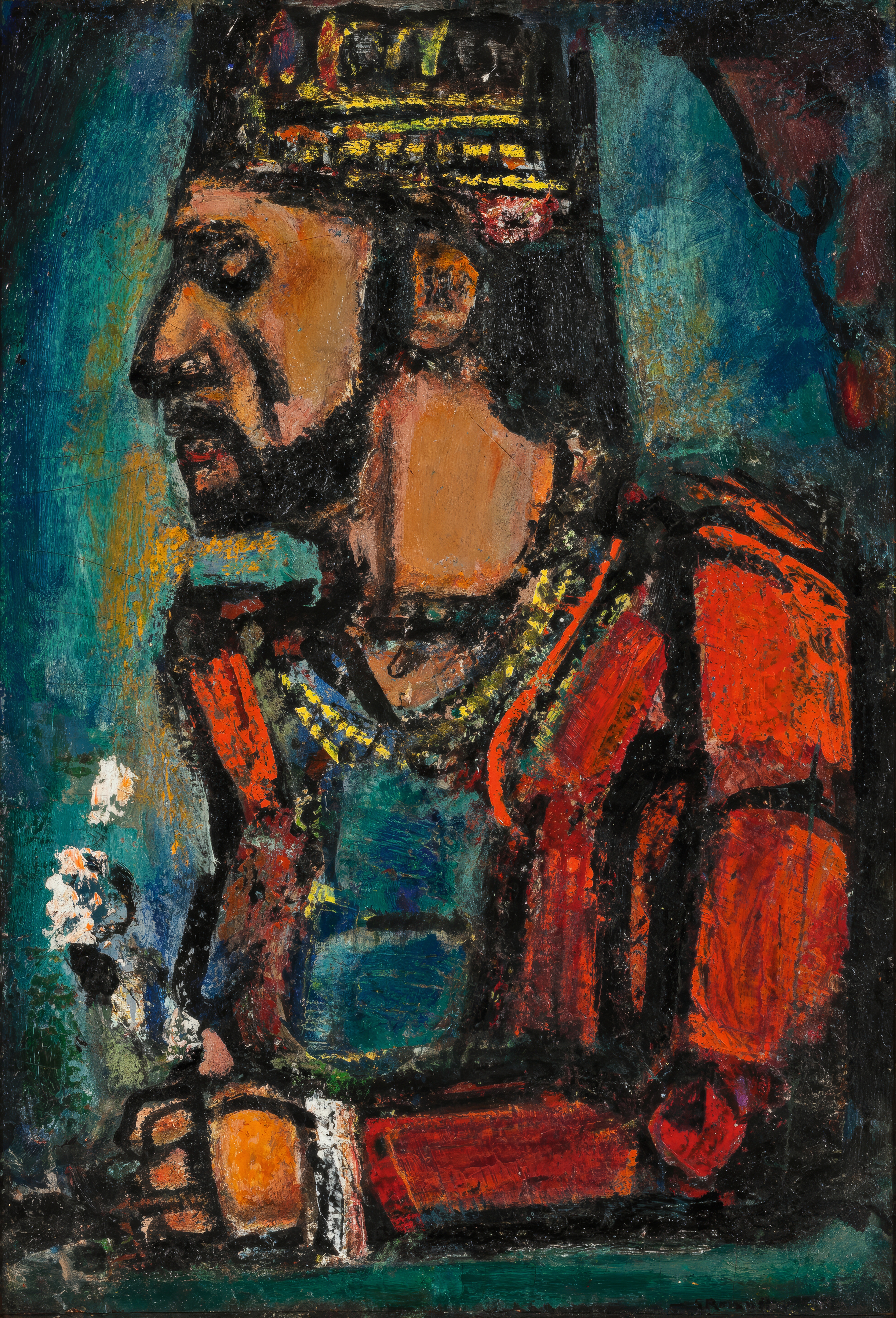
      The old king

      1937 · Oil On Canvas

      In the quiet, heavy atmosphere of Georges Rouault’s 1937 masterpiece, The Old King, one encounters a profound meditation on the human condition. The painting presents a solitary monarch, captured in profile, whose very presence seems to vibrate with an introspective melancholy. Draped in rich, crimson robes that catch the light with a somber intensity, the figure gazes inward, his expression etched with a deep, palpable sadness. This is not merely…

      Jesus on the cross as forgotten there od Georges Rouault
      5

      Jesus on the cross as forgotten there

      Acrylic On Canvas

      Georges Rouault’s “Jesus on the Cross as Forgotten There”: A Descent Into Spiritual Darkness The artwork presents a haunting meditation on faith and suffering, embodied in Georges Rouault's monumental print, "Jesus on the Cross as Forgotten There." Created in 1946 during the Second World War, amidst the pervasive anxieties of occupation and loss, this piece transcends mere depiction; it plunges into the abyss of existential despair, mirroring the artist’s own…

      Femme Affranchie, A Quatorze Heures, Chante Midi od Georges Rouault
      6

      Femme Affranchie, A Quatorze Heures, Chante Midi

      Acrylic

      Georges Rouault’s Femme Affranchie: A Portrait of Resilience Amidst Darkness The Denver Art Museum houses Georges Rouault's “Femme Affranchie, à Quatorze Heures, Chante Midi” (Woman Freed at Noon), a hauntingly beautiful engraving from his seminal Miserere et Guerre series completed in 1923. This artwork transcends mere visual representation; it embodies Rouault’s deeply felt empathy for the vulnerable and his unwavering commitment to exploring profound spiritual themes—a legacy born from witnessing…

      The Judges (1908) od Georges Rouault
      7

      The Judges

      1908 · Oil · Statens Museum for Kunst, Kodaň

      In this 1908 oil painting, three seated figures occupy a shallow, darkened space. The composition is arranged horizontally, with the figures positioned in a way that fills the frame, creating a sense of enclosure. The lighting is low-key, emerging from an indistinct source to illuminate only specific portions of the subjects, such as the pale, ghostly whites of facial features and the edges of clothing. The rest of the scene…

      Hollow dream od Georges Rouault
      8

      Hollow dream

      Oil On Canvas

      The artwork Hollow dream is an oil painting on canvas that presents a portrait of a person, likely male, rendered in an expressionistic style. The composition is a vertical frame that is tightly focused on the head and shoulders, with the subject facing forward and slightly turned toward the viewer's left. The figure fills most of the frame against a dark, undefined background.

      Obrazy umělce Georges Rouault se řadí od 11 do 100

      Bouquet II (1938) od Georges Rouault
      #13

      Bouquet II

      1938

      Georges Rouault: Bouquet II – A Meditation on Suffering and Beauty Georges Rouault’s “Bouquet II,” painted in 1929, stands as a poignant testament to the artist's unwavering commitment…

      Christ od Georges Rouault
      #14

      Christ

      The painting is a portrait of Jesus with his head bowed down. The background features a sky that appears to be blue in color.

      Away the smile of Reims od Georges Rouault
      #15

      Away the smile of Reims

      A single figure occupies the center of the frame, a presence carved from darkness and light. The face is elongated, pulled by invisible forces into a mask of…

      The Three Judges (1928) od Georges Rouault
      #18

      The Three Judges

      1928 · Art Institute of Chicago

      The Three Judges is an oil and gouache work on paper, mounted on cardboard and backed with canvas, created by the French artist Georges Rouault. The piece was…

      Dolls, puppets fire hall and the ''Bride'' od Georges Rouault
      #19

      Dolls, puppets fire hall and the ''Bride''

      The air feels heavy, thick with the scent of old dust and greasepaint. In this claustrophobic corner of a theatrical world, three figures huddle together, their presence casting…

      Legendary Landscape (1935) od Georges Rouault
      #20

      Legendary Landscape

      1935

      The artwork is a vertically oriented oil painting on canvas that presents a stylized, dreamlike landscape. The composition features a simplified architectural structure, possibly a church or monastery,…

      'Man of myrrh' od Georges Rouault
      #22

      'Man of myrrh'

      The artwork presents a somber and emotionally charged scene depicting what appears to be a biblical or allegorical narrative. The composition is centered around a reclining figure, presumably…

      Pierrot (1910) od Georges Rouault
      #24

      Pierrot

      1910

      is a work by the French artist Georges Rouault, executed in 1910. Born in Paris, France, in 1871, Rouault remained connected to his home city until his death…

      Grotesque (1917) od Georges Rouault
      #25

      Grotesque

      1917

      Completed in 1917, Georges Rouault’s Grotesque is a profound exploration of human vulnerability and spiritual resilience. Created against the backdrop of the escalating anxieties of World War I,…

      Crucifixion od Georges Rouault
      #26

      Crucifixion

      The painting depicts a crucifixion scene where the central figure of Jesus Christ is shown on the cross. He is rendered with an elongated torso and contorted limbs,…

      Two Women's Heads (1902) od Georges Rouault
      #27

      Two Women's Heads

      1902

      The painting depicts two women's heads positioned within the frame. On the left side, a woman with long hair is shown looking toward something in front of her,…

      The holy face od Georges Rouault
      #28

      The holy face

      The artwork presents a stylized and emotionally charged depiction of a human face, likely intended to represent Christ or a holy figure. The composition is centered around the…

      Project for the reincarnation of Father Ubu 3 od Georges Rouault
      #29

      Project for the reincarnation of Father Ubu 3

      Georges Rouault's “Project for the Reincarnation of Father Ubu 3” presents not merely a depiction, but an immersion into a world sculpted by anxiety and unsettling satire. This…

      Christ and the Fisherman od Georges Rouault
      #30

      Christ and the Fisherman

      Fine Arts Museums of San Francisco

      Christ and the Fisherman is an oil painting by Georges Rouault. Created in France, the work emerged around 1937. The artist applied oil to paper, which was then…

      Eternally scourged od Georges Rouault
      #31

      Eternally scourged

      In this somber composition, we find ourselves face to face with a figure caught in a moment of profound exhaustion. The subject is positioned slightly off-center, its body…

      King Ubu 1 od Georges Rouault
      #34

      King Ubu 1

      The artwork presents a stylized and somewhat grotesque depiction of a seated figure, identified by the title as King Ubu. The composition is dominated by this central figure,…

      The Superman (1916) od Georges Rouault
      #35

      The Superman

      1916

      In the heavy, somber atmosphere of 1916, as the Great War tore through the heart of Europe, Georges Rouault captured something far more profound than a mere portrait;…

      The Dwarf (1937) od Georges Rouault
      #36

      The Dwarf

      1937 · Art Institute of Chicago

      In this 1937 work, The Dwarf, Georges Rouault presents a figure that occupies the periphery of social visibility. The artist, a Frenchman, turned his attention toward those living…

      Dancer for the Ballets Russes od Georges Rouault
      #37

      Dancer for the Ballets Russes

      Georges Rouault's "Dancer for the Ballets Russes" is a striking portrait that encapsulates the spirit of early 20th-century artistic innovation. Created likely around 1929, this artwork offers a…

      Pierrot 2 od Georges Rouault
      #38

      Pierrot 2

      Georges Rouault's 'Pierrot 2' isn’t merely a depiction of the iconic commedia dell’arte figure; it’s an immersion into a world steeped in sorrow, isolation, and a profound spiritual…

      Twilight or Ile de France od Georges Rouault
      #39

      Twilight or Ile de France

      Georges Rouault’s “Twilight or Ile de France” is a captivating exploration of light, color, and human emotion, firmly rooted in the heart of the Fauvist movement. Painted in…

      Night Fall od Georges Rouault
      #40

      Night Fall

      The artwork presents a stylized and emotionally charged scene depicting figures in what appears to be a coastal or rural setting at night. It carries a somber and…

      '... when the night came. The moon rose' od Georges Rouault
      #41

      '... when the night came. The moon rose'

      In the hauntingly beautiful tableau titled '... when the night came. The moon rose,' Georges Rouault invites us into a world where the boundaries between the physical landscape…

      The blind man sometimes consoles the light od Georges Rouault
      #42

      The blind man sometimes consoles the light

      Georges Rouault's “The Blind Man Sometimes Consoles the Light” is not merely a depiction of two figures; it’s an immersion into a world steeped in sorrow, faith, and…

      Nude with arms raised (combed) od Georges Rouault
      #43

      Nude with arms raised (combed)

      In the quiet, heavy atmosphere of Georges Rouault’s 1937 masterpiece, Nude with Arms Raised (combed), one does not merely observe a figure; one encounters a soul in the…

      Dura Lex Sed Lex od Georges Rouault
      #44

      Dura Lex Sed Lex

      “Dura lex sed lex” – "The law is hard, but it is the law" – this stark and profoundly moving portrait by Georges Rouault transcends a simple depiction…

      Plátna umělce Georges Rouault podle jednotlivých období

      Early 20th Century

      1907 – 1910 · 3 děl v tomto seznamu

      Co nejčastěji maloval Georges Rouault

      Čtyři témata, která se na těchto plátnech nejčastěji objevují, každé s jedním z jejich nejoblíbenějších příkladů.

      Kde visí plátna umělce Georges Rouault

      7 muzea, v nichž je umístěno nejvíce obrazů z této stránky.

      Muzea Město Díla autora Georges Rouault Obrazy z tohoto seznamu
      Art Institute of Chicago, ChicagoArt Institute of Chicago Chicago 2 The Three Judges, The Dwarf
      The Phillips Collection, Washington, D.C.The Phillips Collection Washington, D.C. 3 Verlaine
      Statens Museum for Kunst, KodaňStatens Museum for Kunst Kodaň 1 The Judges
      Fine Arts Museums of San Francisco, San FranciscoFine Arts Museums of San Francisco San Francisco 1 Christ and the Fisherman
      Královské muzeum výtvarného umění Antverpy, AntverpyKrálovské muzeum výtvarného umění Antverpy Antverpy 1 Newspaper Seller
      Národní galerie Kanady, OttawaNárodní galerie Kanady Ottawa 1 Christ on the Cross
      Chimei Museum, TainanChimei Museum Tainan 1 Profile of a Woman

      Dekáda po dekádě: nejuznávanější plátna umělce Georges Rouault

      1. 1900s
        The Judges (1908) od Georges Rouault
        7 z 100

        The Judges

        Věk 29 – 38 · Statens Museum for Kunst

        In this 1908 oil painting, three seated figures occupy a shallow, darkened space. The composition is arranged horizontally, with the figures positioned in a way that fills the…

      2. 1910s
      3. 1920s
        The Three Judges (1928) od Georges Rouault
        18 z 100

        The Three Judges

        Věk 49 – 58 · Art Institute of Chicago

        The Three Judges is an oil and gouache work on paper, mounted on cardboard and backed with canvas, created by the French artist Georges Rouault. The piece was…

      4. 1930s
        The Breton Wedding (1937) od Georges Rouault
        Pořadí 3 z 100

        The Breton Wedding

        Věk 59 – 68

        Georges Rouault’s “The Breton Wedding” is not merely a depiction of a rural ceremony; it's a profound meditation on faith, community, and the quiet dignity of everyday life.…

      Vaše otázky k obrazům autora Georges Rouault, odpovědi

      Který z obrazů autora Georges Rouault je nejuznávanější?Přečtěte si odpověď

      Head of Christ, následovaný dílem Head of Christ 1 a The Breton Wedding (1937).

      Kterých deset obrazů je Georges Rouault nejznámější?Přečtěte si odpověď

      Head of Christ, Head of Christ 1, The Breton Wedding, The old king, Jesus on the cross as forgotten there, Femme Affranchie, A Quatorze Heures, Chante Midi, The Judges, Hollow dream, The Poulot or partner, Red Zone a Landscape from the Bible, Christ and the fishermen. U každého plátna v uvedeném žebříčku je uveden rok jeho vzniku a muzeum, ve kterém se nachází.

      Kolik obrazů autora Georges Rouault je známo?Přečtěte si odpověď

      V našem katalogu je 268 děl umělce Georges Rouault, datovaných od 1902 do 1938.

      Která muzea uchovávají nejznámější plátna umělce Georges Rouault?Přečtěte si odpověď

      Většinou v Art Institute of Chicago (Chicago), The Phillips Collection (Washington, D.C.) a Statens Museum for Kunst (Kodaň); výše uvedený seznam obsahuje názvy jednotlivých muzeí a jejich pláten.

      V jakých letech namaloval Georges Rouault svá nejslavnější plátna?Přečtěte si odpověď

      V období 1900s, které tvoří 5 z 100 děl na této stránce, mezi nimi i The Judges.

      Jaká jsou první a poslední slavná plátna umělce Georges Rouault?Přečtěte si odpověď

      Nejstarší plátno se zde datuje do Two Women's Heads (1902); nejnovější je z Bouquet II (1938).

      Jaká témata se v obrazech umělce Georges Rouault objevují nejčastěji?Přečtěte si odpověď

      Suffering (13), Darkness (11) a Portrait (7) napříč 100 díly na této stránce.

      Čím obvykle maloval/a Georges Rouault?Přečtěte si odpověď

      Oil On Canvas, použito u 11 z 100 děl na této stránce.

      K kterému uměleckému směru patří Georges Rouault?Přečtěte si odpověď

      Fauvism a Expressionism, jak dokazují plátna na této stránce.

      Co mohu vidět od Georges Rouault v Art Institute of Chicago?Přečtěte si odpověď

      Muzeum Art Institute of Chicago, Chicago se vlastní 2 děl z této stránky, mezi nimiž jsou i The Three Judges a The Dwarf.

      Georges Rouault: příběh malíře

      Georges Rouault: A Life Painted in Shadows and Light

      Georges Rouault (27. května 1871 Paříž – 13. února 1958 tamtéž) byl francouzský malíř a grafik, který se často spojuje s fauvizmem a expresionismem. Jeho dílo je charakteristické silnými barvami, temnými obrysy a hlubokým zamyšlením nad lidskou existencí. Rouaultův život byl plný kontrastů – od chudých začátků v Pařížské čtvrti Belleville až po uznání jako významného umělce. Jeho tvorba se vyznačuje silným osobním projevem, často zobrazujícím marginalizované skupiny a lidské utrpení s hlubokým empatickým pohledem.

      Early Years and Artistic Beginnings

      Georges Rouault se narodil v Paříži během turbulentních dnů Pařížské povstání v roce 1871, jeho rodina se musela ukrýt v sklepení. Jeho otec byl pokládkař a matka podporovala jeho zájem o umění. V patnácti letech začal u skláře Georges Hirsche, kde získal zkušenosti s prací s dřevem a barvami, což se později projevilo v charakteristickém stylu jeho obrazů – výrazné černé obrysy a bohaté barvy připomínající vitráže. Jeho raná zkušenost s malováním na sklo ovlivnila jeho pozdější tvorbu, zejména používání kontrastních barev a silných linií. V roce 1891 byl přijat do Pařížské École des Beaux-Arts, kde studoval pod vedením Gustave Moreau, který se stal jeho nejobrázkovějším učitelem. Moreauho vliv je patrný v Rouaultově rané tvorbě, která se vyznačuje symbolizmem a používáním barev, které odrážejí Moreauho estetiku. Po Moreaově smrti v roce 1898 se Rouault stal kurátorem jeho muzea, což ho naučilo cení si umění a jeho významu pro společnost.

      Fauvist Influence and Early Development

      Rouaultův umělecký vývoj nebyl lineární. I když byl ovlivněn symbolisty, brzy se zapojil do fauvizmu, hnutí, které se vyznačovalo používáním jasných, nezkreslených barev a spontánním stylem. Spolupracoval s dalšími fauvisty, jako byli Henri Matisse a Albert Marquet, a účastnil se výstavních akcí. Nicméně, Rouaultův temperament byl spíše melancholický a introspektivní než čistě estetické prozkoumávání svých současníků. Fauvizm mu poskytl základní nástroje, ale brzy je překonal, přidávaje k nim hlubší emocionální náboj a zamyšlení nad lidskou existencí. Jeho obrazy začaly zobrazovat témata, která se často ignorovala nebo považována za nevhodná pro umělecké dílo – pouliční zločince, prostitutky, soudce a vězněné. Tyto postavy nebyly jen portréty marginalizovaných skupin; byly alegoriemi lidské existence, zkoumáním hříchu, odpuštění a inherentní důstojnosti v utrpení.

      The *Miserere* Cycle and Spiritual Depth

      První světová válka měla zásadní dopad na Rouaultův život a jeho umělecké myšlení. Ztratil mnoho přátel a byl svědkem hrůz války, což vedlo k prohloubení jeho duchovního hledání a morálnímu základu jeho tvorby. V této době se rozhodl věnovat se především osobním projektům, zejména cyklu *Miserere* – monumentální sérii leptů inspirovaných Psałmy (Žalmami). Tyto obrazy, vytvořené po více než deset let, jsou považovány za jeho nejvýznamnější a nejdůvěrnější dílo. Rouault se snažil zachytit nejen vizuální podobu utrpení, ale i jeho podstatu a emocionální dopad. Jeho leptání byla pečlivě promyšlená a vyjadřovala hluboké duchovní přesvědčení.

      Mature Period and Legacy

      V posledních letech svého života se Rouault soustředil na obrazy lidských tváří, zobrazení utrpení Krista a krajin. Jeho tvorba v tomto období získala klidnější a barevnější charakter, což naznačuje harmonii a duchovní rovnováhu. Jeho poslední díla jsou často velmi zjednodušená, téměř abstraktní, ale stále vyjadřují silný emocionální náboj. Rouault se pokusil o dokonalost ve svém umění, což ho vedlo k zničení přibližně 300 obrazů – čin, který odráží jeho intenzivní kreativní proces a neochvějné oddanosti svému uměleckému vizi. Georges Rouault zemřel v Paříži v roce 1958 a zanechal po sobě dílo, které rezonuje s lidmi dodnes – důkaz toho, že umění může být zdrojem empatie, víry a hlubokého pochopení lidské duše.

      Všechna díla od Georges Rouault: 268 →