Ateliér — Doprava po celém světě zdarma — Dodání za 2–6 týdnů
      Henry Scott Tuke, 1858 – 1929

      Henry Scott Tuke's 100 Most Famous Paintings

      The Critics (1927) is the painting Henry Scott Tuke is best remembered for. Morning splendour (1921) and Summer Dreams (sketch) complete the trio of best-loved canvases. Our catalogue counts 204 works by Henry Scott Tuke. Here are the 100 most famous, with the year, the museum and the story of each canvas.

      Seřazeno podle našeho skóre popularity, které kombinuje počet vyhledávání, návštěv a objednávek u každého díla. Aktualizováno říjen 2026. Each painting on this page can be ordered as an oil reproduction painted by hand on linen canvas, or as a fine art print, made to the size you choose.

      Portrét Henry Scott Tuke
      Henry Scott Tuke · 1858 – 1929
      Narozen · zemřel
      1858 – 1929, York
      Směr
      Impressionism
      Díla v našem katalogu
      204
      Nejslavnější
      The Critics (1927)
      Nejvíce děl v
      Royal Cornwall Polytechnic Society

      The ten best-loved paintings by Henry Scott Tuke

      The Critics (1927) od Henry Scott Tuke
      1

      The Critics

      1927 · Oil

      In this 1927 work, we find ourselves on the shores of Falmouth, caught in a quiet, luminous afternoon. The scene is one of profound stillness, where the heat of the sun seems to settle heavily upon the sand. Two young men recline on the beach, their backs to us, anchored by the sheer weight of their relaxation. They gaze toward the horizon, lost in a shared moment of repose. From…

      Morning splendour (1921) od Henry Scott Tuke
      2

      Morning splendour

      1921 · Oil On Canvas

      “Morning Splendour,” painted in 1921 by the esteemed English artist Henry Scott Tuke, is a captivating depiction of youthful exuberance and seaside tranquility. This artwork transports viewers to a sun-drenched coastal scene where figures engage in leisurely activities – swimming, rowing, and simply enjoying the warmth of the morning light. More than just a picturesque view, "Morning Splendour" embodies Tuke's signature style and offers a window into early 20th-century British…

      Summer Dreams (sketch) od Henry Scott Tuke
      3

      Summer Dreams (sketch)

      Oil On Panel

      Summer Dreams (sketch) is an oil on panel work by Henry Scott Tuke. This piece is categorized as a sketch, capturing a specific moment of repose. The artist, Henry Scott Tuke, was a British painter known for his figurative works and his ability to render the human form within natural settings.

      Nude Boy on Rocks (1907) od Henry Scott Tuke
      4

      Nude Boy on Rocks

      1907 · Oil On Canvas

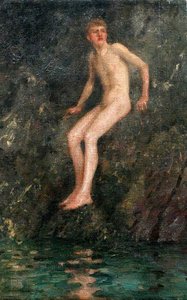
      Nude Boy on Rocks is an oil on canvas painting created by Henry Scott Tuke in 1907. The work depicts a single nude boy positioned upon rocks situated within a body of water. The subject is seated in a natural setting, appearing to look toward something located off-camera. This posture leaves the figure exposed to the elements of the coastal environment.

      Green and Gold (1920) od Henry Scott Tuke
      5

      Green and Gold

      1920 · Oil On Canvas

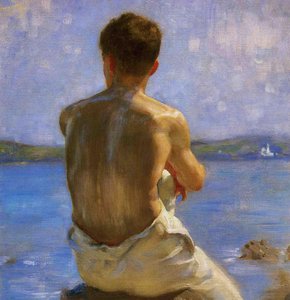
      In the gentle embrace of Henry Scott Tuke’s 1920 masterpiece, "Green and Gold," the viewer is invited to step away from the frantic pace of modern life and into a realm of profound stillness. The painting presents a scene of quiet contemplation, centered around a solitary figure seated upon rugged rocks at the water's edge. With his back turned toward us, the man becomes an avatar for the viewer’s own…

      Reefing the Mainsail (sketch) (1903) od Henry Scott Tuke
      6

      Reefing the Mainsail (sketch)

      1903 · Oil

      The sea is never still, and here, the water churns in restless, muted blues and browns. A small fishing boat tosses upon the waves, caught in a moment of heavy labor under a thick, overcast sky. Onboard, a fisherman and a young boy move with the rhythmic necessity of those who live by the tides. They are focused on the task at hand, perhaps repairing equipment or securing the vessel…

      A Holiday (1914) od Henry Scott Tuke
      10

      A Holiday

      1914

      The painting "A Holiday" by Henry Scott Tuke is a stunning watercolour piece created in 1914. This artwork showcases the artist's ability to capture the beauty of the human form and the serenity of a seaside setting. As seen on AllPaintingsStore.com, this painting is a testament to Tuke's skill in depicting the male figure in a natural and unobtrusive manner. Artistic Style and Influences Tuke's work was influenced by the…

      Henry Scott Tuke: canvases 11 to 100 of the ranking

      A Bathing Group (1914) od Henry Scott Tuke
      #17

      A Bathing Group

      1914 · Royal Academy of Arts

      is an oil on canvas painting by Henry Scott Tuke, executed in 1914. The work captures two young adult males positioned upon a sunlit, rocky shore. This landscape,…

      Order this canvas →
      Lord Ronald Sutherland Gower (1897) od Henry Scott Tuke
      #27

      Lord Ronald Sutherland Gower

      1897 · National Portrait Gallery

      Henry Scott Tuke’s 1897 painting, “Lord Ronald Sutherland Gower,” isn't merely a likeness; it’s a carefully constructed tableau of late Victorian society. The subject himself, Lord Ronald Charles…

      Have it painted by hand →
      A sailor's yarn (1887) od Henry Scott Tuke
      #44

      A sailor's yarn

      1887 · Art Gallery of New South Wales

      The oil painting titled A sailor's yarn is a work by the artist Henry Scott Tuke. This piece is also identified by the name Crotos. It was executed…

      Have it painted by hand →
      Mrs Florence Humphris (1892) od Henry Scott Tuke
      #45

      Mrs Florence Humphris

      1892 · Tate Gallery

      Henry Scott Tuke's “Mrs Florence Humphris,” painted in 1892, is more than just a portrait; it’s a carefully constructed tableau of Victorian sensibility and subtle emotional depth. The…

      Have it painted by hand →
      Hermes at The Pool (sketch) (1900) od Henry Scott Tuke
      #47

      Hermes at The Pool (sketch)

      1900 · Royal Cornwall Polytechnic Society

      The sun hangs heavy over a rugged, rocky landscape, casting a warm glow upon a solitary figure. A naked man sits by the edge of the water, his…

      Order this canvas →

      Henry Scott Tuke's canvases, period by period

      What Henry Scott Tuke painted most

      The four subjects that return most often on these canvases, each with its best-loved example.

      Where Henry Scott Tuke's canvases hang

      8 muzea, v nichž je umístěno nejvíce obrazů z této stránky.

      Muzea Město Díla autora Henry Scott Tuke Obrazy z tohoto seznamu
      Royal Cornwall Polytechnic Society, FalmouthRoyal Cornwall Polytechnic Society Falmouth 4 Hermes at The Pool (sketch), Jack Rolling
      Royal Academy of Arts, LondýnRoyal Academy of Arts Londýn 2 A Bathing Group
      Penlee House, PenzancePenlee House Penzance 1 Dinner Time Ambrose Rouffignac in the Sail Loft
      National Portrait Gallery, LondýnNational Portrait Gallery Londýn 1 Lord Ronald Sutherland Gower
      Yale Center for British Art, New HavenYale Center for British Art New Haven 1 Portrait of a Young Man with Open Collar
      Bavarské státní sbírky malby, MnichovBavarské státní sbírky malby Mnichov 1 Sailors playing cards
      Leeds Art Gallery, LeedsLeeds Art Gallery Leeds 1 The bathers
      Dublin City Gallery The Hugh Lane, DublinDublin City Gallery The Hugh Lane Dublin 1 The sun worshipper (In the morning sun)

      Henry Scott Tuke's most famous canvas, decade after decade

      1. 1870s
      2. 1880s
        Nude Boy (1881) od Henry Scott Tuke
        Ranked 8 of 100

        Nude Boy

        Věk 22 – 31
      3. 1890s
        In Tow (1893) od Henry Scott Tuke
        14 of 100

        In Tow

        Věk 32 – 41
      4. 1900s
        Nude Boy on Rocks (1907) od Henry Scott Tuke
        Canvas 4 of 100

        Nude Boy on Rocks

        Věk 42 – 51

        Nude Boy on Rocks is an oil on canvas painting created by Henry Scott Tuke in 1907. The work depicts a single nude boy positioned upon rocks situated…

      5. 1910s
      6. 1920s
        The Critics (1927) od Henry Scott Tuke
        Ranked 1 of 100

        The Critics

        Věk 62 – 71

        In this 1927 work, we find ourselves on the shores of Falmouth, caught in a quiet, luminous afternoon. The scene is one of profound stillness, where the heat…

      Henry Scott Tuke's canvases, question by question

      Which canvas is Henry Scott Tuke most remembered for?Read the answer

      The Critics (1927), followed by Morning splendour (1921) and Summer Dreams (sketch).

      The Critics: how old was Henry Scott Tuke when it was painted?Read the answer

      Henry Scott Tuke, born in 1858, was 69 years old: The Critics dates from 1927.

      What are Henry Scott Tuke's ten most famous canvases?Read the answer

      The Critics, Morning splendour, Summer Dreams (sketch), Nude Boy on Rocks, Green and Gold, Reefing the Mainsail (sketch), Under the Western Sun, Nude Boy, Dinner Time Ambrose Rouffignac in the Sail Loft a A Holiday. Each canvas in the ranking above comes with its year and its museum.

      How many paintings did Henry Scott Tuke create?Read the answer

      204 works by Henry Scott Tuke are in our catalogue, dated 1877 to 1927.

      Where do Henry Scott Tuke's most famous canvases hang today?Read the answer

      Mostly in Royal Cornwall Polytechnic Society (Falmouth), Royal Academy of Arts (Londýn) a Penlee House (Penzance); the list above names each museum and its canvases.

      When did Henry Scott Tuke paint the most famous canvases?Read the answer

      In 1880s, which gave 33 of the 100 works on this page, Nude Boy among them.

      Which famous Henry Scott Tuke canvas came first, and which came last?Read the answer

      The earliest canvas here is Portrait of a Youth (1877); the latest is The Critics (1927).

      Which subjects did Henry Scott Tuke paint most?Read the answer

      People (4), Water (4) a Landscape (4), across the 100 works on this page.

      Which medium appears most in Henry Scott Tuke's paintings?Read the answer

      Oil On Canvas, used in 8 of the 100 works on this page.

      Which movement is Henry Scott Tuke associated with?Read the answer

      Impressionism, as the canvases on this page show.

      Which paintings by Henry Scott Tuke are held by the Royal Cornwall Polytechnic Society?Read the answer

      The Royal Cornwall Polytechnic Society, Falmouth holds 2 of the works on this page, among them Hermes at The Pool (sketch) a Jack Rolling.

      Where can I buy a reproduction of a Henry Scott Tuke painting?Read the answer

      Yes. Every painting on this page can be ordered from its own page as an oil reproduction painted by hand, or as a fine art print, in the size you choose.

      Meet the painter: Henry Scott Tuke

      Raný život, rodina a vzdělání

      Henry Scott Tuke se narodil 12. června 1858 v Lawrence Street ve Yorku. Vyrostl v významné kvakerské rodině. Jeho otec, Daniel Hack Tuke, pracoval jako lékař se specializací na psychiatrii. Už od útlulí byl Henry Scott Tuke povzbuzován k tomu, aby vzal do rukou štětec a začal objevovat svět kresby a malby. Tyto rané sklonění k umění zásadně formovalo jeho budoucí cestu dávno předtím, než podstoupil formální výuku.

      V roce 1874 jej stěhování do Londýna dovedlo na Slade School of Art. Zde studoval pod vedením Alphonse Legros a sir Edward Poynter. Jeho období strávené na škole Slade bylo charakterizováno neustálým rozvojem technických dovedností. Do roku 1877 získal stipendium, což mu umožnilo pokračovat ve studiu na této prestižní škole a v roce 1880 se vydat na cestu do Itálie.

      Umělecký rozvoj v Paříži a Itálii

      Po prvotním výcviku v Londýně se Henry Scott Tuke vydal na evropský kontinent, přičemž v letech 1880 až 1881 putoval po Itálii. Tato studijní perioada mu položila pevné základy, než se v roce 1881 dostal do Paříže. Ve francouzské metropoli zůstal až do roku 1883, v době, kdy se atmosféra města začala zásadně ovlivňovat jeho přístup k práci se světlem a malbě v exteriéru. Během těchto let studoval pod vedením francouzského historického malíře Jean-Paul Laurens.

      Bydlením v Paříži Henry Scott Tuke navštívil i Jules Bastien-Lepage. Právě toto setkání ho motivovalo k tomu, aby si vzal svůj stojan a vyšel ven, aby mohl praktikovat malbu en plein air. Tento posun směrem k malování přímo z přírody zcela změnil způsob, jakým vnímal svět kolem sebe. Během svého pobytu v metropoli se jeho cesty zkřížily také s americkým malířem John Singer Sargent. Tyto náhodné setkání i lekce learnedé v pařížských ateliérosch mu pomohly zdokonalit jeho techniku a prohloubit pochopení toho, jak světlo interaguje se svým tématem.

      Život a dílo v Newnlu a Falmouthu

      Po strávěné době ve Francii se Henry Scott Tuke přesunul k pobřeží Cornwallu, aby se stal součástí školy Newlyn. Tato skupina umělců upřednostňovala přímočarost malování en plein air a usilovala o zachycení atmosféry pobřeží v jejích nejčistších, okamžitých podobách. Do roku 1885 se usadil v rybářském přístavu Falmouth, kde se světlo a místní obyczaje vesnice staly nedílnou kulisou jeho každodenního života. Dokonce si pořídil rybářskou loď a proměnil ji v plovoucí studio – prostor, kde mohl tvořit svobodně, daleko od tradičních omezení klasických ateliérů na souši.

      Moře bylo v jeho životě neustálou přítomností. Právě v Falmouthu byl seznámen s tradicí koupání v moři nago, což je návyk, který si zachoval až do hlubokého stáří. Tento hluboký vztah k vodě a fyzické realitě pobřeží zásadně formoval jeho okolí i vnímání světa. Žil mezi rybáři v nádech slaného vzduchu a našel svou vlastní, hlubokou identitu v drsné a neukázněné krajině Cornwallu.

      Technika a umělecký styl

      Henry Scott Tuke ovládal štělec s neobvyklým dvojvým cílem. Dokázal totiž mistrovsky propojit volné, neustále hledající světlo tahy impresionismu s disciplinovanými a strukturovanými základy akademické techniky. Tento přístup mu umožnil zachytit způsob, jakým se sluneční záře dotýká kůže nebo hladiny vody, aniž by přitom ztratil pevný tvar svých postav. Byl figurativním malířem, který hluboce rozuměl váze a hmotnosti lidského těla, a přesto se často snažil tuto váhu rozplynout v atmosféře otevřeného prostoru. Čas strávený v Paříži mu naučil hodnotu malování en plein air, což se stalo zvykem, který definoval jeho pozdější roky v Cornwallu.

      Jeho vnímavost však nebyla ohraničena pouze plátnem. Jako fotograf disponoval ostrým citem pro světlo a kompozici, což nesmírně obohatilo jeho malířské dílo. Tato technická preciznost se promítla i do jeho námořnických motivů. Tuke byl uznávaným námořním umělcem, schopným vykreslit specifické textury plavidel a neustálý pohyb moře. Ať už se soustředil na anatomii mladého muže, nebo na lana a rigging lodi, jeho práce zůstávala hluboce zakotvena v přímé observaci fyzického světa.

      Způsob, jakým pracoval s barvou, často odrážel proměnlivé podmínky pobřeží. Hledal pravdu v přirozeném světle a často pracoval na volné prostranství, aby zachytil specifickou čistotu letního odpoledne. Tento neustálý důraz na světlo a lidskou formu se stal jeho primárním způsobem vidění světa.

      Klíčová díla a témata

      Henry Scott Tuke často zaměřoval svůj pohled na lidskou postavu v její nejpřirozenější podobě. Většinu svého času věnoval malování nahých chlapců a mladých mužů, které často umisťoval do drsných, neuspěchaných krajin pobřeží. Tyto postavy málokdy stojí v pózách pro formální portrét; místo toho je vidíme plavat nebo rybařit, někdy osaměle a někdy v malých skupinách. Mnoho z těchto postav se objevuje na lodích nebo podél pobřežního pásu, přičemž jejich kůže zachycuje neustálé světlo otevřeného prostoru.

      Jeho dílo často zachycuje pocit tiché aktivity. Můžete v něm spatřit mladíka uprostřed plavby nebo skupinu námořníků odpočívających u vody. Středem zájmu zůstává interakce mezi tělem a živly – solí, sluncem a mořem. Jedna z jeho nejuznávanějších obrazů, August Blue (cca 1893–94), ukazuje tuto fascinaci světlem a mladistvou formou způsobem, který definoval velkou část jeho tvorby.

      Kde dnes spatřit jeho díla

      Pokud hledáte jeho obrazy, cesty vás často povedou do významných londýnských institucí. Tate Gallery uchovává několik jeho děl, zatímco National Portrait Gallery v sobě nese jeho portréty. Tyto sbírky představují fascinující okno do jeho světa, které nám umožňují spatřit, jak skrze jeho specifický pohled zachytil hru světla na lidské kůži a neustálý pohyb mořských vln.

      V Cornwallu je jeho přítomnost cítit prostřednictvím místních sbírek, které hluboce odrážejí jeho neodmyslitelnou vazbu k pobřeží. Penlee House v Penzance skrývá díla, která svědectví o jeho letech strávených v tomto regionu. Jeho umění lze také nalézt v rámci Royal Cornwall Polytechnic Society ve Falmouthu. Tato místa udržují jeho studie lidské postavy a námořnického života v těsné blízkosti prostředí, které je kdysi inspirovalo.

      Všechna díla od Henry Scott Tuke: 204 →