

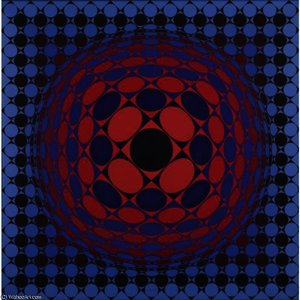
Bivega je obraz, podle kterého je nejznámější Victor Vasarely. Quadrature a ORION-MC doplňují trio nejoblíbenějších pláten. Náš katalog obsahuje 776 děl umělce Victor Vasarely. Zde je 100 nejznámějších děl včetně roku vzniku, muzea a příběhu každého plátna.
Seřazeno podle našeho skóre popularity, které kombinuje počet vyhledávání, návštěv a objednávek u každého díla. Aktualizováno říjen 2026.


Victor Vasarely's *Quadrature* isn't merely a painting; it’s an invitation – an invitation to question the very nature of visual reality. Created by a visionary who anticipated the digital age, this work embodies the core tenets of Op Art, a movement that sought to manipulate perception through carefully constructed geometric forms and vibrant color fields. Painted in 1960s, *Quadrature* showcases Vasarely’s mastery of optical illusion, transforming two dynamic spheres into…

Victor Vasarely's ORION-MC is not merely a painting; it’s an invitation to experience the world through a radically altered lens. This captivating work, rendered in a vibrant palette of red, yellow, green, blue, purple, orange, and black, exemplifies the core tenets of Op Art – Optical Art – pioneered by Vasarely himself. Born Károly Vaszary in 1906 in Pécs, Croatia, his artistic trajectory began with an unexpected detour into medicine…

The artwork titled Zebras (white on black) was created by the artist Victor Vasarely. This piece features two zebras positioned against a black background. The composition includes smaller figures of animals in the background, such as two birds and three additional zebras, which contribute to the depth of the image. The visual structure utilizes geometric shapes and patterns to form the figures.

Vega-Wa-3: A Dance of Geometric Illusion Victor Vasarely’s “Vega-Wa-3” isn't merely a painting; it’s an invitation to experience visual perception in a radically new way. Created in 1968, this striking artwork embodies the spirit of Op Art – Optical Art – a movement that sought to challenge our senses and explore the subconscious through controlled patterns of color and form. The image itself depicts a deceptively simple composition: concentric circles…

To stand before Victor Vasarely’s Kaglo II is to enter a realm where the boundaries between the static and the kinetic dissolve into a rhythmic dance of light and color. Created in 1986, this masterful print serves as a profound testament to the enduring power of geometric abstraction. At first glance, the eye is drawn to a central, commanding red sphere, which acts as the sun within a private cosmos.…

Victor Vasarely’s *Vega 1* isn't merely a painting; it’s an invitation. An invitation to step outside the confines of traditional representation and into a world governed by perception itself. Born in 1906 in Pécs, Croatia – then part of Austria-Hungary – Vasarely’s artistic trajectory was initially rooted in medicine before he decisively embraced the burgeoning field of visual abstraction. This pivotal shift, fueled by his studies at the Podolini-Volkmann Academy…

Victor Vasarely’s “NB 22 Caope” is more than just an abstract painting; it's a meticulously crafted portal into the heart of Op Art, a movement that sought to redefine our perception of reality. This striking work, dominated by a precisely arranged grid of black and white circles, exemplifies Vasarely’s pioneering approach to visual illusion – a technique he developed with mathematical rigor and an almost obsessive attention to detail. The…

To stand before a work by Victor Vasarely is not merely to observe paint on canvas; it is to engage in a sophisticated dialogue with perception itself. This piece, characterized by its vibrant, almost pulsating geometric network, draws the viewer into a mesmerizing optical labyrinth. It speaks directly to the intellectual curiosity of the modern collector and the design sensibility of those who appreciate art as an architectural element. The…

To stand before Harmas is to step directly into the mind of its creator, Victor Vasarely. This piece is not merely an arrangement of color and pattern; it is a vibrant intellectual puzzle, a visual meditation on structure itself. The eye is immediately drawn into the intricate dance between the bold red checks and the myriad small circles that populate the background. It possesses the undeniable energy characteristic of Op…

Victor Vasarely's Pal-Ket, painted in 1974, isn’t merely a visual experience; it’s an invitation to reconsider the very nature of perception. This vibrant acrylic on canvas piece, measuring…

Victor Vasarely's "Vonal-2" is more than just a colorful pattern; it’s a meticulously crafted portal into the heart of Op Art and a testament to the revolutionary ideas…

In this 1957 work, titled Vega II, Victor Vasarely explores the fundamental mechanics of sight. The piece is a purely abstract composition, eschewing any recognizable subject matter in…

To stand before Victor Vasarely's Axo 99 is not merely to observe a painting; it is to engage in a visual dialogue with the very mechanics of sight…

Victor Vasarely's “Abstract Composition 9” is more than just a painting; it’s an invitation to experience the world through the lens of perception itself. Created by one of…

The artwork titled Zebras was created by the artist Victor Vasarely. This piece, dated 1938, emerged from a period of intense graphic experimentation. It is considered one of…

To encounter Victor Vasarely’s Kezdi-Ga is to step away from the stillness of traditional viewing and enter a realm where the canvas breathes, pulses, and vibrates with an…

Victor Vasarely’s ‘SIR-RIS,’ a captivating sculpture rendered in meticulous black and white, stands as a cornerstone of Op Art – a movement that fundamentally challenged our understanding of…

To stand before Victor Vasarely’s "Torony-Nagy" is not merely to observe paint on canvas; it is to engage in a sophisticated dialogue with perception itself. This vibrant 1969…

Victor Vasarely's 'Quasar' is not merely a painting; it’s an invitation into the very fabric of perception, a testament to the revolutionary impact of Op Art and the…

To stand before Victor Vasarely's Zett-Ka is not merely to observe a painting; it is to step into a meticulously constructed optical puzzle. This masterful piece, a quintessential…

Victor Vasarely's "Vega-Kontosh-Va" is not merely a painting; it’s an invitation to experience the world through a radically altered lens. This vibrant composition, dominated by a pulsating red…

We are looking at Vèga 3, a significant work by the artist Victor Vasarely. Created about 1968, this piece belongs to the Op Art movement, a style that…

Zoeld V, 1967 – A Geometric Revelation Victor Vasarely’s “Zoeld V” stands as a cornerstone of Op Art—a movement that revolutionized visual perception in the mid-20th century and…

Victor Vasarely: Pionýr Op Art és Szerződés Érzése Egy Központi Tárlatképen A Victor Vasarely (1906–1997) által alkotott „Abstract Composition 22” egy lenyűgöző műalkotás, amely megmutatja az Op Art…

Sir-Ris: A Geometric Symphony of Perception Victor Vasarely’s “SIR-RIS” is more than just a painting; it's an invitation into a realm where visual perception bends and dances, embodying…

In the realm of Op Art, few works capture the hypnotic essence of visual disruption as masterfully as Victor Vasarely’s Zebras (full body white on blue-black). This striking…

Victor Vasarely's "Kezdi-All," a captivating exploration of optical illusion and geometric abstraction, stands as a cornerstone of Op Art – a movement that fundamentally challenged our understanding of…

To stand before Harmas is to step directly into the mind of its creator, Victor Vasarely. This piece is not merely an arrangement of color and pattern; it…

To encounter Victor Vasarely’s 1951 masterpiece, “Terek,” is to step away from the static world of traditional representation and enter a realm where the canvas itself seems to…

To stand before this piece is to step through a portal built entirely of color and calculated form. It is an immediate confrontation with perception itself. The composition,…

To encounter Victor Vasarely's 'Folklore' is to step away from the stillness of traditional viewing and enter a realm where the canvas begins to breathe, pulse, and vibrate…

Victor Vasarely’s “O N D - I I - V A” is more than just a painting; it's an invitation to experience the world through a radically altered…

The artwork is a grid-based abstract composition dominated by concentric circles of varying sizes and shades of red and green. It presents a highly geometric and symmetrical design,…

Victor Vasarely's "F-VERT-BLEU" is not merely a puzzle; it’s a meticulously crafted portal into the heart of Op Art, a movement that fundamentally altered our perception of space…

Victor Vasarely: Pioneer of Geometric Abstraction and the Birth of Op Art Victor Vasarely (1906-1997), born Károly Vaszary in Pécs, Hungary – now Croatia – embarked on an…

The painting Dia-Tuz-Neg is a blue and white composition characterized by a circular pattern. At the center of the work, a large circle is prominently featured, surrounded by…

Victor Vasarely’s “Caopeo” isn’t merely a painting; it’s an invitation, a carefully constructed illusion designed to challenge and delight the viewer. Created in 1962, this seminal work exemplifies…

Sorata-T is a painted glass triptych executed in 1953. The work is composed of three panels:

The artwork Triond features three colorful balls presented in various shades of blue, purple, pink, and green. These spheres are arranged in a triangular formation, with one ball…

Step closer to observe how the eye begins to move across the surface of Domb-B. At first glance, your attention is drawn to that central blue and yellow…

VP-115 by Victor Vasarely exists as a precise study in the mechanics of sight. The work operates through a calculated arrangement of geometric shapes, specifically a sphere and…

Victor Vasarely's 'Jong,' completed in 1968, is more than just an image; it’s an invitation to question the very nature of reality. This arresting work, a cornerstone of…

The artwork consists of four circles arranged in a square configuration. Each circle is assigned a specific color: blue, orange, yellow, and purple. These shapes are positioned at…

To encounter Victor Vasarely’s “Obor” is to step away from the stillness of traditional viewing and enter a realm where the canvas itself seems to breathe, pulse, and…

Ion-DR: A Geometric Symphony of Color and Illusion Victor Vasarely’s *Ion-DR*, painted in 1967, stands as a cornerstone of Op Art – Optical Art – a movement that…

A Dance of Circles on Crimson: Exploring Victor Vasarely's "Untitled 16" Victor Vasarely, a name synonymous with Op Art and kinetic abstraction, gifted the world a visual language…

Tridem K – A Geometric Revelation by Victor Vasarely Victor Vasarely (1906-1997) stands as an undisputed titan of Op Art, a movement that revolutionized visual perception in the…

The artwork Louisiana features a symmetrical, circular design composed of numerous small, overlapping circles in varying shades of red, orange, and brown. A blue grid subtly underlies the…

A Symphony of Geometry: Exploring Victor Vasarely's "Sikra-Z" Victor Vasarely, a name synonymous with Op Art and kinetic art, dedicated his life to unraveling the mysteries of perception…

Victor Vasarely: A Dynamic Exploration of Optical Illusion in "Kalota-MC" Victor Vasarely představuje klíčovou osobnost oblasti Op Art a kinetického umění. Jeho umělecká cesta překročila tradiční malování tím,…

Victor Vasarely (1906 – 1997), narozený Győző Vásárhelyi v Pécsi, dnes Chorvatsku, byl českým-maďarským umělcem uznávaným jako „dědečkem“ a vůdcem pohybů Op Art a kinetického umění. Jeho život…

Quadrature ''X'' – A Geometric Dance of Color Kvadratura „X“ představuje fascinující dílo Viktora Vasarelyho, jednoho z nejvýznamnějších představitelů pohybového umění a estetiky Op Art. Tento obraz není…

A Dance of Light and Geometry: Unveiling Victor Vasarely’s “Untitled 18” Victor Vasarely's "Untitled 18" isn’t merely a painting; it’s an invitation to step into a world where…

Victor Vasarely (1906 – 1997) byl maďarský francouzský umělec, který je široce uznáván jako „dědeček“ a vůdce proudu Op art. Jeho dílo „Nobel IV“, vytvořené v roce 1983,…

KALOTA T is an artwork created by the artist Victor Vasarely. Born in 1906 and passing away in 1997, the French/Hungarian artist developed a visual language centered on…

Victor Vasarely's "Sikra," painted in 1966, is more than just a colorful composition; it’s a meticulously crafted portal into the heart of Op Art and a testament to…

Victor Vasarely's "Dia-Or" is not merely a painting; it’s an invitation into the very fabric of perception. This captivating work, rendered in oil with meticulous attention to detail,…

To encounter Victor Vasarely's “Mahn” is to step into a realm where the canvas ceases to be a static surface and begins to breathe, pulse, and vibrate with…

Viktor Vasarely: Cheyt - L – A Geometric Dance of Color Victor Vasarely’s “Cheyt - L” stands as a testament to the revolutionary spirit of Op Art, an…

To encounter Victor Vasarely’s Caribe Negatif is to step away from the stillness of traditional viewing and enter a realm where the canvas breathes, vibrates, and dances before…

To encounter Victor Vasarely's “Tomor” is to step away from the static world of traditional imagery and enter a realm where the canvas itself seems to breathe, pulse,…

Victor Vasarely's Rhombus-B is more than just a painting; it’s an invitation to question the very nature of visual perception. Created by one of the foremost figures in…

Victor Vasarely's "Sreeh" is more than just a painting; it’s an invitation into the heart of Op Art, a visual exploration of perception itself. This striking work, dominated…

Victor Vasarely's "Hetta," a deceptively simple composition of four vibrant circles – red, orange, green, and blue – is far more than just an abstract arrangement. It’s a…

Victor Vasarely's *Opus 2604* is not merely a painting; it’s an invitation to question the very nature of visual reality. This mesmerizing work, dominated by a vibrant blue…

This vibrant artwork, designated VY-47-C, is a captivating embodiment of Victor Vasarely's groundbreaking contributions to Op Art and his pioneering exploration of geometric abstraction. Executed with a masterful…

Viktor Vasarelyho Vega-EG – geometrická abstrakce jako iluze pohybu Viktor Vasarelyho dílo Vega-EG je fascinující ukázkou Op Art stylu, který vznikl v letech 50. a 60. let minulého…

Guimen – Výraz geometrického principu percepce Victor Vasarely (1906–1997) byl maďarský francouzský umělec, který je široce uznáván jako „dědeček“ a vůdce pohybů Op Art a kinetického umění. Jeho…

Victor Vasarely's "Molnar" is more than just a painting; it’s an invitation into the mesmerizing world of Op Art, a realm where perception itself becomes the subject. This…

Victor Vasarely's Folkokta is more than just a colorful arrangement of squares; it’s a meticulously crafted portal into the heart of Op Art and a testament to the…

Viktor Vasarely (1906–1997), jedan od najvažnijih umetnika druge polovine XX века, био је човек koji je revolucionarno изменио начин посматрања света и уметности. Рођен у Печу, Аустроугарској, данас…


Victor Vasarely's "Andromeda" isn't merely a painting; it’s an invitation into a realm where perception itself becomes the subject. This striking composition, dominated by a meticulously rendered geometric…

Významná geometrická abstrakce Viktora Vasarelyho – „Planetary Folklore Participations No. 1“ Victor Vasarely (1906–1997), francouzský umělec narozený v Maďarsku, je jednou z nejvýraznějších postav Op Artu a kinetického…
Victor Vasarely's "Versakk" is not merely a painting; it’s an invitation, a carefully constructed illusion that challenges our very perception of space and form. Created by the Hungarian…

Victor Vasarely's DVA-DVA is more than just a colorful square; it’s a meticulously crafted portal into the heart of Op Art and a testament to the revolutionary approach…

Výtvarné dílo „Koule“ Victora Vasarelyho představuje fascinující propojení matematiky a estetiky – základní stavební jednotku prostoru, která se překrývá s konceptem rovnováhy a harmonie. Tento abstraktní obraz vytvořil…

Victor Vasarely: Koska Kar – A Geometric Revelation Victor Vasarely (1906–1997) stands as one of the most influential figures in Op Art, a movement that revolutionized visual perception…

Louisiana 3 – A Symphony of Geometric Illusion Louisiana 3, vytvořeno Viktorem Vasarelym v roce 1964, představuje fascinující ukázku konceptuální abstrakce a jednoho z nejvýznamnějších pohybů umění druhé…

Koentoesh – A Geometric Dance of Color Victor Vasarely’s “Koentoesh,” created in 1974, stands as a cornerstone of Op Art—Optical Art—a movement that revolutionized visual perception during the…

To encounter Victor Vasarely’s Tridim is to step into a realm where the boundaries of the two-dimensional canvas dissolve, replaced by a pulsating, architectural depth that defies the…

Koska-Pint: A Geometric Dance of Color by Victor Vasarely Victor Vasarely’s Koska-Pint is more than just a painting; it's an embodiment of Op Art—Optical Art—a movement that revolutionized…


Victor Vasarely: Výraz geometrické abstrakce – kaleidoskopické pohledy na svět Victor Vasarely (1906–1997) byl maďarský francouzský umělec, který je široce uznáván jako „dědeček“ a vůdce pohybů Op Art…

Pokud máte další otázky ohledně tohoto obrazu nebo potřebujete pomoc s objednávkou, neváhejte nás kontaktovat na adresu [email protected] nebo telefonicky na číslo +420 777 123 456.

“MEH2,” a captivating work by Hungarian artist Victor Vasarely, is more than just a painting; it's an invitation to explore the very nature of visual perception. Executed in…

Victor Vasarely's Vega-Fel is not merely a painting; it’s an invitation to experience the world through a radically altered lens. This captivating work, dominated by a monumental blue…

Victor Vasarely's "Attam" is more than just a painting; it’s an invitation into the very heart of perception, a testament to the revolutionary impact of Op Art and…

To encounter Victor Vasarely’s “Sikra” is to step away from the stillness of traditional viewing and enter a realm where the canvas breathes, pulses, and vibrates with an…

Victor Vasarely's "Atelier Arcay" isn’t merely a painting; it’s an invitation to a perceptual adventure. Created in the heart of the Op Art movement, this vibrant geometric abstraction…

Pozorování geometrického abstrakta „Čtyři kruhy“ Viktora Vasarelyho Victor Vasarelyho dílo „Čtyři kruhy“ představuje fascinující ukázku estetiky Op Art – pohybové umění, které vyvolává iluze pohybu a perspektivy bez…

Victor Vasarely's Composition 7 is more than just a colorful painting; it’s a portal into the heart of Op Art and a testament to the revolutionary ideas of…

Victor Vasarely’s "Variációk" (Variations), created in 1989, is more than just an arrangement of circles; it's a vibrant exploration of perception and the underlying mathematical order that governs…

A Dance of Geometry and Color: Exploring Victor Vasarely's "Abstract Composition 13" Victor Vasarely, a name synonymous with Op Art and kinetic art, gifted the world a visual…

Victor Vasarely's Firaxo II is more than just a colorful textile; it’s a meticulously constructed portal into the heart of Op Art and a testament to the revolutionary…

A Symphony in Black: Exploring Victor Vasarely's Serigraph Victor Vasarely’s serigraphy in black is more than just an image; it’s an experience, a visual puzzle that invites the…

“Vonal-Fegn,” created by Victor Vasarely, is more than just an abstract painting; it's a meticulously crafted exploration of perception itself. Painted in hues of orange, yellow, blue, gray,…

Victor Vasarely's "Ouivar," a captivating exploration of geometric abstraction, invites the viewer into a world where perception itself becomes the subject. This artwork, characterized by its precisely arranged…

Victor Vasarely's "Abstract Composition 17" is more than just an image; it’s an invitation to experience the world anew. Born in 1906 in Pécs, Croatia – then part…
Čtyři témata, která se na těchto plátnech nejčastěji objevují, každé s jedním z jejich nejoblíbenějších příkladů.
3 muzea, v nichž je umístěno nejvíce obrazů z této stránky.
| Muzea | Město | Díla autora Victor Vasarely | Obrazy z tohoto seznamu |
|---|---|---|---|
 Bechtler Museum of Modern Art |
Charlotte | 4 | NB 22 Caope, SIR-RIS, Tridem K |
 Inter-American Development Bank |
Washington, D.C. | 2 | Kaglo II |
 Muzeum krásných umění v Bilbao |
Bilbau | 1 | Pal-Ket |
The artwork titled Zebras was created by the artist Victor Vasarely. This piece, dated 1938, emerged from a period of intense graphic experimentation. It is considered one of…
In this 1957 work, titled Vega II, Victor Vasarely explores the fundamental mechanics of sight. The piece is a purely abstract composition, eschewing any recognizable subject matter in…

Vega-Wa-3: A Dance of Geometric Illusion Victor Vasarely’s “Vega-Wa-3” isn't merely a painting; it’s an invitation to experience visual perception in a radically new way. Created in 1968,…
Victor Vasarely's Pal-Ket, painted in 1974, isn’t merely a visual experience; it’s an invitation to reconsider the very nature of perception. This vibrant acrylic on canvas piece, measuring…

To stand before Victor Vasarely’s Kaglo II is to enter a realm where the boundaries between the static and the kinetic dissolve into a rhythmic dance of light…
Bivega, následovaný dílem Quadrature a ORION-MC.
Bivega, Quadrature, ORION-MC, Zebras (white on black), Vega-Wa-3, Kaglo II, Vega 1, NB 22 Caope, Yon a Harmas. U každého plátna v uvedeném žebříčku je uveden rok jeho vzniku a muzeum, ve kterém se nachází.
V našem katalogu je 776 děl umělce Victor Vasarely, datovaných od 1938 do 1986.
Většinou v Bechtler Museum of Modern Art (Charlotte), Inter-American Development Bank (Washington, D.C.) a Muzeum krásných umění v Bilbao (Bilbau); výše uvedený seznam obsahuje názvy jednotlivých muzeí a jejich pláten.
V období 1960s, které tvoří 10 z 100 děl na této stránce, mezi nimi i Vega-Wa-3.
Nejstarší plátno se zde datuje do Zebras (1938); nejnovější je z Kaglo II (1986).
Visual perception (36), Geometric abstraction (31) a Color field (28) napříč 100 díly na této stránce.
Acrylic On Canvas, použito u 41 z 100 děl na této stránce.
Optical art, jak dokazují plátna na této stránce.
Muzeum Bechtler Museum of Modern Art, Charlotte se vlastní 3 děl z této stránky, mezi nimiž jsou i NB 22 Caope, SIR-RIS a Tridem K.
Károly Vaszary se narodil 9. dubna 1906 v Pécsi, v tehdejším Maďarsku. Muž, který se později proslavil pod jménem Victor Vasarely, začal svou cestu v zcela odlišném oboru. V roce 1925 vstoupil do kolejí Univerzity Eötvösa Loránda v Budapešti, aby studoval medicínu. Po dobu dvou let se jeho mysl věnovala logice lidského těla a vědeckým zákonům, avšak neodolatelná síla vizuální slovy nakonec převážila. Do roku 1927 již nestudoval medicínu, ale rozhodl se pro cestu tradiční akademické malby na Akademii Podolini-Volkmann.
Jeho formování pokračovalo v dílně Sándora Bortnyika, známé jako műhely. Toto pracoviště bylo místem, kde zapouštěly kořeny principy hnutí Bauhaus, soustředící se na průnik funkčního designu a geometrické abstrakce. Právě zde se jeho pozornost přesunula k tomu, co je strukturální a systematické. Lekce, které si v těchto studiích osvojil, položily pevné základy pro jeho pozdější zkoumání toho, jakým způsobem barvy a tvary interagují s lidským okem.
V období mezi lety 1929 a 1944 se Vasarely plně ponořil do grafické práce. Tyto roky strávil fascinujícím experimentováním o tom, jak se světlo a stín vzájemně prolínají s jednoduchými tvary. Jeho rané grafické období zrodilo díla jako Šachovnice (1935) či Girl-power (1934). V roce 1937 pracoval také na díle Zebras. Tato díla odhalují rostoucí zájem o to, jak vnímá divák plochý povrch, a značí jeho odklon od tradičního malířství směrem k preciznějšímu, strukturovanějšímu grafickému přístupu.
Mezi lety 1944 a 1947 se však jeho umělecký směr začal měnit. Procházel různými stylovými etapami, od kubistických a futuristických přes expressionistické a symbolistické až po surrealistické přístupy. Nakonec tyto experimenty překonal v neustálém hledání přesnějšího způsobu organizace prostoru. Tato snaha o odhalení nové logiky ho nakonec vedla k vydání jeho Žlutého manifestu. Jeho tvorba se postupně přestala soustředit na individuální vyjádření a místo toho se zaměřila na samotnou mechaniku vidění. Tento systematický přístup ho nakonec ugruntoval v roli průkopníka a lídra hnutí Op art.
Vasarelyho přístup je založen na systematickém využití geometrie, která má vyvolat u diváka až fyzickou reakci. Ke svému tvorbě neopíral o tradiční zdroje světla ani o klasické chiaroscuro, aby vytvořil tvar. Místo toho využíval sofistikovanou hru vysoce kontrastních pigmentů k simulaci hloubky a pohybu. Manipulací s hustotou barvy dokázal oklamat oko tak, že na plochém plátně vnímáme úseky v recedingu nebo vystupující tvary. Tato metoda proměňuje statický povrch v prostor, který se zdá být v neustálém pohybu, jako by se nafukoval nebo ustupoval do hloubky.
Jeho metoda, kterou označoval jako vizuální kinetika nebo plastique cinétique, spočívá v precizním uspořádání tvarů. K budování těchto iluzí využíval texturové efekty, perspektivu, stín a světlo. Jeho dílo se často opírá o způsob, jakým oko interpretuje rytmický, vnitřní žár, nikoliv o vnější osvětlení. Díky použití mřížek a matematických principů vytvářel vjemy vizuálních vibrací a vířivých efektů. Výsledkem je pocit pohybu, který existuje výhradně v rámci vnímání diváka.
Přesnost jeho techniky je patrná v tom, jak pracuje s barvou a čarou, aby vytvořil až architektonickou hloubku. V dílech jako Torony-Nagy vytváří průnik ostrých bílých linií s hlubokou modří a smaragdovou zelení rytmické optické vibrace. Tyto prvky spolupracují a vyvolávají pocit pulzujícího světla. Tyto nástroje využíval k tomu, aby překročil hranice pouhé reprezentace a soustředil se na samotnou mechaniku toho, jak vidíme.
Rok 1937 a vznik díla Zebra znamenaly zásadní zlom směrem k tomu, co je dnes považováno za jedny z nejranějších příkladů Op Artu. Toto dílo se definitivně vzdáralo tradiční reprezentaci a místo toho se soustředilo na to, jak lidské oko interpretuje ty nejjednodušší tvary. Kolem 60. let 20. století pak jeho experimenty s rytmem a světlem dosáhly svého vrcholu v sedmdesátém nultém roce v magistrálním díle Torony-Nagy. Tato kompozice využívá čtyři stylizované věže a vysoce kontrastní paletu modré, zelené a oranžové barvy, aby vytvořila pocit vnitřního záření. Celá struktura stojí na průseku bílých linií a hustotě barvy, což způsobuje, že plochý povrch zdá se pulzovat a ustupovat do hloubky.
Jeho fascinace pohybem se však neomezovala pouze na plochu plátna, ale rozšířila se i do trojrozměrného prostoru a do světa každodenních předmětů. Navrhl například Georges Pompidou, monumentální kinetický objekt, který dokázal integrovat jeho vizuální teorie do fyzické, pohybující se formy. Tento zájem o praktické využití geometrie vedl i k významné spolupráci se studiem Rosenthal Studio Linie. Výsledkem tohoto partnerství byla série nádobí Suomi, limitovaná série 500 kusů, která přinesla jeho fascinující geometrické vzory přímo do intimního prostoru domácností.
V roce 1966 zahájil Victor Vasarely proces založení nadace Fondation Vasarely. Tento ambiciózní projekt byl postaven na jeho specifických představách o konceptu „umění pro všechny“ a na jeho vizi „města zítřka“. Chtěl vytvořit prostor, který by překročil rámec tradičního galerijního zážitku a stal se živým odrazem těchto principů. Fyzická výstavba budovy pak začala v roce 1973.
Nadace byla oficiálně inaugurována 14. února 1976 v Aix-en-Provence ve Francii. Místo bylo navrženo tak, aby sloužilo jako domov pro jeho díla a zároveň propagovalo jeho teorie o tom, jak mohou spolu působit umění a urbanismus. Samotná architektura tohoto prostoru byla nedílnou součástí této vize; układ budovy byl záměrně navržen tak, aby podpořil způsob, jakým má veřejnost vnímat a prožívat jeho geometrické formy.
Dosah jeho vizuálního jazyka se vyměřením daleko za stěny galerií. Jeho vzory a geometrické struktury našly svou cestu do textur každodenního života a ovlivnily linie v módě, uspořádání v interiérovém designu i logiku grafického designu. Dokonce i raný vývoj počítačové grafiky nese otisk jeho systematického přístupu k formě a vnímání. Jeho myšlenky nebyly omezeny pouze na plátno; pronikly do funkčního světa předmětů a následných digitálních struktur.
V roce 1982 jeho dílo cestovalo do vesmíru, kdy byly serigrafie umístěny na palubě francouzsko-sovětské vesmírné lodi Salyut 7. Tento okamžik podtrhl spojení mezi jeho matematickou precizností a širším lidským usilováním o průzkum neznáma. Zůstal ústřední postavou moderní dějin umění až do své smrti v Paříži, ve Francii, 15. března 1997.
Cesta za jeho dílem vede skrze několik míst v Průmyslové Francii i v Maďarsku. V Aix-en-Provence ve Francii sídlí Fondation Vasarely, která uchovává významnou část jeho tvorby. Tento muzejní prostor byl založen samotným umělcem s cílem prosazovat své vize o umění přístupném všem. Interiér je organizován do sedmi šestiúhelníkových komor, z nichž každá měří 14 metrů na šířku a 11 metrů na výšku, a jsou navrženy tak, aby v nich mohlo sídlit čtyřicet monumentálních děl o rozměrech 6 na 8 metrů.
Jeho stopa v Maďarsku je rovněž hluboce patrná díky vyhrazeným prostorům. Muzeum Vasarely se nachází v Pécsi, jeho rodném městě, a další muzeum se nachází v paláci Zichy v Óbudě v Budapešti. Tato místa umožňují divákovi přímé setkání s geometrickými tvary a optickými efekty, které definovaly jeho tvůrčí činnost. Ve Francii pak lze jeho dílo spatřit v muzeu Vasarely v paláci Saint-Firmin v Gordes.
Kromě těchto konkrétních muzeí se jeho vliv projevuje v řadě institucionálních sbírek. Některá jeho díla jsou zastřežena v Bilbao Fine Arts Museum, zatímco další jsou součástí sbírek Inter-American Development Bank ve Washingtonu, D.C., a Bechtler Museum of Modern Art v Charlotte. Tato rozptýlená místa zajišťují, že jeho vizuální experimenty zůstávají přístupné různým vrstvám diváků po celém světě.


