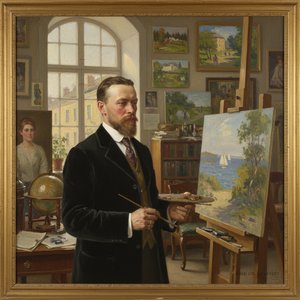
Yrjö Aleksanteri Ollila: A Pioneer of Finnish Impressionism
Yrjö Aleksanteri Ollila (July 20, 1887, Helsinki – November 14, 1932, Helsinki) was a Finnish Impressionist painter, designer and muralist whose vibrant canvases captured the beauty of Finland’s landscapes and infused decorative arts with innovative color palettes. Born into a family that emigrated to America after the tragic loss of his older brothers, Ollila found guardianship in Alex Rapp, a prominent decorative painter who nurtured his artistic talent and fostered an appreciation for European art movements. His life was tragically cut short by poisoning resulting from prolonged exposure to toxic dyes and pigments—a poignant reminder of the era’s artistic experimentation and its inherent risks.
Early Life and Artistic Education
Ollila began his formal artistic training at the Drawing School of the Finnish Art Society between 1903 and 1906, honing foundational skills before embarking on a transformative journey to Paris in 1912. Supported by a state scholarship, he immersed himself in the epicenter of Impressionism, absorbing the stylistic innovations championed by artists like Claude Monet and Pierre-Auguste Renoir. This Parisian influence profoundly shaped his artistic vision, propelling him toward a bold embrace of pure color—a hallmark of the Septem Group, an association advocating for expressive chromatic harmony.
A Versatile Artistic Career
Ollila’s creative output spanned diverse mediums, reflecting his adaptability and intellectual curiosity. Beyond painting, he excelled as a movie poster designer, crafting captivating visuals that conveyed emotion and narrative. He also contributed to wallpaper patterns, injecting artistic flair into domestic interiors, and designed toys—demonstrating an understanding of visual communication across various sectors. Notably, Ollila established Helsingin Taidevärjäämö (Helsinki Art Dye Works) in 1927, pioneering the creation of designer fabrics utilizing groundbreaking color combinations and innovative printing techniques. Furthermore, he undertook monumental mural commissions for buildings like the elementary school on Tehtaankatu Street and the Eira branch of Kansallis-osake-pankki, imbuing public spaces with artistic grandeur.
Notable Works: Capturing Finnish Essence
Ollila’s oeuvre is distinguished by his masterful depiction of Finnish landscapes—particularly the Gulf of Finland—where he skillfully employed luminous colors to convey atmospheric depth and textural nuances. His painting “Load of Hay” exemplifies his Impressionist style, showcasing a dynamic composition bathed in golden light and capturing the immediacy of rural life. Similarly, “Fear in the Woods,” attributed to Hugo Simberg (though Ollila himself painted it), embodies Simberg’s expressive approach to nature, conveying both tranquility and underlying apprehension. "Malliharjoitelma," also by Simberg, showcases Ollila's exploration of Post-Impressionist techniques—characterized by bolder brushstrokes and intensified color saturation—demonstrating his willingness to push artistic boundaries.
Legacy: An Enduring Influence
Yrjö Aleksanteri Ollila’s legacy extends beyond his individual artworks; he stands as a pivotal figure in Finnish art history, championing Impressionism's chromatic ideals and establishing Helsingin Taidevärjäämö as a cornerstone of Finnish decorative arts. His commitment to artistic innovation—coupled with his untimely demise—solidifies his place among Finland’s most influential artists of the early 20th century. He remains an inspiration for contemporary painters and designers seeking to infuse their creations with vibrancy and emotional resonance, ensuring that Ollila's vision continues to illuminate the Finnish art landscape.