

1
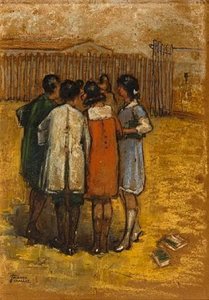
Nannies in the National Garden
Hand-painted oil reproduction from $178 34 × 29 cm
Same size as the original $461 110 × 94 cm Order at original size →
Det mest elskede maleri af Theophrastos Triantafyllidis er Nannies in the National Garden (1940). Bathers on the boat (1930) og Boats in calm water følger derefter blandt de lærreder, som læserne kender bedst. Vores katalog indeholder 33 værker af Theophrastos Triantafyllidis: her er de 33 mest berømte, hver med årstal, museum og hvad der gør dem mindeværdige.
Rangordnet efter vores popularitetsscore, som kombinerer søgninger, besøg og ordrer for hvert værk. Opdateret oktober 2026. Hvert maleri på denne side kan bestilles som en håndmalet oliereproduktion på lærred, eller som et kunsttryk i den størrelse, du vælger.


De fire motiver, der optræder hyppigst på disse lærreder, hver med sit mest elskede eksempel.


Nannies in the National Garden (1940), efterfulgt af Bathers on the boat (1930) og Boats in calm water.
Theophrastos Triantafyllidis, født i 1881, var 59 år gammel: Nannies in the National Garden er fra 1940.
Nannies in the National Garden, Bathers on the boat, Boats in calm water, Masks, Photographer, Two Children on the Beach, Harvesting, Vase with flowers, Flea Market og Self-Portrait. Hvert lærred i den ovenstående rangliste er angivet med årstal og museum.
33 værker af Theophrastos Triantafyllidis er i vores katalog, dateret fra 1919 til 1952.
I 1930s, som udgør 3 af de 33 værker på denne side, herunder Bathers on the boat.
Det tidligste lærred her er Two Children on the Beach (1919); det seneste er Self-Portrait (1952).
Gardens and parks (4), Reflection (2) og Children (2), fordelt på de 33 værker på denne side.
Impressionism og Post-impressionism, som lærrederne på denne side viser.
Ja. Hvert maleri på denne side kan bestilles fra sin egen side som en håndmalet oliereproduktion eller som et kunsttryk i den størrelse, du vælger.
Theophrastos Triantafyllidis (1881-1955) stands as a pivotal figure in the history of Greek art, particularly recognized for his contribution to Impressionism and Post-Impressionism. Born in Izmir, Ottoman Greece – now Turkey – Triantafyllidis’s artistic journey began amidst the burgeoning cultural landscape of the early 20th century, shaping him into an artist deeply attuned to both European avant-garde trends and the unique spirit of his homeland.
His formative years were spent studying at Athens School of Fine Arts, where he absorbed the teachings of prominent instructors who championed classical ideals alongside modern experimentation. This dual influence proved crucial in establishing Triantafyllidis’s distinctive artistic style – one characterized by a masterful blend of Impressionistic luminosity and expressive distortions reminiscent of Post-Impressionists like Cézanne and Gauguin.
Early works demonstrate a clear affinity with Impressionist principles, prioritizing fleeting moments of light and color to capture the essence of everyday life. Subjects such as landscapes—particularly scenes from Mykonos—and portraits are rendered with delicate brushstrokes and vibrant hues, reflecting Triantafyllidis’s fascination with capturing atmospheric conditions and conveying emotion through visual representation.
However, Triantafyllidis swiftly moved beyond mere imitation of established masters. As he matured as an artist, his style evolved towards a more personal expressionism, incorporating bolder colors and fractured forms to convey psychological depth and emotional intensity. This stylistic shift cemented his reputation as a visionary innovator who pushed the boundaries of artistic convention.
Notable achievements include numerous exhibitions showcasing his paintings across Greece and internationally, establishing him as one of the foremost proponents of Greek Impressionism. His oeuvre continues to inspire admiration for its lyrical beauty and profound exploration of human experience—a testament to Triantafyllidis’s enduring legacy as a transformative force in the artistic panorama of his era.
Triantafyllidis’s artistic vision was profoundly shaped by the Impressionist movement, spearheaded by artists like Monet and Renoir. He embraced their emphasis on capturing fleeting impressions of light and color—a technique he skillfully applied to landscapes and portraits alike.
However, Triantafyllidis transcended mere stylistic imitation, forging his own distinctive path toward expressionism. His canvases pulsate with emotional intensity, achieved through bold brushstrokes and distorted forms that convey psychological states rather than literal representations of reality. This approach aligns him with artists like Edvard Munch and Vincent van Gogh—figures who championed subjective experience as paramount to artistic endeavor.
Theophrastos Triantafyllidis’s contribution to Greek art remains significant, securing his place among the foremost proponents of Impressionism and Post-Impressionism. His enduring influence can be observed in subsequent generations of artists who embraced similar stylistic innovations—a testament to his pioneering spirit and unwavering commitment to artistic experimentation.
