




impressionist vs expressionist
 Autumn at Argenteuil
, Claude Monet
Impressionism focuses on capturing the fleeting, sensory impressions of the external world, particularly the play of light and atmosphere. Expressionism prioritizes subjective emotional experience, using distorted forms and bold colors to manifest the artist's inner psychological states and anxieties rather than depicting objective, physical reality.
In our workshop, we see these differences clearly in the way paint is applied to the surface. Impressionism, as seen in Claude Monet’s Autumn at Argenteuil, relies on loose, expressive brushwork to document a specific moment in time. This movement emerged in France during the late 19th century as a reaction against the rigid rules of Academicism, with artists often exhibiting in independent groups outside the official Salon de Paris.
Expressionism, by contrast, often feels more jarring and intense. It emerged in Northern Europe around the beginning of the 20th century, often during periods of significant social and political upheaval. While an Impressionist might paint a landscape to show how morning sun softens the edges of trees, an Expressionist might use jagged lines and fragmented compositions to evoke a specific, perhaps unsettling, mood.
- Impressionism: Focuses on the perceptual truth of seeing and the optical play of light.
- Expressionism: Focuses on the psychological truth of feeling and subjective experience.
how do they use color and light differently?
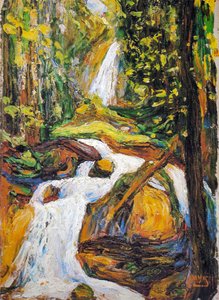
 Ravine Improvisation
, Wassily Kandinsky
Impressionists use unblended colors and visible brushstrokes to capture the transient, luminous effects of natural light on a subject. Expressionists utilize intense, non-naturalistic, and often bold colors to convey emotional resonance and spiritual meaning, moving away from the subtle chromatic shifts found in the natural world.
When we examine the texture of the paint, the distinction becomes even clearer. In Monet’s Irises in Monet's Garden, the impasto technique—applying thick layers of paint—adds a tangible depth that mimics the way light hits the flowers. The goal is to capture the diffuse lighting and soft transitions that create a sense of harmony and tranquility.
Expressionist works, such as Wassily Kandinsky’s Ravine Improvisation, do not seek to replicate the way light actually falls on an object. Instead, they use color as a tool for eruption. The colors are often used to project internal feelings like joy or existential dread, rather than to document the shifting qualities of the sun or atmosphere.
is it about external perception or internal emotion?
Impressionism is an art of observation, documenting the sensory experience of the eye and the fleeting effects of the atmosphere on the visible world. Expressionism is an art of eruption, looking inward to manifest internal psychological states, prioritizing the sensation in the soul over physical reality.
The direction of the artist's gaze is the fundamental divider. For the Impressionist, truth is found in the optical play of light and how it changes the color of a landscape. They seek to record the colors and forms of objects as they appear in natural light at a given time, often abandoning the muted palettes of traditional landscape painting for something brighter and sunnier.
For the Expressionist, truth is found in the psychological weight of an experience. This movement often utilizes:
- Distorted forms to evoke specific moods.
- Energetic, sometimes violent brushwork.
- A focus on the artist's subjective response to the world rather than the world itself.
Frequently asked questions
Where did Impressionism begin?
Impressionism emerged in France during the late 19th century.
Where is Monet's Irises in Monet's Garden located?
Claude Monet's Irises in Monet's Garden is in the Musée d'Orsay.
Who coined the term Impressionist?
The term Impressionist was first used by journalist Louis Leroy in 1874.
How many exhibitions did the Impressionist group hold?
The Impressionist group held seven exhibitions between 1874 and 1886.
Learn more
- 1840 – 1926Claude MonetImmerse yourself in the luminous world of the master of light and color.
- Claude MonetAutumn at ArgenteuilDiscover how Impressionism captures the fleeting, delicate essence of a changing season.


