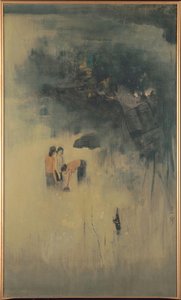
The Architect of Nanyang Modernism
In the vibrant tapestry of twentieth-century Asian art, few threads shine as brightly or as uniquely as those woven by Cheong Soo Pieng. A visionary who bridged the vast distance between the ancient traditions of the East and the avant-garde movements of the West, Cheong stands as a monumental figure in Singaporean art history. Born in 1917 in Amoy, China, his early life was marked by a profound connection to the classical aesthetics of his heritage, yet his spirit was destined for the tropical rhythms of Southeast Asia. His formative education at the Xiamen Academy of Fine Art and later in Shanghai provided him with a rigorous foundation in Chinese ink painting, but it was his move to Singapore in 1946 that would ignite his true artistic revolution.
Cheong did not merely adopt a new landscape; he reimagined it through a lens of modernism. Alongside contemporaries like Chen Wen Hsi, he became a primary architect of the Nanyang style—a movement that sought to capture the soul of the Malay Peninsula and the Indonesian archipelago. This was not a mere imitation of European trends, but a sophisticated fusion. He took the structural lessons of Cubism and the dreamlike qualities of Surrealism and breathed into them the warmth, color, and cultural vitality of Southeast Asian life. His work became a dialogue between the geometric precision of the West and the organic, flowing essence of the tropics.
A Symphony of Form and Local Essence
To gaze upon a Cheong Soo Pieng masterpiece is to witness a masterful command of both line and light. His technique was characterized by an extraordinary ability to use bold, saturated colors and thick black contours to delineate forms that felt both grounded and ethereal. He possessed a signature way of depicting indigenous tribal people, often portraying figures with elongated limbs and almond-shaped eyes—a stylistic choice that lent his subjects a graceful, almost mythic quality. This rhythmic approach to the human figure allowed him to transform everyday scenes into something timeless and iconic.
His subject matter served as a love letter to the regional identity. Through his brush, the mundane became magnificent:
- The Rhythms of Labor: He captured the communal spirit of Weaver and the industriousness of fishermen hauling nets or farmers tending to rice paddies.
- Cultural Heritage: Works like Kayan Musician celebrate the traditional musical performances that define the region's cultural heartbeat.
- Tropical Serenity: In pieces such as Bali Beach, he invited viewers into a world of relaxation and sun-drenched landscapes, using fragmented geometric shapes to mirror the heat and movement of the shore.
- The Beauty of the Ordinary: Even in his more intimate studies, such as Drying Salted Fish or his various still lifes, there is an unwavering dedication to the palpable essence of human experience within a specific cultural context.
Legacy and the Enduring Spirit of Innovation
As his career progressed, Cheong’s experimentation knew no bounds. He was never content with staying within the safety of oil or watercolor; he fearlessly pushed the limits of his medium by exploring metal reliefs, lacquer, Masonite, and mixed media. This relentless pursuit of innovation ensured that his work remained dynamic, evolving from the figurative clarity of his early Nanyang years toward more complex, layered, and abstract compositions. His later works, such as Abstract Composition, demonstrate a profound depth where texture and color take center stage, reflecting a mature artist grappling with the very essence of spatial relationships.
Cheong Soo Pieng passed away in 1983, but his influence remains an indelible part of the global art canon. He did more than create paintings; he helped forge a visual identity for a region in transition. By rejecting rigid European academic conventions in favor of a style that honored local textures and rhythms, he gave Southeast Asia a modern voice. Today, his works reside in prestigious collections such as the National Gallery Singapore, serving as a permanent testament to a man who saw the beauty in the fragmented, the strength in the stylized, and the eternal in the everyday.