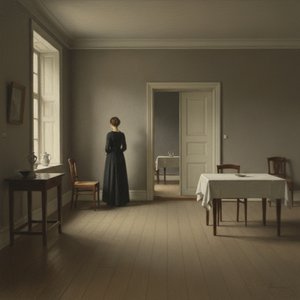
A Life Immersed in Light: The Art of Kristen “Kraesten” Iversen
Kristen “Kræsten” Iversen, born in the quiet Danish parish of Holsted in 1886, was an artist whose life became inextricably linked with the exploration and manipulation of light. He wasn’t merely a painter; he was a weaver of atmospheres, a master of both canvas and glass who left an indelible mark on Denmark's artistic landscape. His journey began with formal training at the Copenhagen Technical College between 1904 and 1905, laying the groundwork for a career that would see him embrace diverse mediums – oils, frescos, watercolours, mosaics, and most notably, stained glass. Early exhibitions at the Artists’ Autumn Exhibition from 1910 to 1918 showcased a developing talent, but it was his first encounter with the island of Bornholm in 1920 that truly ignited his artistic vision.
The Influence of Bornholm and the Royal Commissions
Bornholm, with its unique natural colours and distinctive light quality, proved transformative for Iversen. The island’s landscapes weren't simply subjects to be depicted; they were sources of inspiration, a palette from which he drew an increasingly vibrant and nuanced understanding of colour and form. This newfound aesthetic direction propelled him into a period of significant recognition. In 1923, he was awarded the prestigious Eckersberg Medal, acknowledging his growing mastery. However, it was the commission to create the large painted ceiling decoration in the royal hall at Christiansborg Palace between 1927 and 1931 that cemented his position as a leading artist of his time. This monumental undertaking demanded not only technical skill but also an ability to translate grandeur and history into visual form – challenges Iversen met with remarkable success, establishing a style characterized by both classical precision and a distinctly modern sensibility.
Beyond the Canvas: A Pioneer in Stained Glass
While celebrated for his paintings, Kristen Iversen’s legacy extends far beyond the traditional canvas. He became a true pioneer in the art of stained glass, transforming this often-overlooked medium into a powerful form of artistic expression. His first foray into glasswork came with windows for Risskov Church, but it was his subsequent designs – including those for the North Chapel at Fårevejle Church and the Danish church in Buenos Aires – that truly showcased his innovative approach. Iversen didn’t simply fill spaces with coloured glass; he crafted luminous narratives, using light itself as a primary element of design. He understood how to manipulate colour, texture, and form to create windows that were not merely decorative but deeply evocative, imbued with spiritual resonance and artistic depth. His work on churches like Sankt Nicolai Church in Svendborg further demonstrated his ability to seamlessly integrate art into architectural spaces, creating environments that were both beautiful and profoundly moving.
A Professor and Director: Shaping a Generation of Artists
Iversen’s influence wasn't limited to his own creations; he also dedicated himself to nurturing the next generation of artists. In 1930, he accepted a professorship at the Royal Danish Academy of Fine Arts, a position he held until his death in 1955. He later served as director of the academy from 1949–1952, guiding countless students and shaping the direction of Danish art for decades to come. His teaching philosophy likely emphasized the importance of observation, experimentation, and a deep understanding of both historical traditions and contemporary trends. He was knighted with the Order of the Dannebrog in 1932, a testament to his significant contributions to Danish culture.
A Lasting Legacy: The Enduring Power of Light
Kristen “Kræsten” Iversen’s death in Copenhagen in 1955 marked the end of a remarkable artistic journey. He left behind a body of work that is as diverse as it is compelling, encompassing paintings, frescos, mosaics, and stunning stained-glass windows. He was exceptionally diversified in his art work which covered oils, frescos, watercolours, mosaics and glass painting. His landscapes, imbued with the light of Bornholm, continue to captivate viewers with their vibrant colours and atmospheric depth. But perhaps it is his pioneering work in stained glass that truly defines his legacy – a testament to his ability to transform a traditional medium into a powerful form of artistic expression. Iversen’s art remains a potent reminder of the enduring power of light, colour, and imagination, continuing to inspire artists and audiences alike.