

Det mest elskede maleri af Lars Ravn er The Four Elements - or the Feast at the Round Table (1982), som hænger på Statens Museum for Kunst i København. Vores katalog indeholder 2 værker af Lars Ravn: her er de 2 mest berømte, hver med årstal, museum og hvad der gør dem mindeværdige.
Rangordnet efter vores popularitetsscore, som kombinerer søgninger, besøg og ordrer for hvert værk. Opdateret november 2026.


Det museum, der rummer flest af malerierne på denne side.
| Museum | By | Værker af Lars Ravn | Malerier fra denne liste |
|---|---|---|---|
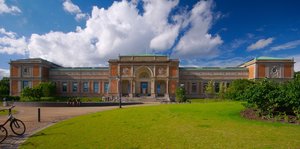 Statens Museum for Kunst |
København | 2 | The Four Elements - or the Feast at the Round Table, The Coffee, the Rabbit, the Woman/Abyss |
De daterede lærreder af Lars Ravn på denne side dækker kun 4 år, fra 1982 til 1985: følg dem år for år, i deres eget lys.


The Four Elements - or the Feast at the Round Table (1982)
Lars Ravn, født i 1959, var 23 år gammel: The Four Elements - or the Feast at the Round Table er fra 1982.
2 værker af Lars Ravn er i vores katalog, dateret fra 1982 til 1985.
Primært i Statens Museum for Kunst (København); listen ovenfor nævner hvert museum og dets lærreder.
Det tidligste lærred her er The Four Elements - or the Feast at the Round Table (1982); det seneste er The Coffee, the Rabbit, the Woman/Abyss (1985).
Statens Museum for Kunst, København har 2 af værkerne på denne side, herunder The Four Elements - or the Feast at the Round Table og The Coffee, the Rabbit, the Woman/Abyss.
Born in 1959 in Aalborg, Denmark, Lars Ravn grew up in Vejle, where his early connection to the visual world began to take root. He was not a student of the Royal Danish Academy of Fine Arts; instead, he followed a path of self-directed learning. His education came from the quiet corners of libraries and the guidance of established hands. He sought out mentors to learn the physical demands of different media, studying ceramics under Erik Nyholm, glasswork with Per Hesebgaard, and the intricate process of copperplate printing with Niels Borch Jensen.
This period of apprenticeship allowed him to build a technical foundation that would later support his more experimental ideas. His high school art teacher once noted a resemblance between his emerging style and the works of Paul Klee or Wassily Kandinsky, even though Ravn had not yet encountered those names. Driven by this curiosity, he spent much of his youth immersed in art history books, teaching himself the language of form and color through sheer persistence.
Ravn’s work is characterized by an eclectic approach that brings together humor, surrealism, and symbolism. He often creates dreamlike scenarios where mythology and nature meet the unexpected. His paintings and drawings frequently use bold colors to explore themes that feel both fantastical and deeply human. There is a certain playfulness in his imagery, yet it remains grounded in a raw, expressive technique that avoids being purely decorative.
His artistic development has seen him move through various media, including printmaking, mixed media, and even ceramics. This versatility allows him to bridge the gap between classical traditions and contemporary pop culture. In many ways, his work functions as a visual dialogue between the old and the new, using the tools of the past to interpret the strange, often absurd realities of the present.
A significant thread in Ravn’s career is his deep engagement with the visual legacy of Hans Christian Andersen. This fascination began early, when he painted an illustration for one of Andersen's poems. Years later, this interest evolved into large-scale projects that reinterpreted Andersen’s own sketches and paper cuttings. In 2019, at Valdemars Slot, his interpretations were placed alongside the original works of the famous author, creating a shared space between two different eras of Danish creativity.
His reach has extended far beyond the borders of Denmark, with exhibitions in Iceland, Germany, China, and Italy. His work is held in several notable collections, including:
Beyond the gallery walls, Ravn has contributed to public spaces through murals and decorations, such as a piece for a university in Hohhot, China, and glasswork for a gymnasium in Ikast. Whether working on a large-scale wall or a small print, his focus remains on the intersection of storytelling and visual expression.