

Det mest elskede maleri af Otto van Rees er H. Benoit Labre (1916), som hænger på Museum Catharijneconvent i Utrecht. Christ Heals the Blind (1925) og Preparatory Study for a Station of the Cross (1949) følger derefter blandt de lærreder, som læserne kender bedst. Vores katalog indeholder 3 værker af Otto van Rees: her er de 3 mest berømte, hver med årstal, museum og hvad der gør dem mindeværdige.
Rangordnet efter vores popularitetsscore, som kombinerer søgninger, besøg og ordrer for hvert værk. Opdateret november 2026.


Det museum, der rummer flest af malerierne på denne side.
| Museum | By | Værker af Otto van Rees | Malerier fra denne liste |
|---|---|---|---|
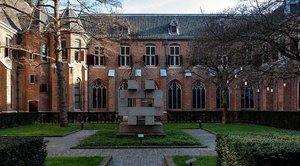 Museum Catharijneconvent |
Utrecht | 3 | H. Benoit Labre, Christ Heals the Blind, Preparatory Study for a Station of the Cross |


H. Benoit Labre (1916), Museum Catharijneconvent, Utrecht. Christ Heals the Blind (1925) og Preparatory Study for a Station of the Cross (1949) følger efter.
Otto van Rees, født i 1884, var 32 år gammel: H. Benoit Labre er fra 1916.
3 værker af Otto van Rees er i vores katalog, dateret fra 1916 til 1949.
Primært i Museum Catharijneconvent (Utrecht); listen ovenfor nævner hvert museum og dets lærreder.
Det tidligste lærred her er H. Benoit Labre (1916); det seneste er Preparatory Study for a Station of the Cross (1949).
Museum Catharijneconvent, Utrecht har 3 af værkerne på denne side, herunder H. Benoit Labre, Christ Heals the Blind og Preparatory Study for a Station of the Cross.
Born in Freiburg im Breisgau, Germany, Otto van Rees was a prolific artist whose career spanned several decades. After finishing high school, he moved to Paris in 1904, where he lived and worked alongside his wife, Adya Dutilh. During his time in Paris, he was part of a vibrant artistic circle, residing in the Bateau Lavoir and spending summers in Fleury-en-Bière. His work underwent significant transformations, moving from neo-impressionistic experiments focused on sunlight and perspective toward a concentration on volume and form, evolving from physic cubism to analytic cubism.
During the first world war, Van Rees relocated to Ascona, Switzerland. In 1915, he held a famous exhibition at the gallery Tanner in Zürich alongside Arp, an event now viewed as the beginning of Dada in Zürich. Art dealer Henri Kahnweiler noted that Van Rees brought the collage technique from Paris to Zürich. Later, in 1928, he constructed a house in Losone, near Ascona, featuring a ground plan of a circle and a square.
Following the death of his oldest daughter in France, Van Rees spent increasing amounts of time in Holland, eventually moving there in 1934. In the Netherlands, he was regarded as a mentor by young painters. His artistic output was diverse, encompassing various roles such as:
His mural paintings embellished numerous public buildings in Holland, including churches, railway stations, courthouses, ministries, and theatres. He died in Utrecht, Holland.