Atelier — Gratis fragt til hele verden — Leveringstid: 2–6 uger
      Georges Rouault, 1871 – 1958

      Georges Rouault: De 100 mest kendte malerier

      Af alle Georges Rouault's malerier er Head of Christ det mest berømte. Lige efter følger Head of Christ 1 og The Breton Wedding (1937). Blandt de 268 værker af Georges Rouault i vores katalog er disse 100 de mest fejrede, hver vist med sin dato, sit museum og sin historie.

      Rangordnet efter vores popularitetsscore, som kombinerer søgninger, besøg og ordrer for hvert værk. Opdateret oktober 2026.

      Portræt af Georges Rouault
      Georges Rouault · 1871 – 1958
      Født · død
      1871 – 1958, 19. arrondissement i Paris
      Bevægelse
      Fauvism
      Værker i vores katalog
      268
      Mest kendte
      Head of Christ
      Flest værker hos
      Art Institute of Chicago

      Georges Rouaults 10 mest fejrede malerier

      Head of Christ af Georges Rouault
      1

      Head of Christ

      Oil On Panel

      The face emerges from a deep, saturated blue background. It is a man's countenance, fixed with an intense and focused gaze that meets the viewer directly. His eyes are wide, open, and heavy with a quiet, introspective weight. A beard provides a rough texture to his features, grounding the ethereal color of the backdrop in something physical and tactile. On the left side of the face, a small bird rests,…

      Head of Christ 1 af Georges Rouault
      2

      Head of Christ 1

      Oil On Panel

      In this portrait, the face of Christ emerges from a profound, saturated blue, a space that offers no horizon and no sense of physical depth. The subject's countenance is fixed with an intense, focused gaze that meets the viewer directly, creating an immediate sense of intimacy and confrontation. There is a heavy, introspective weight in the eyes, which appear wide and open, as if carrying the gravity of existence itself.…

      The Breton Wedding (1937) af Georges Rouault
      3

      The Breton Wedding

      1937 · Oil On Canvas

      Georges Rouault’s “The Breton Wedding” is not merely a depiction of a rural ceremony; it's a profound meditation on faith, community, and the quiet dignity of everyday life. Painted in 1937, this canvas pulsates with an intensely personal vision, born from Rouault’s own devout Catholic beliefs and his deep empathy for the marginalized. The scene unfolds within a church or cathedral – a space traditionally imbued with solemnity – yet…

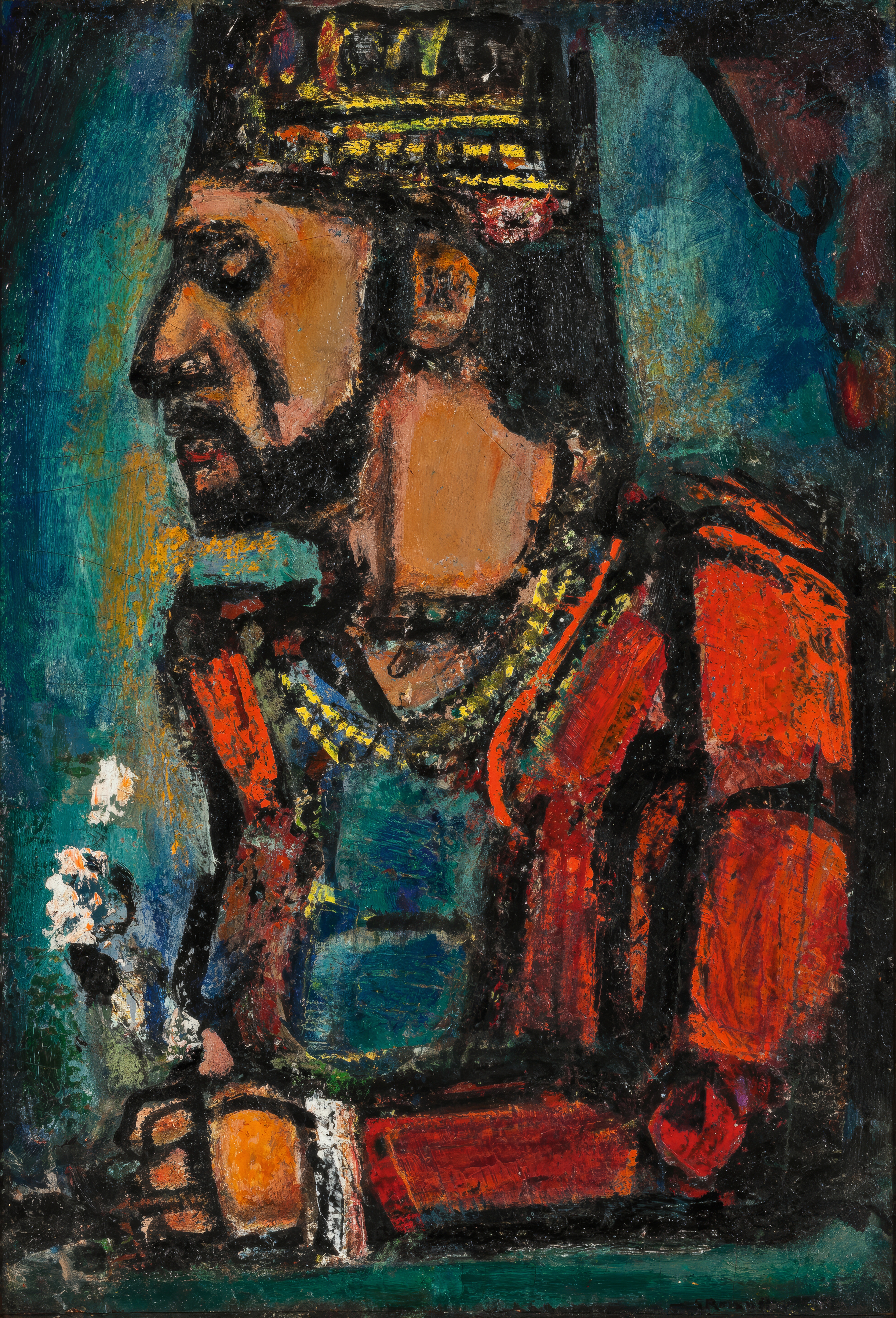
      The old king (1937) af Georges Rouault
      4

      The old king

      1937 · Oil On Canvas

      In the quiet, heavy atmosphere of Georges Rouault’s 1937 masterpiece, The Old King, one encounters a profound meditation on the human condition. The painting presents a solitary monarch, captured in profile, whose very presence seems to vibrate with an introspective melancholy. Draped in rich, crimson robes that catch the light with a somber intensity, the figure gazes inward, his expression etched with a deep, palpable sadness. This is not merely…

      Jesus on the cross as forgotten there af Georges Rouault
      5

      Jesus on the cross as forgotten there

      Acrylic On Canvas

      Georges Rouault’s “Jesus on the Cross as Forgotten There”: A Descent Into Spiritual Darkness The artwork presents a haunting meditation on faith and suffering, embodied in Georges Rouault's monumental print, "Jesus on the Cross as Forgotten There." Created in 1946 during the Second World War, amidst the pervasive anxieties of occupation and loss, this piece transcends mere depiction; it plunges into the abyss of existential despair, mirroring the artist’s own…

      Femme Affranchie, A Quatorze Heures, Chante Midi af Georges Rouault
      6

      Femme Affranchie, A Quatorze Heures, Chante Midi

      Acrylic

      Georges Rouault’s Femme Affranchie: A Portrait of Resilience Amidst Darkness The Denver Art Museum houses Georges Rouault's “Femme Affranchie, à Quatorze Heures, Chante Midi” (Woman Freed at Noon), a hauntingly beautiful engraving from his seminal Miserere et Guerre series completed in 1923. This artwork transcends mere visual representation; it embodies Rouault’s deeply felt empathy for the vulnerable and his unwavering commitment to exploring profound spiritual themes—a legacy born from witnessing…

      The Judges (1908) af Georges Rouault
      7

      The Judges

      1908 · Oil · Statens Museum for Kunst, København

      In this 1908 oil painting, three seated figures occupy a shallow, darkened space. The composition is arranged horizontally, with the figures positioned in a way that fills the frame, creating a sense of enclosure. The lighting is low-key, emerging from an indistinct source to illuminate only specific portions of the subjects, such as the pale, ghostly whites of facial features and the edges of clothing. The rest of the scene…

      Hollow dream af Georges Rouault
      8

      Hollow dream

      Oil On Canvas

      The artwork Hollow dream is an oil painting on canvas that presents a portrait of a person, likely male, rendered in an expressionistic style. The composition is a vertical frame that is tightly focused on the head and shoulders, with the subject facing forward and slightly turned toward the viewer's left. The figure fills most of the frame against a dark, undefined background.

      Georges Rouaults malerier rangeret fra 11 til 100

      Bouquet II (1938) af Georges Rouault
      #13

      Bouquet II

      1938

      Georges Rouault: Bouquet II – A Meditation on Suffering and Beauty Georges Rouault’s “Bouquet II,” painted in 1929, stands as a poignant testament to the artist's unwavering commitment…

      Christ af Georges Rouault
      #14

      Christ

      The painting is a portrait of Jesus with his head bowed down. The background features a sky that appears to be blue in color.

      Away the smile of Reims af Georges Rouault
      #15

      Away the smile of Reims

      A single figure occupies the center of the frame, a presence carved from darkness and light. The face is elongated, pulled by invisible forces into a mask of…

      The Three Judges (1928) af Georges Rouault
      #18

      The Three Judges

      1928 · Art Institute of Chicago

      The Three Judges is an oil and gouache work on paper, mounted on cardboard and backed with canvas, created by the French artist Georges Rouault. The piece was…

      Dolls, puppets fire hall and the ''Bride'' af Georges Rouault
      #19

      Dolls, puppets fire hall and the ''Bride''

      The air feels heavy, thick with the scent of old dust and greasepaint. In this claustrophobic corner of a theatrical world, three figures huddle together, their presence casting…

      Legendary Landscape (1935) af Georges Rouault
      #20

      Legendary Landscape

      1935

      The artwork is a vertically oriented oil painting on canvas that presents a stylized, dreamlike landscape. The composition features a simplified architectural structure, possibly a church or monastery,…

      'Man of myrrh' af Georges Rouault
      #22

      'Man of myrrh'

      The artwork presents a somber and emotionally charged scene depicting what appears to be a biblical or allegorical narrative. The composition is centered around a reclining figure, presumably…

      Pierrot (1910) af Georges Rouault
      #24

      Pierrot

      1910

      is a work by the French artist Georges Rouault, executed in 1910. Born in Paris, France, in 1871, Rouault remained connected to his home city until his death…

      Grotesque (1917) af Georges Rouault
      #25

      Grotesque

      1917

      Completed in 1917, Georges Rouault’s Grotesque is a profound exploration of human vulnerability and spiritual resilience. Created against the backdrop of the escalating anxieties of World War I,…

      Crucifixion af Georges Rouault
      #26

      Crucifixion

      The painting depicts a crucifixion scene where the central figure of Jesus Christ is shown on the cross. He is rendered with an elongated torso and contorted limbs,…

      Two Women's Heads (1902) af Georges Rouault
      #27

      Two Women's Heads

      1902

      The painting depicts two women's heads positioned within the frame. On the left side, a woman with long hair is shown looking toward something in front of her,…

      The holy face af Georges Rouault
      #28

      The holy face

      The artwork presents a stylized and emotionally charged depiction of a human face, likely intended to represent Christ or a holy figure. The composition is centered around the…

      Project for the reincarnation of Father Ubu 3 af Georges Rouault
      #29

      Project for the reincarnation of Father Ubu 3

      Georges Rouault's “Project for the Reincarnation of Father Ubu 3” presents not merely a depiction, but an immersion into a world sculpted by anxiety and unsettling satire. This…

      Christ and the Fisherman af Georges Rouault
      #30

      Christ and the Fisherman

      Fine Arts Museums of San Francisco

      Christ and the Fisherman is an oil painting by Georges Rouault. Created in France, the work emerged around 1937. The artist applied oil to paper, which was then…

      Eternally scourged af Georges Rouault
      #31

      Eternally scourged

      In this somber composition, we find ourselves face to face with a figure caught in a moment of profound exhaustion. The subject is positioned slightly off-center, its body…

      King Ubu 1 af Georges Rouault
      #34

      King Ubu 1

      The artwork presents a stylized and somewhat grotesque depiction of a seated figure, identified by the title as King Ubu. The composition is dominated by this central figure,…

      The Superman (1916) af Georges Rouault
      #35

      The Superman

      1916

      In the heavy, somber atmosphere of 1916, as the Great War tore through the heart of Europe, Georges Rouault captured something far more profound than a mere portrait;…

      The Dwarf (1937) af Georges Rouault
      #36

      The Dwarf

      1937 · Art Institute of Chicago

      In this 1937 work, The Dwarf, Georges Rouault presents a figure that occupies the periphery of social visibility. The artist, a Frenchman, turned his attention toward those living…

      Dancer for the Ballets Russes af Georges Rouault
      #37

      Dancer for the Ballets Russes

      Georges Rouault's "Dancer for the Ballets Russes" is a striking portrait that encapsulates the spirit of early 20th-century artistic innovation. Created likely around 1929, this artwork offers a…

      Pierrot 2 af Georges Rouault
      #38

      Pierrot 2

      Georges Rouault's 'Pierrot 2' isn’t merely a depiction of the iconic commedia dell’arte figure; it’s an immersion into a world steeped in sorrow, isolation, and a profound spiritual…

      Twilight or Ile de France af Georges Rouault
      #39

      Twilight or Ile de France

      Georges Rouault’s “Twilight or Ile de France” is a captivating exploration of light, color, and human emotion, firmly rooted in the heart of the Fauvist movement. Painted in…

      Night Fall af Georges Rouault
      #40

      Night Fall

      The artwork presents a stylized and emotionally charged scene depicting figures in what appears to be a coastal or rural setting at night. It carries a somber and…

      '... when the night came. The moon rose' af Georges Rouault
      #41

      '... when the night came. The moon rose'

      In the hauntingly beautiful tableau titled '... when the night came. The moon rose,' Georges Rouault invites us into a world where the boundaries between the physical landscape…

      The blind man sometimes consoles the light af Georges Rouault
      #42

      The blind man sometimes consoles the light

      Georges Rouault's “The Blind Man Sometimes Consoles the Light” is not merely a depiction of two figures; it’s an immersion into a world steeped in sorrow, faith, and…

      Nude with arms raised (combed) af Georges Rouault
      #43

      Nude with arms raised (combed)

      In the quiet, heavy atmosphere of Georges Rouault’s 1937 masterpiece, Nude with Arms Raised (combed), one does not merely observe a figure; one encounters a soul in the…

      Dura Lex Sed Lex af Georges Rouault
      #44

      Dura Lex Sed Lex

      “Dura lex sed lex” – "The law is hard, but it is the law" – this stark and profoundly moving portrait by Georges Rouault transcends a simple depiction…

      Georges Rouaults lærreder, periode for periode

      Early 20th Century

      1907 – 1910 · 3 værker på denne liste

      Hvad Georges Rouault har malet mest af

      De fire motiver, der optræder hyppigst på disse lærreder, hver med sit mest elskede eksempel.

      Hvor Georges Rouault's lærreder hænger

      De 7 museer, der rummer flest af malerierne på denne side.

      Museum By Værker af Georges Rouault Malerier fra denne liste
      Art Institute of Chicago, ChicagoArt Institute of Chicago Chicago 2 The Three Judges, The Dwarf
      The Phillips Collection, Washington, D.C.The Phillips Collection Washington, D.C. 3 Verlaine
      Statens Museum for Kunst, KøbenhavnStatens Museum for Kunst København 1 The Judges
      Fine Arts Museums of San Francisco, San FranciscoFine Arts Museums of San Francisco San Francisco 1 Christ and the Fisherman
      Det Kongelige Museum for Fin Kunst Antwerpen, AntwerpenDet Kongelige Museum for Fin Kunst Antwerpen Antwerpen 1 Newspaper Seller
      National Gallery of Canada, OttawaNational Gallery of Canada Ottawa 1 Christ on the Cross
      Chimei Museum, TainanChimei Museum Tainan 1 Profile of a Woman

      Årti for årti: Georges Rouaults mest fejrede lærred

      1. 1900s
        The Judges (1908) af Georges Rouault
        7 ud af 100

        The Judges

        Alder 29 – 38 · Statens Museum for Kunst

        In this 1908 oil painting, three seated figures occupy a shallow, darkened space. The composition is arranged horizontally, with the figures positioned in a way that fills the…

      2. 1910s
      3. 1920s
        The Three Judges (1928) af Georges Rouault
        18 ud af 100

        The Three Judges

        Alder 49 – 58 · Art Institute of Chicago

        The Three Judges is an oil and gouache work on paper, mounted on cardboard and backed with canvas, created by the French artist Georges Rouault. The piece was…

      4. 1930s
        The Breton Wedding (1937) af Georges Rouault
        Rangeret som nr. 3 ud af 100

        The Breton Wedding

        Alder 59 – 68

        Georges Rouault’s “The Breton Wedding” is not merely a depiction of a rural ceremony; it's a profound meditation on faith, community, and the quiet dignity of everyday life.…

      Dine spørgsmål om Georges Rouaults malerier, besvaret

      Hvilket er det mest berømte maleri af Georges Rouault?Læs svaret

      Head of Christ, efterfulgt af Head of Christ 1 og The Breton Wedding (1937).

      Hvilke ti malerier er Georges Rouault mest kendt for?Læs svaret

      Head of Christ, Head of Christ 1, The Breton Wedding, The old king, Jesus on the cross as forgotten there, Femme Affranchie, A Quatorze Heures, Chante Midi, The Judges, Hollow dream, The Poulot or partner, Red Zone og Landscape from the Bible, Christ and the fishermen. Hvert lærred i den ovenstående rangliste er angivet med årstal og museum.

      Hvor mange malerier af Georges Rouault er kendt?Læs svaret

      268 værker af Georges Rouault er i vores katalog, dateret fra 1902 til 1938.

      Hvilke museer udstiller Georges Rouaults mest kendte lærreder?Læs svaret

      Primært i Art Institute of Chicago (Chicago), The Phillips Collection (Washington, D.C.) og Statens Museum for Kunst (København); listen ovenfor nævner hvert museum og dets lærreder.

      I hvilke år malede Georges Rouault sine mest berømte lærreder?Læs svaret

      I 1900s, som udgør 5 af de 100 værker på denne side, herunder The Judges.

      Hvad er de første og de sidste af Georges Rouaults berømte lærreder?Læs svaret

      Det tidligste lærred her er Two Women's Heads (1902); det seneste er Bouquet II (1938).

      Hvilke motiver går oftest igen i Georges Rouault's malerier?Læs svaret

      Suffering (13), Darkness (11) og Portrait (7), fordelt på de 100 værker på denne side.

      Hvad malede Georges Rouault normalt med?Læs svaret

      Oil On Canvas, anvendt i 11 af de 100 værker på denne side.

      Hvilken kunstretning tilhører Georges Rouault?Læs svaret

      Fauvism og Expressionism, som lærrederne på denne side viser.

      Hvad kan jeg se af Georges Rouault på Art Institute of Chicago?Læs svaret

      Art Institute of Chicago, Chicago har 2 af værkerne på denne side, herunder The Three Judges og The Dwarf.

      Georges Rouault: malerens historie

      En Mand Forbundet Af Skygger Og Tro

      Georges Rouault, født i Paris i 1871 midt i kaoset efter kommunen, levede et liv dybt præget af vanskeligheder og en inderlig åndelig søgen. Hans tidlige år blev faktisk levende i skyggerne – hans familie søgte ly i en kælder under byens bombardement, en begivenhed der ville resonere gennem hele hans kunstneriske vision. Denne ydmyge begyndelse, kombineret med en dybt katolsk opdragelse formet af hans mor, indgydede ham en dyb medfølelse for de marginaliserede og lidende, temaer der skulle blive centrale i hans oeuvre. Han var ikke bestemt til akademisk privilegium; i stedet begav han sig ud på et læreforhold som glasmaler ved fjorten, en håndværk, der dybt formede hans æstetiske sansninger. De livlige farver og skarpe konturer i smuktglas blev fundamentale for hans modne stil – en karakteristisk brug af mørke konturer, der rammer lysende farvefelter, som minder om middelalderkunst. Denne tidlige indlevelse var ikke kun teknisk; den var åndelig, og gav ham en forståelse for den fortællende kraft af lys og billede. Samtidig søgte han formel uddannelse på École des Beaux-Arts, hvor han blev en dedikeret elev af Gustave Moreau, hvis symbolistiske tendenser yderligere ernærede Rouaults tilbøjelighed mod følelsesladede emner.

      Fra Fauvism’s Omfavnelse Til Ekspressionistiske Dybder

      Rouaults kunstneriske rejse var ikke en af øjeblikkelig anerkendelse eller let kategorisering. Selvom han i starten blev påvirket af Symbolister, fandt han sig selv tiltrækket af den spirende Fauvist bevægelse i de tidlige 20’ere. Han blev venner med kunstnere som Henri Matisse og Albert Marquet, deltog i udstillinger sammen med dem, men hans temperament styrede altid ham mod en mere melankolsk og introspektiv vej end sine samtidigheders rene æstetiske udforskninger. Fauvism's livlige farver tjente som et springbræt, men Rouault overgik hurtigt deres begrænsninger, og indgydede sine lærred med en følelsesmæssig intensitet, der forudså Ekspressionisme. Han begyndte at fokusere på emner, der ofte blev overset eller betragtet som uværdige til kunstnerisk opmærksomhed: prostituerede, klovne, dommere og fanger. Disse var ikke blot billeder af samfundets udstødte; de var panteoner for den menneskelige tilstand – udforskninger af synd, frelse og den iboende værdighed i lidelse. Hans karakteriseringer, ofte groteske men dybt medfølende, resonerede med en voksende følelse af uro og fremmedgørelse i det moderne samfund, og påvirkede en generation af ekspressionistiske kunstnere, der søgte at udtrykke indre turbulens gennem forvrængede former og skærende farver.

      En Moralsk Kompas På Lærredet Og I Udskæringen

      Første Verdenskrig viste sig at være et afgørende øjeblik for Rouault, der befæstede hans åndelige engagement og dybere den moralske vægt i sin kunst. Han trak sig i vid udstrækning tilbage fra offentlige udstillinger i denne periode og dedikerede sig til intenst personlige projekter som *Miserere*-serien – en monumental cyklus af graveringer, der var inspireret af Salmebogen. Disse værker, skabt over mere end et årti, er måske hans mest kraftfulde og vedvarende præstationer. Selve pladerne blev omarbejdet gentagne gange, hvilket afspejler Rouaults utrættelige søgen efter følelsesmæssig sandhed og åndelig forståelse. Han var ikke interesseret i blot repræsentation; han søgte at fange den rå essens af menneskelig erfaring – lidelsen, fortvivlelsen, men også glimtet af håb, der stadig eksisterer selv i de mørkeste hjørner af eksistensen. Ud over *Miserere* fortsatte hans malerier med at udforske lignende temaer, ofte med figurer isolerede og plaget af deres omstændigheder, men med en stille værdighed. Hans billeder af klovne var for eksempel ikke blot komiske; de var tragiske figurer, der udtrykte absurditeten og ensomheden i livet.

      En Samling Af Skæbnesvangre Ansikter

      Rouaults kunst er kendt for sine mange portrætter, ofte med et melankolsk eller trist udtryk. Han malede portrætter af en række mennesker, herunder skuespillere, musikere og intellektuelle, der ofte var i periferien af samfundet. Disse portrætter er ikke blot gengivelser af fysiske træk; de er forsøg på at fange essensen af personlighed, deres indre liv og deres plads i verden. Rouaults portrætter er ofte præget af en dyb følelse af medfølelse og forståelse for sine emner, hvilket giver dem en særlig varme og menneskelighed.

      Et Symbol på Åndelighed Og Udfordring

      Rouaults kunst kan ses som et symbol på åndelighed og udfordring i det moderne samfund. Han udtrykte sin tro gennem sit arbejde, og han udfordrede konventionelle opfattelser af skønhed ved at omfavne ubehageligheden og lidelsen som integrale aspekter af den menneskelige erfaring. Han forlod den rene dekorativitet til fordel for kunst, der konfronterede seerne med ubehagelige sandheder om sig selv og deres samfund. Hans arbejde er et vidnesbyrd om hans evne til at fange essensen af menneskelig lidelse og håb, og det fortsætter med at berøre os i dag.

      Alle 268 værker af Georges Rouault →