Atelier — Gratis fragt til hele verden — Leveringstid: 2–6 uger
      Palma Giovane, 1550 – 1628

      Palma Giovanes 100 mest berømte malerier

      The Crucifixion of St Peter (1614) er det maleri, som Palma Giovane er bedst kendt for; det befinder sig på Gallerie dell'Accademia di Venezia, Venedig. Pietà with Angels (1620) og Paolo Veronese (1600) fuldender trioen af de mest elskede lærreder. Vores katalog indeholder 161 værker af Palma Giovane. Her er de 100 mest berømte, med årstal, museum og historien bag hvert lærred.

      Rangordnet efter vores popularitetsscore, som kombinerer søgninger, besøg og ordrer for hvert værk. Opdateret oktober 2026. Hvert maleri på denne side kan bestilles som en håndmalet oliereproduktion på lærred, eller som et kunsttryk i den størrelse, du vælger.

      Portræt af Palma Giovane
      Palma Giovane · 1550 – 1628
      Født · død
      1550 – 1628, Venedig
      Bevægelse
      Renaissance
      Værker i vores katalog
      161
      Mest kendte
      The Crucifixion of St Peter (1614)
      Flest værker hos
      Bavarian State Painting Collections

      De ti mest elskede malerier af Palma Giovane

      The Crucifixion of St Peter (1614) af Palma Giovane
      1

      The Crucifixion of St Peter

      1614 · Oil On Canvas · Gallerie dell'Accademia di Venezia, Venedig

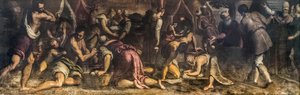
      Michelangelo Palma il Giovane’s “The Crucifixion of St Peter,” painted in 1614, is not merely a depiction of a pivotal moment in Christian history; it's a profound exploration of suffering, faith, and the raw emotion of martyrdom. This monumental canvas, measuring 170 x 135 cm, transports the viewer directly into the heart of the scene – a chaotic yet deeply moving tableau unfolding outdoors beneath a dramatic, stormy sky. Palma,…

      Pietà with Angels (1620) af Palma Giovane
      2

      Pietà with Angels

      1620 · Oil · Kunsthistorisches Museum, Wien

      A heavy, limp body rests across the lap of the Virgin Mary. The pale skin of Christ contrasts against the deep red of her tunic and the dark blue of her mantle. Shadows swallow the background, pushing the figures forward into a sharp, theatrical light. Two large angels flank the upper scene, their faces etched with grief. Below, small cherubs support the weight of the limbs, one near the arm…

      Paolo Veronese (1600) af Palma Giovane
      3

      Paolo Veronese

      1600 · Oil On Canvas · Galleria degli Uffizi, Firenze

      A Venetian Synthesis: Palma il Giovane’s Portrait of Saint Philip Jacopo Palma il Giovane, a pivotal figure in the Venetian Renaissance, stands as a testament to the artistic dynamism that flourished during his lifetime. Born in Venice in 1548 and tragically deceased in 1628, he inherited a legacy from his father, Jacopo Palma Vecchio—a lineage steeped in tradition yet driven by an unwavering pursuit of innovation. His formative years were…

      The Conversion of Saint Paul (1590) af Palma Giovane
      4

      The Conversion of Saint Paul

      1590 · Oil · Museo del Prado, Madrid

      The air thickens with sudden, celestial violence as the scene erupts in a chaotic swirl of motion. Saul, once a persecutor of the faithful, is caught in a moment of profound physical and spiritual disorientation. He is thrown from his horse, a heavy, muscular form tumbling toward the earth, while the animal recoils in a tangle of limbs and frantic energy. Above this earthly commotion, a brilliant, piercing light breaks…

      The Crucifixion (1596) af Palma Giovane
      5

      The Crucifixion

      1596 · Oil On Canvas · Metropolitan Museum of Art, New York

      The composition reflects the transition from the High Renaissance to the burgeoning drama of the Baroque. The style is characterized by intense emotional weight and dynamic movement typical of the late Renaissance or Mannerist period. The texture appears smooth yet painterly, capturing the anatomical detail of Christ's torso and the heavy fabric of the mourning figures. Through the use of light as a narrative tool, the composition guides the eye…

      Venus and Mars (1605) af Palma Giovane
      6

      Venus and Mars

      1605 · Oil On Canvas · J. Paul Getty Museum, Los Angeles

      The oil on canvas work titled Venus and Mars presents a mythological encounter between the personification of love and the god of war. Painted by Palma il Giovane, the scene captures these lovers in a moment of intimate proximity. The figures of Venus and Mars respond to one another through anticipatory gestures, their bodies arranged in a way that suggests a shared, private space. A small Cupid occupies the lower…

      The prophet Nathan admonishes King David (1600) af Palma Giovane
      7

      The prophet Nathan admonishes King David

      1600 · Oil On Canvas · Kunsthistorisches Museum, Wien

      The oil painting The prophet Nathan admonishes King David presents an emotionally charged biblical scene set within a shallow, stage-like space. The composition centers on two primary figures engaged in an intense interaction. On the left, King David is depicted sitting in a large, ornate golden throne. He wears a red velvet robe trimmed with thick white ermine fur and a prominent gold crown, his posture heavy and dejected with…

      Portrait of a Sculptor (1605) af Palma Giovane
      8

      Portrait of a Sculptor

      1605 · Oil On Canvas · Kunsthistorisches Museum, Wien

      The room falls into a heavy, quiet stillness as we gaze upon an elderly man, his face etched with the deep lines of a life spent in focused labor. He sits in a three-quarter view, caught in a moment of profound introspection. A sharp, directional light enters from the upper left, carving his features out of the surrounding darkness. This intense chiaroscuro pulls his weathered forehead and greyish-white beard into…

      Lamentation with angels (1612) af Palma Giovane
      9

      Lamentation with angels

      1612 · Oil · Kunsthistorisches Museum, Wien

      In this 1612 oil painting, we find ourselves drawn into the immediate, heavy atmosphere of the Lamentation. The composition centers on the pale, lifeless body of Christ, which lies horizontally across the lower half of the frame. There is a stillness here that feels almost physical, a quietude that contrasts with the intense emotional weight of the scene. To the left, a figure draped in deep red robes holds a…

      Judith Placing the Head of Holofernes onto a Cloth Held by Another Female Figure, the Foreshortened Body of Holofernes Gushes with Blood from the Neck (1628) af Palma Giovane
      10

      Judith Placing the Head of Holofernes onto a Cloth Held by Another Female Figure, the Foreshortened Body of Holofernes Gushes with Blood from the Neck

      1628 · Etching

      In this etching print, we find ourselves witnessing a scene of profound, sudden movement. The composition centers on the aftermath of a decisive act: Judith is captured in the precise, heavy moment of placing the severed head of Holofernes onto a cloth. Another female figure assists, her hands steadying the fabric to catch the weight of the deed. There is a certain anatomical tension here, particularly in the foreshortened body…

      Palma Giovane: lærreder fra 11 til 100 på ranglisten

      Pietá (1611) af Palma Giovane
      #13

      Pietá

      1611 · Museo del Prado

      In this somber work titled Pietá, Palma il Giovane captures a moment of profound grief. Also known as Iacopo Negretti, the artist was a significant figure in the…

      Bring dette lys hjem →
      St Sebastian (1590) af Palma Giovane
      #17

      St Sebastian

      1590 · Hermitage Museum

      A single, muscular figure clings to the rough bark of a dark tree, his body a landscape of physical strain and quiet endurance. The light catches the pale,…

      Bring dette lys hjem →
      Flagellation of Christ (1586) af Palma Giovane
      #20

      Flagellation of Christ

      1586 · Bavarian State Painting Collections

      In the Flagellation of Christ, Palma il Giovane constructs a scene of profound tension and movement. The composition is dynamic, pulling the eye through a series of sharp,…

      Få det malet i hånden →
      Portrait of a Gentleman (1590) af Palma Giovane
      #23

      Portrait of a Gentleman

      1590 · Art Institute of Chicago

      A somber, three-quarter length portrait of an elderly man emerges from a deep, dark background. The subject is positioned slightly off-center, lending a sense of physical weight to…

      Bestil dette lærred →
      Return of the Prodigal Son (1595) af Palma Giovane
      #61

      Return of the Prodigal Son

      1595 · Gallerie dell'Accademia di Venezia

      In the heart of Venice, within the hallowed halls of the Gallerie dell'Accademia, resides a masterpiece that captures the very essence of human vulnerability and divine grace. Jacopo…

      Bring dette lys hjem →
      Cain and Abel (1603) af Palma Giovane
      #68

      Cain and Abel

      1603 · Kunsthistorisches Museum

      Cain and Abel, a religious painting by Palma il Giovane, captures the violent climax of the first murder in the Book of Genesis. The work focuses on the…

      Få det malet i hånden →
      Annunciation (1600) af Palma Giovane
      #69

      Annunciation

      1600 · Madonna dell'Orto

      In this Annunciation by Palma il Giovane, the canvas splits into two distinct realms. The lower portion holds the earthly sphere, where the Virgin Mary kneels in profile…

      Få det malet i hånden →
      Washing of the Feet (1591) af Palma Giovane
      #71

      Washing of the Feet

      1591 · San Giovanni in Bragora

      In "Washing of the Feet" by Jacopo Palma il Giovane, the canvas captures a quiet moment of service from the Gospel. Completed in 1591, the work focuses on…

      Bestil dette lærred →
      Lamentation (1620) af Palma Giovane
      #72

      Lamentation

      1620 · National Gallery of Art

      The heavy silence of a profound loss hangs in the air within Lamentation, a work by Palma il Giovane. This oil on canvas captures a moment of deep…

      Bestil dette lærred →
      Joseph and Potiphar's Wife af Palma Giovane
      #73

      Joseph and Potiphar's Wife

      Statens Museum for Kunst

      The composition is defined by a sharp, diagonal movement that captures a moment of sudden, physical struggle. On the left, a woman reclines with an intense focus, her…

      Bring dette lys hjem →
      The Flagellation af Palma Giovane
      #81

      The Flagellation

      Museo del Prado

      The air in the room feels heavy, thick with the scent of dust and old stone. In the center of a claustrophobic, swirling chaos, a man hangs bound…

      Bestil dette lærred →
      A Venetian Senator af Palma Giovane
      #98

      A Venetian Senator

      Museo del Prado

      The gaze of an older man meets the viewer in A Venetian Senator, a work by Jacopo Palma Il Giovane. This portrait captures a figure of significant presence,…

      Bring dette lys hjem →
      Amusements of the Prodigal Son (1595) af Palma Giovane
      #99

      Amusements of the Prodigal Son

      1595 · Gallerie dell'Accademia di Venezia

      A Venetian Revelry: Palma Giovane’s “Amusements of the Prodigal Son” Jacopo Palma il Giovane's "Amusements of the Prodigal Son," painted in 1595, is more than just a depiction…

      Bestil dette lærred →

      Hvad Palma Giovane har malet mest af

      De fire motiver, der optræder hyppigst på disse lærreder, hver med sit mest elskede eksempel.

      Hvor Palma Giovane's lærreder hænger

      De 8 museer, der rummer flest af malerierne på denne side.

      Museum By Værker af Palma Giovane Malerier fra denne liste
      Bavarian State Painting Collections, MünchenBavarian State Painting Collections München 14 Moses Brings the Tablets of the Law, Adoration of the Shepherds, Flagellation of Christ
      Kunsthistorisches Museum, WienKunsthistorisches Museum Wien 8 Pietà with Angels, The prophet Nathan admonishes King David, Portrait of a Sculptor
      Museo del Prado, MadridMuseo del Prado Madrid 5 The Conversion of Saint Paul, Pietá, David with Goliath's Head
      Royal Collection, LondonRoyal Collection London 5 The Expulsion of the Vices of the Church, Venus and Cupid, Prometheus Chained to the Caucasus
      Dogepaladset, VenedigDogepaladset Venedig 4 The Pope allows Otto to go to his father to negotiate peace, Victory of Francesco Bembo over Filippo Maria Visconti, Allegory of the Victory over the League of Cambrai (detail)
      Gallerie dell'Accademia di Venezia, VenedigGallerie dell'Accademia di Venezia Venedig 3 The Crucifixion of St Peter, Return of the Prodigal Son, Amusements of the Prodigal Son
      Hermitage Museum, Sankt PetersborgHermitage Museum Sankt Petersborg 2 St Sebastian, Apostles at the Virgin's Tomb
      Fitzwilliam MuseumFitzwilliam Museum 2 Christ calling Zacchaeus, Elijah and the Angel

      Palma Giovanes mest berømte lærred, årti efter årti

      1. 1560s
      2. 1570s
      3. 1580s
        Portrait of Niccolo da Ponte (1491-1585), Doge of Venice (1580) af Palma Giovane
        11 ud af 100

        Portrait of Niccolo da Ponte (1491-1585), Doge of Venice

        Alder 30 – 39 · Kunsthistorisches Museum

        A heavy silence hangs within the frame as Niccolò da Ponte meets the viewer's gaze. The elderly Doge sits in a three-quarter length pose, his presence commanding the…

      4. 1590s
        The Conversion of Saint Paul (1590) af Palma Giovane
        Rangeret som nr. 4 ud af 100

        The Conversion of Saint Paul

        Alder 40 – 49 · Museo del Prado

        The air thickens with sudden, celestial violence as the scene erupts in a chaotic swirl of motion. Saul, once a persecutor of the faithful, is caught in a…

      5. 1600s
        Paolo Veronese (1600) af Palma Giovane
        3 ud af 100

        Paolo Veronese

        Alder 50 – 59 · Galleria degli Uffizi

        A Venetian Synthesis: Palma il Giovane’s Portrait of Saint Philip Jacopo Palma il Giovane, a pivotal figure in the Venetian Renaissance, stands as a testament to the artistic…

      6. 1610s
        The Crucifixion of St Peter (1614) af Palma Giovane
        1 ud af 100

        The Crucifixion of St Peter

        Alder 60 – 69 · Gallerie dell'Accademia di Venezia

        Michelangelo Palma il Giovane’s “The Crucifixion of St Peter,” painted in 1614, is not merely a depiction of a pivotal moment in Christian history; it's a profound exploration…

      7. 1620s
        Pietà with Angels (1620) af Palma Giovane
        Rangeret som nr. 2 ud af 100

        Pietà with Angels

        Alder 70 – 78 · Kunsthistorisches Museum

        A heavy, limp body rests across the lap of the Virgin Mary. The pale skin of Christ contrasts against the deep red of her tunic and the dark…

      Palma Giovanes lærreder, spørgsmål for spørgsmål

      Hvilket lærred er Palma Giovane mest kendt for?Læs svaret

      The Crucifixion of St Peter (1614), Gallerie dell'Accademia di Venezia, Venedig. Pietà with Angels (1620) og Paolo Veronese (1600) følger efter.

      The Crucifixion of St Peter: hvor gammel var Palma Giovane, da det blev malet?Læs svaret

      Palma Giovane, født i 1550, var 64 år gammel: The Crucifixion of St Peter er fra 1614.

      Hvad er Palma Giovanes ti mest berømte lærreder?Læs svaret

      The Crucifixion of St Peter, Pietà with Angels, Paolo Veronese, The Conversion of Saint Paul, The Crucifixion, Venus and Mars, The prophet Nathan admonishes King David, Portrait of a Sculptor, Lamentation with angels og Judith Placing the Head of Holofernes onto a Cloth Held by Another Female Figure, the Foreshortened Body of Holofernes Gushes with Blood from the Neck. Hvert lærred i den ovenstående rangliste er angivet med årstal og museum.

      Hvor mange malerier har Palma Giovane skabt?Læs svaret

      161 værker af Palma Giovane er i vores katalog, dateret fra 1569 til 1628.

      Hvor hænger Palma Giovanes mest berømte lærreder i dag?Læs svaret

      Primært i Bavarian State Painting Collections (München), Kunsthistorisches Museum (Wien) og Museo del Prado (Madrid); listen ovenfor nævner hvert museum og dets lærreder.

      Hvornår malede Palma Giovane sine mest berømte lærreder?Læs svaret

      I 1590s, som udgør 27 af de 100 værker på denne side, herunder The Conversion of Saint Paul.

      Hvilket berømt lærred af Palma Giovane kom først, og hvilket kom sidst?Læs svaret

      Det tidligste lærred her er Fighting soldiers (1569); det seneste er Judith Placing the Head of Holofernes onto a Cloth Held by Another Female Figure, the Foreshortened Body of Holofernes Gushes with Blood from the Neck (1628).

      Hvilke motiver malede Palma Giovane mest?Læs svaret

      Man (14), Woman (8) og People (7), fordelt på de 100 værker på denne side.

      Hvilket medie optræder hyppigst i Palma Giovane's malerier?Læs svaret

      Oil On Canvas, anvendt i 20 af de 100 værker på denne side.

      Hvilken stilart er Palma Giovane associeret med?Læs svaret

      Renaissance og Baroque, som lærrederne på denne side viser.

      Hvilke malerier af Palma Giovane er i Bavarian State Painting Collectionss samling?Læs svaret

      Bavarian State Painting Collections, München har 13 af værkerne på denne side, herunder Moses Brings the Tablets of the Law, Adoration of the Shepherds og Flagellation of Christ.

      Hvor kan jeg købe en reproduktion af et maleri af Palma Giovane?Læs svaret

      Ja. Hvert maleri på denne side kan bestilles fra sin egen side som en håndmalet oliereproduktion eller som et kunsttryk i den størrelse, du vælger.

      Mød maleren: Palma Giovane

      Jacopo Palma il Giovanes strålende eftermæle

      I den venetianske renæssances gyldne skumring, en periode defineret af en uovertruffen beherskelse af farve og lys, trådte en maler frem, hvis penselstrøg byggede bro mellem højrenæssancen og barokkens spirende drama. Jacopo Palma il Giovane, født som Iacopo Negretti omkring 1548, var ikke blot en efterfølger til de store mestre, men et livsvigtigt led i den venetianske skoles kontinuitet. Som grandnevø til den berømte Palma Vecchio blev han født ind i en slægt af kunstnerisk ekspertise og arvede en dyb forståelse for den kromatiske rigdom, der kendetegner den venetianske tradition. Hans liv og virke repræsenterer en sømløs overgang, der førte forgængernes lysende elegance ind i en ny æra af følelsesmæssig intensitet og teatralsk storhed.

      Fundamentet for Palmas kunstneriske virke blev lagt i Venedigs værksteder, hvor luften var tyk af arven fra Tizian og Tintoretto. Selvom historiske beretninger antyder, at han kan have forfinet sin teknik gennem studiet af Tizians betagende farvepaletter, var det Tintorettos dynamiske energi, der for alligent formede hans modne vision. Efter Tintorettos død i 1594 steg Palma il Giovane til en position af fremtrædenhed og blev den dominerende kunstneriske kraft i Venedig. Han besad en sjælden evne til at syntetisere disse to vidt forskellige indflydelser: Fra Tizian hentede han en sofistikeret kontrol over lys og hudtoner, mens han fra Tintoretto adopterede en følelse af bevægelse, dramatisk chiaroscuro og en narrativ hastighed, der resonerede dybt med modreformationens religiøse iver.

      En mester af fortælling og emotion

      Palma il Giovanes værk er et vidnesbyrd om hans evne til at transformere bibelske og mytologiske temaer til sanselige menneskelige erfaringer. Hans malerier er sjældent statiske; de pulserer med en livskraft, der drager beskueren ind i dramaets hjerte. Uanset om han skildrer alvoren i et religiøst martyrium eller det livlige kaos i en værtshusscene, bruger hans arbejde lyset som et fortællerværktøj, der guider øjet gennem komplekse kompositioner for at finde historiens følelsesmæssige kerne. Hans mesterskab er særligt tydeligt i værker som Sankt Catharina af Alexandrias martyrium, hvor samspillet mellem skygge og glans forstærker følelsen af guddommelig kamp, og Apostlene ved Jomfruens grav, som indfanger et dybt øjeblik af kollektiv sorg gennem svungne, energiske penselstrøg.

      Udover sine religiøse bestillingsværker tillod Palmas alsidighed ham at udforske et bredt spektrum af emner. Hans talent for at indfange den menneskelige ånd ses måske mest intimt i hans Selvportræt, et værk der afslører en sjælfuld introspektion og en teknisk kunnen, der er i stand til at gengive de fineste nuancer i ansigtsudtrykket. Selv i mere verdslige eller anekdotiske scener, såsom Den fortabte søns fornøjelser, opretholder han en levende, rytmisk kvalitet, der fejrer teksturerne og farverne i det venetianske liv. Denne evne til at svinge mellem det dybsindige og det legende sikrede hans relevans i forskellige mæcenatkredse, fra de kirkelige myndigheder i Venedig til de kejserlige hoffer i Centraleuropa.

      Historisk betydning og vedvarende indflydelse

      Jacopo Palma il Giovanes historiske betydning rækker langt ud over Den Venetianske Republiks grænser. Hans indflydelse spredte sig udad og nåede helt til Bergamo og hoffet hos kejser Rudolf II i Prag, hvilket markerede ham som en kunstner af international rang. Han blot kopierede ikke fortiden; han udviklede den og forberedte jorden for de mere følelsesladede og dramatiske stilarter, der skulle definere det 17. århundrede. Ved at vejlede efterfølgende generationer, herunder skikkelser der yderligere ville forfine den venetianske æstetik, sikrede han, at hans slægts traditioner forblev levende og transformative.

      I dag anerkender vi Palma il Giovane som en skelsættende figur, hvis arbejde fungerer som en bro mellem epoker. Hans eftermæle findes i:

      • Syntesen af stilarter: Den sømløse integration af Tizians koloristiske genialitet med Tintorettos dramatiske dynamik.
      • Modreformationens kunstneriske udtryk: Brugen af kraftfuld billedsprog til at kommunikere den spirituelle intensitet, som den katolske kirke krævede i en periode med dybe religiøse forandringer.
      • <Den venetianske skoles fortsættelse: Opretholdelsen af Venedigs status som et globalt epicenter for kunst gennem hans omfattende bestillingsværker og pædagogiske indflydelse.

      Gennem sin ekspressive pensel og mesterlige brug af lys indfangede Palma il Giovane selve essensen af en verden i forandring, og efterlod sig et værk, der fortsat betager og bevæger den moderne beskuer.

      Alle 161 værker af Palma Giovane →