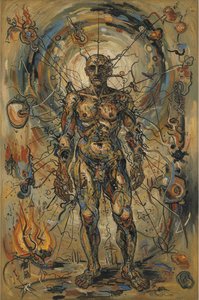
The Surrealist Reality of Valentine Hugo
To look at the work of Valentine Hugo is to confront the raw edges of the twentieth-century avant-garde. She was not a mere bystander in the French Surrealist circle; she was an active, often volatile participant. While history frequently relegates women of this era to the role of muses, Hugo’s presence was defined by her technical versatility and her direct involvement in the movement's most famous experiments. From wood engravings for Jean Cocteau to the collaborative cadavre exquis drawings, her hand is unmistakable. She did not just observe the revolution; she drove it, quite literally, as the only member of her circle with a vehicle to transport her companions through the Parisian landscape.
Her early career was anchored in the discipline of the École des Beaux-Arts in Paris. This formal training under Jacques Fernand Humbert provided the foundation for a practice that would later embrace much more radical forms. Before the Surrealist label took hold, Hugo’s work was deeply connected to the theatricality of the Ballets Russes. Her sketches and designs for productions like Parade and Roméo et Juliette demonstrate a sharp eye for movement and costume. This period established her connection to figures such as Jean Cocteau and Vaslav Nijinsky, grounding her later, more abstract explorations in a concrete understanding of stagecraft and visual impact.
A Life Defined by Friction
The personal and professional lives of Hugo were inseparable and often collided with violent results. Her marriage to the painter Jean Hugo brought her into the heart of an influential artistic dynasty, yet it was her tumultuous relationship with André Breton that truly placed her at the center of Surrealist tension. The fallout from this affair was not merely emotional; it was physical and public, marked by a documented incident where she punched Breton in the mouth. Such friction is essential to understanding her work. It stripped away any pretense of polite salon culture, leaving behind an art that dealt with the unsettling and the subconscious.
Her technical repertoire was as varied as her associations. She moved between several distinct modes of creation:
- Painting and Oil on Panel: Notable for works like the Portrait d’Arthur Rimbaud, which utilized collage elements such as rhinestones to disrupt the surface.
- Printmaking: Including wood engravings, lithographs, and dry-point etchings.
- Drawing and Pastel: Often executed on black paper to enhance the luminosity of her gouache applications.
- Design: Costume and set design for theatre and ballet.
The Weight of the Image
Hugo’s significance lies in her ability to translate the psychological instability of her era into tangible objects. Her Objet à fonctionnement symbolique (1931) remains a primary example of how she utilized the Surrealist interest in symbolic function. She did not shy away from the darker, more disturbing elements of the movement. In her later years, even as she returned to stage design, she continued to paint "in secret," maintaining a sense of surprise and chance that defined her aesthetic. Her work, now held in permanent collections like the Museum of Modern Art (MoMA) and the Tate, demands a reassessment of the female Surrealist as an author of the movement's visual language rather than a peripheral figure.