Das melancholische Porträt von Jeanne Hebutern – Ein Fenster in die Seele des Expressionismus
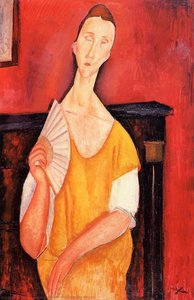
Amedeo Modigliani’s “Portrait of Jeanne Hebutern” from 1918 is more than just a painting; it's an intimate glimpse into the soul of a woman and a profound meditation on beauty, fragility, and the inherent melancholy that permeated the artist’s life. This arresting image, currently residing in the Yale University Art Gallery, immediately draws the viewer in with its stark simplicity and intensely focused gaze. The subject, Jeanne Hebutern, is presented not as a grand figure of societal importance, but as an individual – vulnerable yet undeniably captivating – captured within a remarkably restrained composition.
The painting’s power lies largely in Modigliani's masterful manipulation of form and color. His signature elongated features, a hallmark of his style, are particularly evident here, lending Jeanne Hebutern a subtly unsettling elegance. Her face is an exercise in controlled distortion; the nose, slightly oversized and sharply defined, contrasts dramatically with her closed eyes, creating a sense of quiet contemplation or perhaps even suppressed sorrow. The background – a plain, unadorned wall – serves to heighten this effect, isolating the subject and forcing us to confront her directly. This deliberate reduction of visual elements is characteristic of Modigliani’s approach, prioritizing emotional resonance over detailed representation.
Die Wurzeln des Expressionismus in einem jüdischen Erbe
To fully appreciate “Portrait of Jeanne Hebutern,” it's crucial to understand the context within which it was created. Born into a Jewish family in Livorno, Italy, in 1884, Modigliani’s life was shaped by both artistic ambition and personal hardship. His early years were marked by illness – recurring bouts of pleurisy and typhoid fever – experiences that undoubtedly contributed to the pervasive sense of vulnerability that permeates his work. His family's financial struggles further complicated his path, yet it was through exposure to the philosophical writings of Nietzsche, Baudelaire, and Lautréamont—introduced by his mother and grandfather—that he developed a radical artistic sensibility, one that rejected academic conventions in favor of expressing inner emotions.
The influence of these thinkers is palpable in Modigliani’s work. He sought to capture not merely the outward appearance of his subjects but their emotional state, their unspoken desires, and their underlying anxieties. “Portrait of Jeanne Hebutern” embodies this ambition perfectly; it's a study in psychological depth rendered through simplified forms and carefully chosen colors.
Farben, Licht und die Sprache der Distanz
Modigliani’s palette is deliberately restrained – primarily consisting of muted earth tones punctuated by the vibrant red of Jeanne Hebutern’s hair. This strategic use of color serves to amplify the painting's emotional impact. The red, a symbol of passion and vitality, stands in stark contrast to the cool, somber background, creating a visual tension that mirrors the subject’s internal state. The lighting is equally deliberate; it’s soft and diffused, casting gentle shadows across her face and contributing to the overall atmosphere of quiet introspection.
Furthermore, Modigliani employs a technique known as “distancing,” where he deliberately creates a sense of separation between himself and his subject. This isn't achieved through physical distance but rather through stylistic choices – the simplified forms, the lack of detail, and the carefully controlled composition—that invite the viewer to engage with the painting on an emotional level rather than simply observing it as a representation of reality.
Ein Erbe der Sehnsucht und des Verlustes
“Portrait of Jeanne Hebutern” is not merely a beautiful image; it’s a poignant reflection of Modigliani's own life—a life marked by both artistic brilliance and profound personal loss. His tragically short career, cut short by illness and poverty, imbued his work with a sense of longing and melancholy that continues to resonate with viewers today. This painting, like many others in his oeuvre, speaks to the universal human experience of vulnerability, beauty, and the bittersweet nature of existence. Owning a high-quality reproduction allows one to bring this powerful piece into their own space, inviting contemplation and offering a connection to the enduring legacy of Amedeo Modigliani.



 Preview
 Druck bestellen
 Versenden
 Teilen
 Details anzeigen

 Herunterladen
 Ähnliche Objekte
 Röntgenaufnahme
 Diashow anzeigen


 Weiterlesen






































 Die Glasoption ist nur in Größen unter 110 cm verfügbar.