A Tapestry of Time: Unveiling England’s Heritage in Doncaster The English Heritage Trust’s Doncaster sites – Brodsworth Hall & Gardens and Conisbrough Castle – stand as poignant reminders of Britain's evolving narrative, offering visitors an immersiv...
The weight of history is often most palpable where the stone meets the sky. In the rugged landscapes of Britain, certain structures do not merely occupy space; they anchor it. Conisbrough Castle, with its imposing 12th-century stone keep, serves as a silent witness to the strategic shifts of the Norman era. Its architecture was born from necessity—a robust engineering feat designed to withstand the pressures of siege and the passage of centuries. When we look upon such heavy, weathered masonry, we are seeing more than a ruin; we and observing a period where power was expressed through physical permanence and unyielding defense.
This sense of enduring strength finds a parallel in the way artists approach the geological bones of the land. Just as the Norman builders relied on the stability of stone, painters like Paul Cézanne sought to find a structural language within the natural world. In his work Rocks at Fontainebleau, the focus shifts from the fleeting light to the eternal weight of the boulder. He used deep purples and earthy browns to sculpt form, much like the heavy foundations of a medieval keep. Both the castle and the canvas remind us that beneath the surface of change, there exists a fundamental, unmoving architecture.
Refined Borders: Victorian Estates and the Art of Controlled Nature
A Tapestry of Time: Exploring England’s Heritage Through Its Historic Sites Step into a realm where centuries whisper from weathered stones and vibrant tapestries unfold across landscapes steeped in legend. English Heritage isn't merely a collection ...
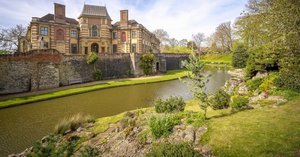
As the centuries progressed, the raw power of the medieval landscape gave way to a more curated, domestic elegance. The Victorian era introduced a different kind of mastery over the earth—one defined by social standing and the careful arrangement of flora. At Brodsworth Hall in Doncaster, the gardens reflect this 19th-century desire for order. Here, the landscape is an extension of the home, where formal lawns and herbaceous borders create a serene, structured atmosphere. This was a period when the estate became a stage for displaying refined taste, using nature to mirror the complex social rituals of the era.
This impulse toward controlled beauty echoes the meticulous traditions found in British landscape painting. Artists like Charles Crombie, trained at the Royal College of Art, brought a quiet, disciplined beauty to his depictions of the countryside. His work does not seek to disrupt the peace but to honor its structured serenity. Much like the manicured borders of a Victorian estate, Crombie’s paintings offer a sense of composed elegance, capturing the landscape with a precision that respects the boundaries between the wild and the cultivated.
Shifting Light: Impressionist Revolutions and the English Mist
An Impressionistic Whisper of the English Countryside In this evocative Landscape Study , Sir Alfred James Munnings invites the viewer into a world where the boundaries between earth and sky dissolve into a poetic haze. The painting captures a moment...
The rigid structures of the past eventually encountered a revolution of perception. In the late 19th century, the arrival of Impressionism challenged the idea that a landscape must be defined by hard edges or permanent boundaries. Artists began to look at the atmosphere itself—the way a morning mist clings to a river or how a sunset dissolves the horizon into violet haze. This movement was a rebellion against the controlled shadows of the studio, favoring the en plein air experience where light is never static. It was an attempt to capture the very pulse of a moment before it vanished.
We see this pursuit of the ephemeral in the works of Sir Alfred James Munnings, whose Landscape Study invites us into a world of atmospheric stillness. He does not focus on topographical accuracy but rather on the way light and heavy skies interact to create a poetic haze. His use of thick, textured oil paint allows the viewer to feel the movement of the clouds and the dampness of the air. In this way, the Impressionist tradition connects us to the transient nature of our own lives, reminding us that beauty often resides in the most fleeting of transitions.
The Painter’s Legacy: Preserving Vanishing Rural Rhythms
James Henry Crossland: A Yorkshire Painter of Mountain Majesty James Henry Crossland (1852-1939) emerges from the heart of Victorian England as a quietly significant landscape artist, a master of capturing the rugged beauty and atmospheric drama of t...
There is a profound melancholy in observing a landscape that is slowly receding from the modern world. For many artists, the act of painting was a way to document the rhythms of rural life before they were altered by industrialization and urban expansion. James Henry Crossland, working within the Yorkshire Dales and the Peak District, captured the rugged, dramatic weather and the solitary beauty of the mountains. His work provides an intimate glimpse into a world of swirling mists and golden sunsets, preserving the essence of a landscape that feels increasingly distant from our digital age.
This preservation of memory is a heavy responsibility held by both the artist and the historian. Just as Crossland used his brush to hold onto the atmospheric drama of the Yorkshire hills, organizations like English Heritage work to safeguard the physical remnants of our past. By protecting sites ranging from prehistoric monuments to Victorian industrial landmarks, they ensure that the stories woven into the earth are not lost to time. The painting and the monument both serve as vessels for a collective memory, keeping the textures of previous generations accessible to those of us living in the present.
Layers of Identity: How Landscapes Shape National Character
Captivating Subject and Lush Landscape Immerse yourself in the vibrant beauty of a tropical paradise captured through the masterful brushwork of Paul Gauguin. This evocative scene depicts the lush, mountainous terrain of Martinique, where the natural...
Ultimately, a landscape is more than a collection of hills, rivers, and trees; it is a living synthesis of people and place. The way we inhabit the land—through our architecture, our agriculture, and our art—defines our identity. From the strategic importance of Tintagel Castle to the expansive vistas of the English countryside, these views provide the backdrop for our national narrative. The landscape holds the tension between what was built by hand and what grew from the soil, creating a complex layers of history that we continue to navigate.
This ongoing dialogue between the land and its inhabitants is reflected in the very evolution of the word "landscape" itself. Emerging from the Dutch landschap, the term has always been about more than just scenery; it is about the way we perceive our surroundings. Whether through the bold, expressive colors of Gauguin’s Martinique Landscape or the subtle, personal flair of British masters, we are constantly reinterpreting our relationship with the earth. To look upon a landscape is to see ourselves reflected in the enduring patterns of the world around us.
At TopImpressionists.com, we believe that every brushstroke carries a piece of this history. Through our hand-painted reproductions and custom commissions, we invite you to bring these layers of time and texture into your own space, honoring the profound beauty of the landscapes that shaped us.
Vom TopImpressionists.com Redaktionsteam
Paul Cézanne
b. 1839 · Aix-en-Provence, Frankreich
Französischer Postimpressionist, der durch Farbmodulation und geometrische Formen den Mont Sainte-Victoire mit konstruktiven Pinselstrichen einfing.
Erleben Sie die Magie der englischen Romantik: Entdecken Sie die 25 bedeutendsten Meisterwerke von John Constable. Von atmosphärischen Landschaften bis zu meisterhaften Ölmalereien – finden Sie Inspiration und museale Kunstreproduktionen auf TopImpressionists.com.
TIAtelier-ConciergeOnline · antwortet innerhalb einer Minute
Hallo! Ich kann Ihnen dabei helfen, ein Kunstwerk auszuwählen, eine Bestellung zu verfolgen oder Fragen zur Garantie zu beantworten. Wie kann ich Ihnen heute behilflich sein?



 English Heritage
 English Heritage
 Landscape Study
 James Henry Crossland
 Martinique Landscape


