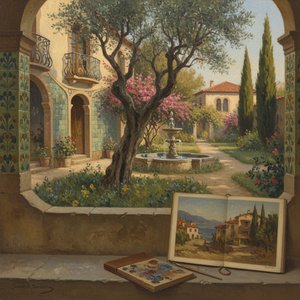
Isidoro Marin Gares: Granada’s Watercolorist and Echoes of Impressionism
Isidoro Marín Garés (1863 – 1926) occupies a niche yet vital position in Spanish art history, primarily celebrated for his exquisite watercolors that capture the essence of Granada and its surrounding Andalusian region. Born in Granada, Spain, he pursued an artistic path profoundly shaped by influences ranging from Mariano Fortuny to the burgeoning Impressionist movement—a confluence that resulted in artworks brimming with both meticulous observation and atmospheric sensitivity. Beyond merely producing aesthetically pleasing images, Marín Garés was a multifaceted craftsman – ceramicist, art restorer – actively interwoven into Granada’s cultural fabric, demonstrating an unwavering dedication to artistic pursuits and civic engagement.
Early Life and Artistic Training
Marín Garés began his artistic education at the Escuela de Bellas Artes de Granada, where he diligently honed his skills under the guidance of respected instructors. Despite exhibiting only once outside Granada – specifically at the Barcelona Universal Exposition of 1888 – this singular appearance signaled an ambition to transcend regional limitations and engage in dialogues with broader artistic currents. The exposition served as invaluable exposure to international trends, notably Impressionism, which exerted a decisive impact on his stylistic sensibilities. This formative experience instilled within him a desire to explore new horizons while retaining the core principles of realism and expressive color.
Influences and Artistic Style
Mariano Fortuny’s meticulous technique—characterized by layering glazes and achieving remarkable tonal gradations—served as an indelible cornerstone for Marín Garés' artistic approach. Like Fortuny, he prioritized capturing the subtle nuances of light and shadow, striving to convey not simply what was seen but also how it felt – a hallmark of Impressionistic art. This commitment to realism combined with Impressionistic techniques—particularly broken brushstrokes and vibrant hues—produced watercolors imbued with an ethereal luminescence that distinguishes them from more conventional depictions. His landscapes are meticulously rendered, revealing the textures of stone, foliage, and water with astonishing precision; a testament to his dedication to capturing the true spirit of Granada’s natural beauty.
Notable Works and Artistic Contributions
Marín Garés' oeuvre comprises numerous watercolor paintings depicting iconic Granada landmarks – La Vega, the city’s historic agricultural heartland – alongside scenes from everyday Andalusian life. These works exemplify Costumbrista painting—a genre dedicated to portraying authentic Spanish customs and traditions—reflecting a deep connection to his cultural heritage. He was also an active participant in the Centro Artístico Literario y Científico de Granada, fostering artistic collaboration and promoting the dissemination of watercolor techniques within the local community. Furthermore, he co-founded the Granada Watercolorists’ Society, nurturing camaraderie amongst fellow artists and championing the advancement of watercolor artistry. His paintings are held in prominent museums across Spain, ensuring his legacy continues to inspire admiration for generations to come.
Legacy and Historical Significance
Isidoro Marín Garés' enduring significance resides not only in his contribution to Granada’s artistic heritage but also in his embodiment of Impressionistic ideals within Spanish painting—a pivotal moment in the evolution of modern art. His watercolors persist as captivating representations of a bygone era, simultaneously celebrating the timeless splendor of the Andalusian landscape and upholding the values of meticulous observation and skillful execution. He stands as an exemplary figure bridging academic tradition with artistic innovation – a poignant reminder that beauty can emerge from both careful study and expressive experimentation.