Ατελιέ — Δωρεάν αποστολή σε όλο τον κόσμο — Παράδοση σε 2–6 εβδομάδες
      Χένρι Σκάουτ Τούκε, 1858 – 1929

      Χένρι Σκάουτ Τούκε's 100 Most Famous Paintings

      The Critics (1927) is the painting Χένρι Σκάουτ Τούκε is best remembered for. Morning splendour (1921) and Summer Dreams (sketch) complete the trio of best-loved canvases. Our catalogue counts 204 works by Χένρι Σκάουτ Τούκε. Here are the 100 most famous, with the year, the museum and the story of each canvas.

      Καταταγίζονται με βάση το σκορ δημοφιλίας μας, το οποίο συνδυάζει τις αναζητήσεις, τις επισκέψεις και τις παραγγελίες για κάθε έργο. Ενημερώθηκε Οκτώβριος 2026. Each painting on this page can be ordered as an oil reproduction painted by hand on linen canvas, or as a fine art print, made to the size you choose.

      Πορτρέτο του Χένρι Σκάουτ Τούκε
      Χένρι Σκάουτ Τούκε · 1858 – 1929
      Γεννημένος · πεθνημένος
      1858 – 1929, Γιορκ
      Κίνηση
      Impressionism
      Έργα στον κατάλογό μας
      204
      Τα πιο διάσημα
      The Critics (1927)
      Πολλές εργασίες στο
      Royal Cornwall Polytechnic Society

      The ten best-loved paintings by Χένρι Σκάουτ Τούκε

      The Critics (1927) του Χένρι Σκάουτ Τούκε
      1

      The Critics

      1927 · Oil

      In this 1927 work, we find ourselves on the shores of Falmouth, caught in a quiet, luminous afternoon. The scene is one of profound stillness, where the heat of the sun seems to settle heavily upon the sand. Two young men recline on the beach, their backs to us, anchored by the sheer weight of their relaxation. They gaze toward the horizon, lost in a shared moment of repose. From…

      Morning splendour (1921) του Χένρι Σκάουτ Τούκε
      2

      Morning splendour

      1921 · Oil On Canvas

      “Morning Splendour,” painted in 1921 by the esteemed English artist Henry Scott Tuke, is a captivating depiction of youthful exuberance and seaside tranquility. This artwork transports viewers to a sun-drenched coastal scene where figures engage in leisurely activities – swimming, rowing, and simply enjoying the warmth of the morning light. More than just a picturesque view, "Morning Splendour" embodies Tuke's signature style and offers a window into early 20th-century British…

      Summer Dreams (sketch) του Χένρι Σκάουτ Τούκε
      3

      Summer Dreams (sketch)

      Oil On Panel

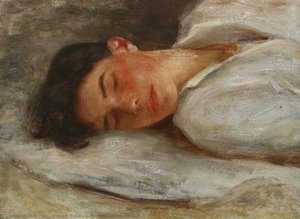
      Summer Dreams (sketch) is an oil on panel work by Henry Scott Tuke. This piece is categorized as a sketch, capturing a specific moment of repose. The artist, Henry Scott Tuke, was a British painter known for his figurative works and his ability to render the human form within natural settings.

      Nude Boy on Rocks (1907) του Χένρι Σκάουτ Τούκε
      4

      Nude Boy on Rocks

      1907 · Oil On Canvas

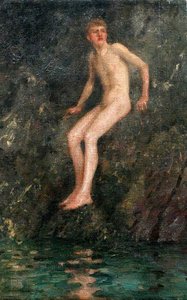
      Nude Boy on Rocks is an oil on canvas painting created by Henry Scott Tuke in 1907. The work depicts a single nude boy positioned upon rocks situated within a body of water. The subject is seated in a natural setting, appearing to look toward something located off-camera. This posture leaves the figure exposed to the elements of the coastal environment.

      Green and Gold (1920) του Χένρι Σκάουτ Τούκε
      5

      Green and Gold

      1920 · Oil On Canvas

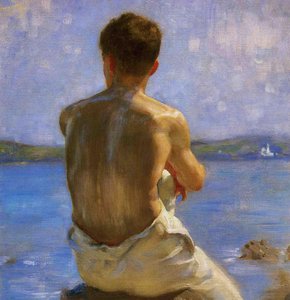
      In the gentle embrace of Henry Scott Tuke’s 1920 masterpiece, "Green and Gold," the viewer is invited to step away from the frantic pace of modern life and into a realm of profound stillness. The painting presents a scene of quiet contemplation, centered around a solitary figure seated upon rugged rocks at the water's edge. With his back turned toward us, the man becomes an avatar for the viewer’s own…

      Reefing the Mainsail (sketch) (1903) του Χένρι Σκάουτ Τούκε
      6

      Reefing the Mainsail (sketch)

      1903 · Oil

      The sea is never still, and here, the water churns in restless, muted blues and browns. A small fishing boat tosses upon the waves, caught in a moment of heavy labor under a thick, overcast sky. Onboard, a fisherman and a young boy move with the rhythmic necessity of those who live by the tides. They are focused on the task at hand, perhaps repairing equipment or securing the vessel…

      Under the Western Sun (1917) του Χένρι Σκάουτ Τούκε
      7

      Under the Western Sun

      1917 · Oil

      Under the Western Sun is a painting by Henry Scott Tuke, created in 1917. The work captures a quiet moment on a beach near the ocean, where the light of the early 20th century settles upon the shore. Two naked men occupy the scene, their forms grounded by the salt and the sand. One man stands while holding a towel, while the other is seated nearby. They exist in a…

      Nude Boy (1881) του Χένρι Σκάουτ Τούκε
      8

      Nude Boy

      1881 · Oil

      Henry Scott Tuke produced Nude Boy in 1881. This work emerged during a period when the artist was traveling through Italy, a journey that followed his formal training at the Slade School of Art in London. The piece reflects the early development of his technical approach to the human form and natural light.

      Dinner Time Ambrose Rouffignac in the Sail Loft (1883) του Χένρι Σκάουτ Τούκε
      9

      Dinner Time Ambrose Rouffignac in the Sail Loft

      1883 · Oil · Penlee House, Penzance

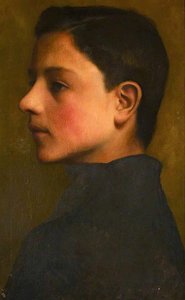
      The oil painting titled Dinner Time Ambrose Rouffignac in the Sail Loft was created by the artist Henry Scott Tuke. This work dates to 1883. The subject of the piece is a young boy positioned within a maritime setting. He is dressed in a blue sweater and brown pants, seated upon a wooden bench. The boy holds a small object in his hands while looking toward the viewer.

      A Holiday (1914) του Χένρι Σκάουτ Τούκε
      10

      A Holiday

      1914 · Watercolor

      Created in 1914, A Holiday is a watercolour by Henry Scott Tuke. This work captures a sense of serenity within a seaside setting, focusing on the quietude of the coast. Through his delicate application of the medium, Tuke explores the subtle nuances of light and the natural environment.

      Χένρι Σκάουτ Τούκε: canvases 11 to 100 of the ranking

      A Bathing Group (1914) του Χένρι Σκάουτ Τούκε
      #17

      A Bathing Group

      1914 · Βασιλική Ακαδημία Τέχνης

      is an oil on canvas painting by Henry Scott Tuke, executed in 1914. The work captures two young adult males positioned upon a sunlit, rocky shore. This landscape,…

      Order this canvas →
      Lord Ronald Sutherland Gower (1897) του Χένρι Σκάουτ Τούκε
      #27

      Lord Ronald Sutherland Gower

      1897 · Εθνική Πορτραίτητος Γκαλερί

      Henry Scott Tuke’s 1897 painting, “Lord Ronald Sutherland Gower,” isn't merely a likeness; it’s a carefully constructed tableau of late Victorian society. The subject himself, Lord Ronald Charles…

      Have it painted by hand →
      A sailor's yarn (1887) του Χένρι Σκάουτ Τούκε
      #44

      A sailor's yarn

      1887 · Art Gallery of New South Wales

      The oil painting titled A sailor's yarn is a work by the artist Henry Scott Tuke. This piece is also identified by the name Crotos. It was executed…

      Have it painted by hand →
      Mrs Florence Humphris (1892) του Χένρι Σκάουτ Τούκε
      #45

      Mrs Florence Humphris

      1892 · Tate Gallery

      Henry Scott Tuke's “Mrs Florence Humphris,” painted in 1892, is more than just a portrait; it’s a carefully constructed tableau of Victorian sensibility and subtle emotional depth. The…

      Have it painted by hand →
      Hermes at The Pool (sketch) (1900) του Χένρι Σκάουτ Τούκε
      #47

      Hermes at The Pool (sketch)

      1900 · Royal Cornwall Polytechnic Society

      The sun hangs heavy over a rugged, rocky landscape, casting a warm glow upon a solitary figure. A naked man sits by the edge of the water, his…

      Order this canvas →

      Χένρι Σκάουτ Τούκε's canvases, period by period

      Late Period

      1884 – 1927 · 3 έργα σε αυτή τη λίστα

      What Χένρι Σκάουτ Τούκε painted most

      The four subjects that return most often on these canvases, each with its best-loved example.

      Where Χένρι Σκάουτ Τούκε's canvases hang

      Τα 8 μουσεία που φιλοξενούν το μεγαλύτερο μέρος των έργων σε αυτήν τη σελίδα.

      Μουσεία Πόλη Έργα του Χένρι Σκάουτ Τούκε Πάτρια από αυτή τη λίστα
      Royal Cornwall Polytechnic Society, FalmouthRoyal Cornwall Polytechnic Society Falmouth 4 Hermes at The Pool (sketch), Jack Rolling
      Βασιλική Ακαδημία Τέχνης, ΛονδίνοΒασιλική Ακαδημία Τέχνης Λονδίνο 2 A Bathing Group
      Penlee House, PenzancePenlee House Penzance 1 Dinner Time Ambrose Rouffignac in the Sail Loft
      Εθνική Πορτραίτητος Γκαλερί, ΛονδίνοΕθνική Πορτραίτητος Γκαλερί Λονδίνο 1 Lord Ronald Sutherland Gower
      Yale Center for British Art, New HavenYale Center for British Art New Haven 1 Portrait of a Young Man with Open Collar
      Bavarian State Painting Collections, ΜόναχοBavarian State Painting Collections Μόναχο 1 Sailors playing cards
      Leeds Art Gallery, ΛιντςLeeds Art Gallery Λιντς 1 The bathers
      Dublin City Gallery The Hugh Lane, ΔουβλίνDublin City Gallery The Hugh Lane Δουβλίν 1 The sun worshipper (In the morning sun)

      Χένρι Σκάουτ Τούκε's most famous canvas, decade after decade

      1. 1870s
      2. 1880s
        Nude Boy (1881) του Χένρι Σκάουτ Τούκε
        Ranked 8 of 100

        Nude Boy

        Ηλικία 22 – 31

        Henry Scott Tuke produced Nude Boy in 1881. This work emerged during a period when the artist was traveling through Italy, a journey that followed his formal training…

      3. 1890s
        In Tow (1893) του Χένρι Σκάουτ Τούκε
        14 of 100

        In Tow

        Ηλικία 32 – 41
      4. 1900s
        Nude Boy on Rocks (1907) του Χένρι Σκάουτ Τούκε
        Canvas 4 of 100

        Nude Boy on Rocks

        Ηλικία 42 – 51

        Nude Boy on Rocks is an oil on canvas painting created by Henry Scott Tuke in 1907. The work depicts a single nude boy positioned upon rocks situated…

      5. 1910s
        Under the Western Sun (1917) του Χένρι Σκάουτ Τούκε
        7 of 100

        Under the Western Sun

        Ηλικία 52 – 61

        Under the Western Sun is a painting by Henry Scott Tuke, created in 1917. The work captures a quiet moment on a beach near the ocean, where the…

      6. 1920s
        The Critics (1927) του Χένρι Σκάουτ Τούκε
        Ranked 1 of 100

        The Critics

        Ηλικία 62 – 71

        In this 1927 work, we find ourselves on the shores of Falmouth, caught in a quiet, luminous afternoon. The scene is one of profound stillness, where the heat…

      Χένρι Σκάουτ Τούκε's canvases, question by question

      Which canvas is Χένρι Σκάουτ Τούκε most remembered for?Read the answer

      The Critics (1927), followed by Morning splendour (1921) and Summer Dreams (sketch).

      The Critics: how old was Χένρι Σκάουτ Τούκε when it was painted?Read the answer

      Χένρι Σκάουτ Τούκε, born in 1858, was 69 years old: The Critics dates from 1927.

      What are Χένρι Σκάουτ Τούκε's ten most famous canvases?Read the answer

      The Critics, Morning splendour, Summer Dreams (sketch), Nude Boy on Rocks, Green and Gold, Reefing the Mainsail (sketch), Under the Western Sun, Nude Boy, Dinner Time Ambrose Rouffignac in the Sail Loft και A Holiday. Each canvas in the ranking above comes with its year and its museum.

      How many paintings did Χένρι Σκάουτ Τούκε create?Read the answer

      204 works by Χένρι Σκάουτ Τούκε are in our catalogue, dated 1877 to 1927.

      Where do Χένρι Σκάουτ Τούκε's most famous canvases hang today?Read the answer

      Mostly in Royal Cornwall Polytechnic Society (Falmouth), Βασιλική Ακαδημία Τέχνης (Λονδίνο) και Penlee House (Penzance); the list above names each museum and its canvases.

      When did Χένρι Σκάουτ Τούκε paint the most famous canvases?Read the answer

      In 1880s, which gave 33 of the 100 works on this page, Nude Boy among them.

      Which famous Χένρι Σκάουτ Τούκε canvas came first, and which came last?Read the answer

      The earliest canvas here is Portrait of a Youth (1877); the latest is The Critics (1927).

      Which subjects did Χένρι Σκάουτ Τούκε paint most?Read the answer

      Water (5), Beach (5) και Ocean (4), across the 100 works on this page.

      Which medium appears most in Χένρι Σκάουτ Τούκε's paintings?Read the answer

      Oil On Canvas, used in 8 of the 100 works on this page.

      Which movement is Χένρι Σκάουτ Τούκε associated with?Read the answer

      Impressionism, as the canvases on this page show.

      Which paintings by Χένρι Σκάουτ Τούκε are held by the Royal Cornwall Polytechnic Society?Read the answer

      The Royal Cornwall Polytechnic Society, Falmouth holds 2 of the works on this page, among them Hermes at The Pool (sketch) και Jack Rolling.

      Where can I buy a reproduction of a Χένρι Σκάουτ Τούκε painting?Read the answer

      Yes. Every painting on this page can be ordered from its own page as an oil reproduction painted by hand, or as a fine art print, in the size you choose.

      Meet the painter: Χένρι Σκάουτ Τούκε

      Early Life, Family and Training

      Henry Scott Tuke was born on June 12, 1858, in Lawrence Street, York. He grew up within a prominent Quaker family. His father, Daniel Hack Tuke, worked as a medical doctor with a specialty in psychiatry. From a young age, Henry Scott Tuke was encouraged to pick up a brush and explore drawing and painting. These early inclinations shaped his path long before he reached formal training.

      In 1874, the move to London brought him to the Slade School of Art. He studied there under the guidance of Alphonse Legros and Sir Edward Poynter. His time at the Slade was marked by a steady development of his technical skills. By 1877, he had won a scholarship. This achievement allowed him to continue his training at the Slade and eventually travel to Italy in 1880.

      Artistic Development in Paris and Italy

      After his initial training in London, Tuke moved toward the continent, traveling to Italy between 1880 and 1881. This period of study provided a foundation before he arrived in Paris in 1881. He remained in the French capital until 1883, a time when the atmosphere of the city began to shape his approach to light and outdoor painting. During these years, he studied under the French history painter Jean-Paul Laurens.

      While living in Paris, Tuke encountered Jules Bastien-Lepage. It was this meeting that encouraged him to take his easel outside and practice en plein air. This shift toward painting directly from nature changed how he observed the world. He also crossed paths with the American painter John Singer Sargent during his time in the city. These encounters and the lessons learned in the studios of Paris helped refine his technique and his understanding of how light interacts with its subject.

      Life and Work in Newlyn and Falmouth

      After his time in France, Tuke moved toward the Cornish coast to join the Newlyn School. This group of artists preferred the directness of plein air painting, seeking to capture the atmosphere of the coast as it happened. By 1885, he had settled in the fishing port of Falmouth. The light and the local customs of the village became the backdrop for his daily life. He even purchased a fishing boat and converted it into a studio, a space where he could work away from the traditional constraints of a land-based room.

      The sea was a constant presence in his life. In Falmouth, he was introduced to the habit of nude sea bathing, a practice he maintained well into his old age. This connection to the water and the physical reality of the coast shaped his surroundings. He lived among the fishermen and the salt air, finding a sense of place in the rugged landscape of Cornwall.

      Technique and Artistic Style

      Tuke’s hand moved with a specific kind of dual purpose. He blended the loose, light-seeking brushwork of Impressionism with the disciplined, structured foundations of academic technique. This approach allowed him to capture the way sunlight hits skin or water without losing the solid form of his subjects. He was a figurative painter who understood the weight of the human body, yet he often sought to dissolve that weight into the atmosphere of the outdoors. His time in Paris taught him the value of painting en plein air, a habit that defined his later years in Cornwall.

      His eye was not limited to the canvas. As a photographer, he possessed a keen understanding of light and composition that informed his paintings. This technical precision extended to his maritime work. He was an established maritime artist, capable of rendering the specific textures of sailing ships and the movement of the sea. Whether he was focusing on the anatomy of a young man or the rigging of a vessel, his work remained grounded in a direct observation of the physical world.

      The way he handled color often mirrored the shifting conditions of the coast. He looked for the truth in natural light, often working in the open air to catch the specific clarity of a summer afternoon. This focus on light and the human form became his primary way of seeing.

      Key Works and Subject Matter

      Tuke’s gaze often settled on the human form in its most natural state. He spent much of his time painting nude boys and young men, frequently placing them within the rugged, unhurried landscapes of the coast. These figures are rarely posed for a formal portrait; instead, they are seen swimming or fishing, sometimes alone and sometimes in small groups. Many of these subjects appear on boats or along the shoreline, their skin catching the light of the open air.

      His work often captures a sense of quiet activity. You might find a young man mid-swim or a group of sailors resting near the water. The focus remains on the interaction between the body and the elements—the salt, the sun, and the sea. One of his most recognized paintings, August Blue (about 1893–94), shows this preoccupation with light and the youthful form in a way that defined much of his output.

      Where to See the Works Today

      To find his paintings, one often looks to the major institutions in London. The Tate Gallery holds several of his pieces, while the National Portrait Gallery contains his portraits. These collections offer a way to see how he captured the light on skin and the movement of the sea through his specific lens.

      In Cornwall, his presence is felt through local collections that reflect his connection to the coast. Penlee House in Penzance holds works that speak to his time in the region. You can also find his art within the Royal Cornwall Polytechnic Society in Falmouth. These locations keep his studies of the human form and maritime life close to the environments that inspired them.

      Όλα τα 204 έργα του Χένρι Σκάουτ Τούκε →