Atelier — Complimentary worldwide shipping — Delivery 2–6 weeks
Painting from Photo Wishlist Cart
PreviewPreview AR previewAR preview Buy Print Buy PrintBuy Image Buy Image SendSend
DetailsDetails Add to favorites Add to favorites DownloadDownload SimilarsSimilars X-RayX-Ray DiaporamaDiaporama

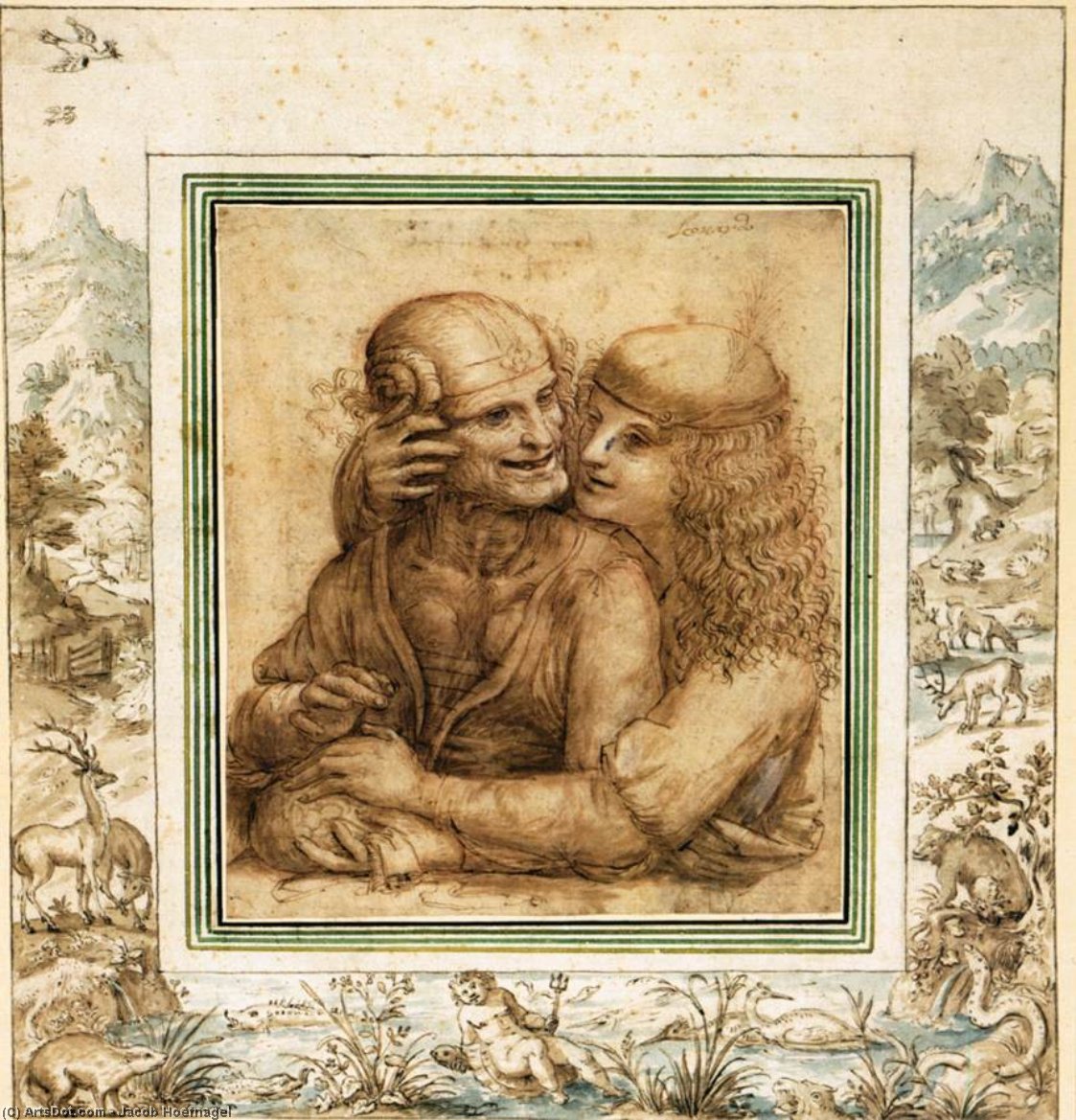
A Young Man Caresses an Old Woman

Explore Jacob Hoefnagel’s ‘A Young Man Caresses an Old Woman,’ a detailed Mannerist drawing of intimacy & emotion. Renaissance art, pen & ink study – a captivating piece.

Jacob Hoefnagel (1573-c.1632) was a Flemish painter renowned for detailed natural history illustrations, portraits, & emblems. Court artist to Rudolf II, his work blends Mannerism with scientific observation. Explore his art & legacy!

Hand Made Oil Reproduction

Hand-painted oil on canvas in your size and frame, made to order by our artists. (Buy Print Buy PrintBuy Image Buy Image)

P118B $10
P118H $10
P118W $10
P438Z $10
P508JH $12
P508YH $12
P805H $10
P805Z $10
P919BZ $10
P919G $10
P919XJ $10
P959ZH $10
P968JZ $12
W106C $8
W218G $10
W218JH $8
W218Y $10
W307PJ $10
W316G $10
W316PJ $8
W316Y $10
W398PJ $8
W4111J $10
W500HY $15
W500JH $15
W692G $12
W849H $8
W940BG $15
W953PJ $8

Standard
custom
CM
INCH

Pick from our preset sizes that match the artwork's original proportions.

width
height

You may enter your own dimensions to fit a specific frame or space. If your selected size does not match the original image's proportions, we will either crop the artwork or extend the painting with additional hand-painted elements. A digital mockup will be sent for your approval before production begins.
Please note that the on-screen preview does not reflect the actual cropping or extension. Only the mockup will accurately show the final composition.
While custom sizes are available, we recommend selecting a dimension from the predefined list to preserve the original proportions.

Examples of what can be changed: Replace face with customer photo; Add pet (e.g., replace cat with dog); Include hidden message in background; Change background landscape or elements.
After order, TopImpressionists.com team will email client for instructions and provide a mockup preview

Worldwide Delivery () in 3/4 weeks instead of standard 5 weeks. (15 August). No compromise on quality.

why_choose_icon
Free Worldwide Express Shipping
why_choose_icon
High-Quality Linen Canvas
why_choose_icon
Full Shipping Insurance
why_choose_icon
Customs Tax Refund Guarantee
why_choose_icon
True Color Matching Guarantee
why_choose_icon
60-Day Return Policy (Defects Only)
why_choose_icon
100% Money-Back Guarantee
why_choose_icon
Bulk Discount Offer

Total Price

$ 294

reproduction

A Young Man Caresses an Old Woman

Reproduction Medium

Reproduction Size

-

Total Price

$ 294

Quick Facts

  • Subject or theme: Romantic Encounter
  • Influences: Leonardo da Vinci
  • Notable elements or techniques: Detailed hatching & crosshatching
  • Location: Private Collection
  • Dimensions: 310 x 290 cm
  • Artistic style: Elegant, Psychological Depth
  • Movement: Renaissance Mannerism

Art Quiz

There is only one correct answer for each question.

Question 1:
What artistic movement is Jacob Hoefnagel’s ‘A Young Man Caresses an Old Woman’ primarily associated with?
Question 2:
The drawing utilizes hatching and cross-hatching extensively. What is the primary purpose of this technique?
Question 3:
What symbolic elements are present in the landscape depicted within the artwork?
Question 4:
Jacob Hoefnagel’s style is characterized by elongated forms and expressive gestures. Where does this stylistic influence originate?
Question 5:
What was Jacob Hoefnagel’s role during Rudolf II's reign in Prague?

Artwork Description

A Portrait of Intimacy: Jacob Hoefnagel’s ‘A Young Man Caresses an Old Woman’

Jacob Hoefnagel's “A Young Man Caresses an Old Woman” stands as a testament to the Renaissance fascination with psychological depth and symbolic representation, capturing a moment of profound connection amidst a backdrop of artistic innovation. Executed in meticulous pen and ink on parchment – likely chosen for its texture and association with illuminated manuscripts – this drawing transcends mere depiction; it delves into themes of desire, vulnerability, and the complexities of human relationships. Created around 1602 during Rudolf II’s reign in Prague, Hoefnagel's work exemplifies the Mannerist style prevalent at the time, characterized by elongated figures, expressive gestures, and a deliberate distortion of perspective to convey emotion rather than strict realism.
  • Style & Technique: The drawing embodies the Mannerist aesthetic, prioritizing emotional impact over anatomical accuracy. Hoefnagel’s masterful use of hatching and cross-hatching creates a rich textural surface, skillfully building up tonal variations to illuminate the figures and their surroundings. Linear precision dominates, establishing a formal elegance that distinguishes it from earlier Renaissance styles.
  • Historical Context: Rudolf II's patronage fostered an environment ripe for artistic experimentation, encouraging artists like Hoefnagel to push boundaries and explore new expressive possibilities. The drawing reflects the humanist ideals of the era—a preoccupation with human emotion and experience—and aligns with a broader trend toward portraying psychological states rather than simply representing physical appearances.
  • Symbolism: Beyond its immediate depiction, “A Young Man Caresses an Old Woman” operates on multiple symbolic levels. The embrace itself represents intimacy and affection, but also carries connotations of wisdom versus youth, experience versus innocence—themes frequently explored in Renaissance art to convey moral lessons and philosophical ideas.
  • Material & Medium: Hoefnagel utilized pen and ink on parchment – a material favored for illuminated manuscripts – demonstrating his commitment to traditional artistic practices while simultaneously adapting them to contemporary sensibilities. The choice of parchment contributes to the drawing’s solemn atmosphere and reinforces its connection to the intellectual traditions of the Renaissance.
  • Emotional Impact: The artwork evokes feelings of tenderness, melancholy, and contemplation. Hoefnagel's ability to convey subtle nuances of emotion through gesture and shading speaks to his profound understanding of human psychology—a hallmark of Mannerist art’s ambition to engage viewers on an emotional level.

Leonardo’s Legacy: Influences & Artistic Innovation

Hoefnagel's work owes considerable debt to Leonardo da Vinci, whose anatomical studies and exploration of human emotion profoundly impacted artistic conventions. Like Da Vinci, Hoefnagel sought to capture the essence of his subjects—not merely their physical form but also their inner life—demonstrating a commitment to scientific observation combined with artistic sensitivity. This fusion of intellect and artistry is characteristic of the Renaissance spirit and distinguishes Hoefnagel’s oeuvre from earlier artistic traditions.

A Window into Prague: Artistic Patronage & Cultural Exchange

Rudolf II's court in Prague served as a crucible for artistic innovation, attracting talent from across Europe—including Flemish artists like Hoefnagel—who benefited from the emperor’s generous patronage and fostered vibrant cultural exchange. The drawing reflects this cosmopolitan atmosphere, showcasing influences from both Northern European Mannerism and humanist scholarship—a testament to the transformative power of royal sponsorship in shaping artistic trends.

Beyond Representation: Exploring Texture & Emotion

Ultimately, “A Young Man Caresses an Old Woman” transcends mere visual representation; it invites viewers to contemplate profound questions about human connection and experience. Hoefnagel’s masterful technique—particularly his meticulous hatching and cross-hatching—creates a textured surface that enhances the drawing's emotional impact, conveying subtleties of gesture and shading that illuminate the psychological complexities of the scene. This artwork remains an enduring symbol of Renaissance artistic achievement—a testament to the pursuit of beauty and intellectual insight.

Artist Biography

Jacob Hoefnagel: A Renaissance Naturalist and Court Artist

Born in Antwerp around 1573, Jacob Hoefnagel’s life was a vibrant tapestry woven from artistic pursuits, diplomatic endeavors, and the shifting currents of European politics. More than simply a painter, he was a multifaceted figure – a miniaturist, draftsman, art dealer, diplomat, merchant, and even a political player during a tumultuous era. His legacy rests primarily on his remarkably detailed illustrations of natural history subjects, a field where his meticulous observation and artistic skill converged to create works that continue to fascinate and inform us today. Hoefnagel’s career unfolded against the backdrop of the late Renaissance and early Baroque periods, a time of burgeoning scientific inquiry and artistic experimentation.

His early life was deeply intertwined with the artistic lineage of his father, Joris Hoefnagel, a renowned miniaturist and court painter to the Dukes of Bavaria and Emperor Rudolf II. Unlike his father, who began as a merchant dealing in luxury goods, Jacob received formal training under Abraham Liesaert in Antwerp’s Guild of Saint Luke, marking a deliberate shift towards a dedicated artistic career. This structured education provided him with the foundational skills necessary for his later success, though it was arguably his experiences outside the confines of the guild – his travels and interactions within various European courts – that truly shaped his distinctive style.

The Court Artist and Scientific Observation

Hoefnagel’s rise to prominence began with his publication in 1592 of *Archetypa studiaque patris Georgii Hoefnagelii*, a groundbreaking collection of engravings depicting plants, insects, and small animals. This work, meticulously copied from his father's drawings, established him as a skilled illustrator and demonstrated an early fascination with the natural world. His subsequent years were spent at the court of Rudolf II in Prague, a position he held until 1613. During this time, he produced a remarkable body of work that blended Mannerist elegance with a burgeoning scientific approach to observation – a hallmark of his artistic identity.

The works created during his time at the Prague court are particularly noteworthy. *Orpheus charming the animals* (circa 1613) exemplifies this fusion, showcasing a dramatic scene rendered in a late Mannerist style, yet imbued with an astonishing level of detail and realism. Similarly, *Winter* (1618) captures a frozen landscape with a precise attention to texture and light, reflecting the growing interest in scientific understanding of natural phenomena. These paintings weren’t merely decorative; they were carefully constructed studies, demonstrating Hoefnagel's commitment to accurate representation.

A Turbulent Life: Politics and Exile

Hoefnagel’s life was not without its challenges. Financial difficulties plagued him throughout his career, often attributed to the court’s failure to consistently pay his salary. He became deeply involved in the political turmoil of the Thirty Years' War, siding with Frederick V, the Protestant Winter King of the Palatinate, against the Catholic Habsburg dynasty. This allegiance ultimately led to his downfall; he was convicted *in absentia* of embezzlement and all his possessions were confiscated. This period marked a significant turning point in his life, forcing him into exile.

Driven by political conviction, Hoefnagel sought refuge in the Dutch Republic, where he served as an agent for the Bohemian estates. He spent several years in Amsterdam, engaging in trade and diplomatic activities. His experiences during this time undoubtedly influenced his artistic output, adding a layer of complexity to his depictions of human interaction and social dynamics. His final years were marked by continued travel and shifting allegiances, culminating in his death around 1632 in Hamburg.

Notable Works and Lasting Legacy

Jacob Hoefnagel’s artistic output is remarkably diverse, encompassing portraits, topographical views, emblems, and of course, his celebrated natural history illustrations. His *A Young Man Caressing an Old Woman* (circa 1605) offers a poignant example of his ability to convey complex emotions through subtle gestures and nuanced expressions – a testament to his skill as a portraitist. His meticulous depictions of insects, flowers, and animals were not simply aesthetically pleasing; they represented a significant contribution to the burgeoning field of natural history illustration.

While he may not be as widely recognized as some of his contemporaries, Jacob Hoefnagel’s work holds a unique place in art history. He stands as a bridge between the artistic conventions of the Renaissance and the scientific observation that would characterize the early Baroque period. His legacy lies not only in the beauty of his paintings but also in his pioneering approach to naturalistic illustration – an approach that continues to inspire artists and researchers alike. His detailed studies remain valuable resources for understanding the flora and fauna of his era, offering a glimpse into a world where art and science were inextricably linked.

Jacob Hoefnagel

Jacob Hoefnagel

1575 - 1632 , Belgium

Quick Facts

  • Artistic Movement Or Style: Mannerism, Natural history
  • Artists Or Movements Influenced By This Artist: ['Abraham Liesaert']
  • Artists Who Influenced This Artist: ['Joris Hoefnagel']
  • Date Of Birth: 1573, Antwerp
  • Date Of Death: c.1632, Hamburg
  • Full Name: Jacob Hoefnagel
  • Nationality: Flemish
  • Notable Artworks:
    • Orpheus charming animals
    • Winter
    • A Young Man Caresses an Old Woman
  • Place Of Birth: Antwerp, Belgium
Explore artworks organized by themes, styles, and characteristics.
© TopImpressionists.com — All Rights Reserved  ·  100% Hand-Painted · Satisfaction Guaranteed · Free Worldwide Shipping
VISA MASTERCARD