The Serenity of the Dutch Golden Age Landscape
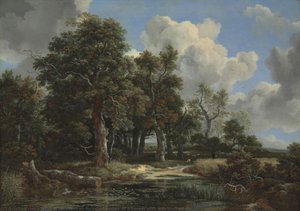
To gaze upon Jacob Isaackszoon van Ruisdael's "Landscape with a Village in the Distance" is to step directly into the heart of the Dutch Golden Age. This painting, executed in 1646, is more than just a depiction of rolling hills and distant structures; it is a profound meditation on nature’s enduring tranquility set against the backdrop of burgeoning human civilization. Van Ruisdael, the pre-eminent landscape painter of his era, possessed an unparalleled gift for capturing the ephemeral quality of light—the way sunlight struggles to break through a veil of passing clouds. The scene unfolds with a palpable sense of quietude, inviting the viewer to slow their own hurried pace and simply breathe in the vastness of the Dutch countryside.
Mastery of Atmosphere and Depth
Technically, the painting is a breathtaking showcase of atmospheric perspective. Notice how the foreground commands attention with its dramatic elements: two large, bare-branched trees anchor the composition, their dark forms providing immediate depth. Beneath them, fallen leaves and patches of grass speak eloquently of seasonal transition—a poignant reminder of life's cyclical nature. As the eye travels down the winding dirt path, it is gently guided toward the middle ground, where a small village nestles peacefully among the contours of the land. This careful recession into space culminates in the background, where low hills fade into a soft, hazy blue under an expansive, cloud-laden sky. Van Ruisdael achieves this illusion not merely through color shifts, but through his masterful handling of light and shadow, giving the entire scene a three-dimensional, almost breathable quality.
Symbolism in the Rural Vista
The inclusion of the village itself adds layers of symbolic meaning to this pastoral view. The steeple of the church, visible in the distance, represents humanity's enduring connection to community and faith, yet it remains harmoniously integrated into the overwhelming embrace of nature. This juxtaposition—the ordered geometry of man’s settlement against the wild, untamed sweep of the landscape—is a hallmark of Dutch art. It suggests that even amidst the bustle of life, there is always a profound, grounding peace to be found in the natural world. The interplay between light and shadow becomes a metaphor for moments of clarity piercing through uncertainty.
Bringing the Masterpiece Home
For those who wish to capture this sublime feeling within their own walls, acquiring a high-quality reproduction of this work is an act of bringing history and serenity into modern life. The rich, naturalistic palette—the deep browns of the foreground contrasting with the pale blues and grays of the sky—offers incredible versatility for interior design, complementing both rustic farmhouse aesthetics and more classically appointed rooms. Owning a piece inspired by Van Ruisdael allows one to connect directly with the contemplative spirit of 17th-century Dutch masters, transforming a mere wall hanging into a focal point of quiet contemplation.



 Preview
 Switch to Print
 Send
Send Share
Share
 Details

 Download
 Similars
 X-Ray
X-Ray Diaporama


 Read More






































 Glass option is only available in size under 110 CM