A Vision of Remembrance: The Unexecuted Design for St Quentin
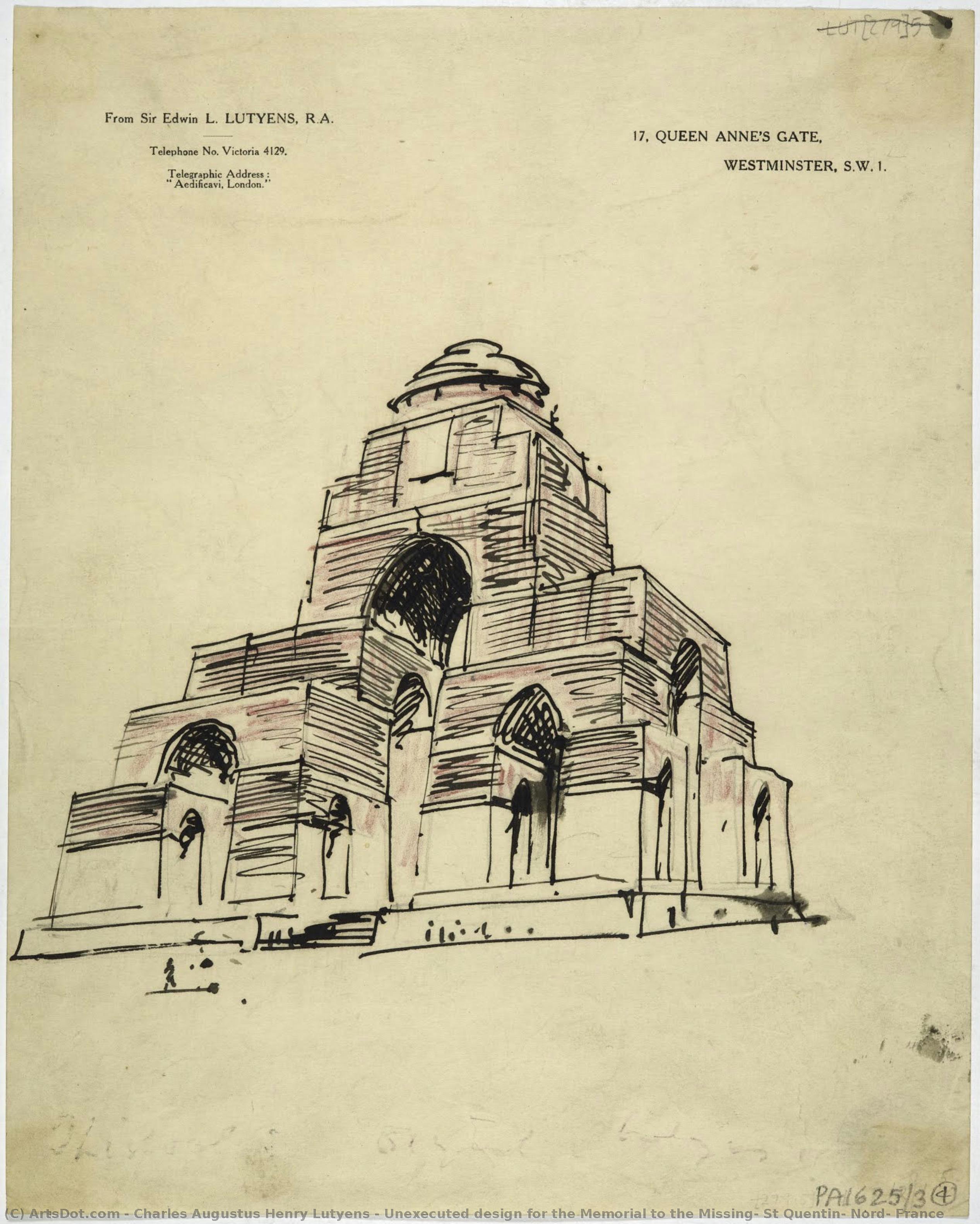
In the quiet, monochromatic depths of this 1923 architectural drawing, we encounter a profound moment of historical reflection. This piece, an unexecuted design for the Memorial to the Missing in St Quentin, Nord, France, serves as a hauntingly beautiful window into the aftermath of the Great War. Through the meticulous hand of Charles Augustus Henry Lutyens, the paper transforms into a landscape of memory and architectural ambition. The drawing captures a monumental structure characterized by a soaring central tower, crowned with a cross that reaches toward an unseen sky. It is not merely a blueprint for stone and mortar, but a poetic attempt to give form to the intangible grief of a generation lost.
The technique employed here relies on the stark, evocative power of black and white line work. Lutyens utilizes fine, precise strokes to delineate the intricate textures of the masonry and the imposing geometry of the tower, creating a sense of permanence and weight. The interplay of light and shadow—achieved through delicate hatching and varying line densities—lends the structure a sculptural quality, making the stone appear almost tactile. By including small, silhouetted figures scattered around the base of the monument, the artist masterfully establishes a sense of scale. These tiny human presences serve as a poignant reminder of the lives the memorial was intended to honor, grounding the grand architectural vision in the intimate reality of human loss.
Beyond its technical mastery, the artwork carries a heavy symbolic weight. The architecture itself, blending elements of classical order with a somber, commemorative gravity, speaks to the desire for stability and peace in a world fractured by conflict. The central tower acts as an axis mundi, a bridge between the earthly realm of mourning and the spiritual realm of eternal remembrance. For the collector or the interior designer, this piece offers more than just aesthetic value; it provides a sophisticated focal point that invites contemplation. Its understated elegance and historical depth make it an ideal selection for spaces dedicated to reflection, such as a private library, a study, or a gallery wall curated with works of significant cultural resonance.
Owning a high-quality reproduction of this Lutyens design allows one to bring a piece of architectural history into the modern home. It is an invitation to engage with the legacy of one of Britain’s most visionary architects and to preserve the spirit of a design that, while never realized in stone, remains eternally alive through the artistry of its conception. This drawing is a testament to the power of art to capture the echoes of history, offering a timeless beauty that transcends the era in which it was created.


 Preview
 Switch to Print
 Send
Send Share
Share
 Details

 Download
 Similars
 X-Ray
X-Ray Diaporama


 Read More






































 Glass option is only available in size under 110 CM




![Cottage, Knebworth, Hertfordshire County, England; [exterior elevations, floor plans, sketches]](/media/artworks/images/thumbnails/c0/dc/c0dce0f50e744a7b99def226b905a5ae.jpg)



