

The Genesis of a Movement: Responding to Modernity and the Great Depression
 Grant Wood & American Regionalism: Identity, Myth & the Rural Landscape
The Genesis of Regionalism: A Response to Modernity Wikipedia: Regionalism (art) American Regionalism is an American realist modern art movement that included paintings, murals, lithographs, and illustrations depicting realistic scenes of rural and s...
To understand the profound pull of American Regionalism, one must first listen to the quiet tremors of a world in flux. In the early decades of the twentieth century, the global art landscape was undergoing a seismic shift. The galleries of Europe were erupting with the radical, fragmented energies of Cubism, Surrealism, and Futurism—movements that challenged every traditional notion of representation. While these avant-garde innovations captivated many, they often presented an abstract reality that felt increasingly detached from the lived experiences of the American public. Across the Atlantic, a different current was beginning to flow, one born not from a desire to dismantle convention, but from a deep-seated need to reaffirm it.
As the United States moved through the 1930s, the looming shadow of the Great Depression intensified a collective yearning for stability and authenticity. The rapid industrialization and urbanization reshaping the nation created a palpable disconnect between the burgeoning modern art scene and the realities of everyday life for most Americans, particularly those residing in the rural heartland. Regionalism arose as a soulful reaction to this perceived cosmopolitan detachment. It was a movement born from crisis, seeking to find beauty within the familiar and to provide a sense of groundedness during an era of unprecedented economic and social upheaval.
Echoes of Place: The Midwestern Landscape as a Cultural Anchor
American literary regionalism, often used interchangeably with the term "local color", is a style or genre of writing in the United States that gained popularity in the mid-to-late 19th century and early 20th century. In this style of writing, which ...
At the heart of this movement lay a profound reverence for the landscape—not merely as a backdrop, but as a character in its own right. For the Regionalists, the Midwest was more than a geographic location; it was a repository of national identity and enduring values. This era of art functioned as a mirror, attempting to capture the essence of a nation grappling with hardship by celebrating the resilience found within its own borders. The movement emphasized the unique character of specific regions, focusing on the rhythms of rural life, the customs of small towns, and the very soil that sustained them.
This focus on "local color" allowed artists to create works that were deeply resonant with the American spirit. By depicting the quiet dignity of small-town existence and the rhythmic cycles of agricultural life, Regionalism offered a reassuring vision of the American heartland. It was an art of homecoming, inviting viewers to find solace in the recognizable textures of their own surroundings. Through these depictions, the landscape became a cultural anchor, providing a sense of continuity and permanence even as the modern world threatened to sweep traditional structures away.
Mastery of the Everyday: Grant Wood’s Technique and Flemish Influence
 Grant Wood
Early Life and Career Grant DeVolson Wood, an American painter, was born on February 13, 1891, in rural Iowa. His life changed dramatically after the death of his father in 1901, when his mother relocated the family to Cedar Rapids. Wood began his ar...
No figure embodies the mastery of this movement more completely than Grant Wood. Born in rural Iowa, Wood possessed an innate understanding of the Midwestern aesthetic, yet his technical approach was deeply informed by a much older tradition. He did not look solely to the contemporary trends of his time; instead, he found profound inspiration in the meticulous clarity of the 15th-century Flemish masters, such as Jan van Eyck. This unique synthesis—combining European craftsmanship with Midwestern authenticity—allowed Wood to transform ordinary scenes into extraordinary icons of art history.
In his most celebrated masterpiece, American Gothic, one can observe this incredible precision. Wood employed remarkably smooth brushwork and a precise rendering of texture that achieved an almost photographic clarity. His use of oil on beaverboard allowed for a luminous quality, particularly in the way light interacts with the Carpenter Gothic architecture of the farmhouse. By utilizing geometric forms—the rectangular house, the triangular pitchfork, the oval faces—Wood created a sense of structured, enduring strength. This deliberate flattening of space and emphasis on form gave his work a unique visual impact that transcended simple portraiture, elevating the mundane to the level of the monumental.
Beyond the Canvas: American Regionalism and the Search for National Identity
 Echoes of Place: Regionalism & American Identity in Interwar Art
The Rise of Regionalism: A Response to Modernity & Crisis Wikipedia: Regionalism (art) American Regionalism is an American realist modern art movement that included paintings, murals, lithographs, and illustrations depicting realistic scenes of rural...
The significance of Regionalism extends far beyond its aesthetic merits; it was a vital component in the construction of a modern American identity. During the interwar period, the United States was still navigating its place on the world stage, caught between its agrarian roots and an increasingly industrial future. The art produced during this time served as a tool for nationalistic expression, rejecting the perceived domination of French art in favor of something uniquely homegrown. It was a movement that sought to define what it meant to be American through the lens of local experience.
This search for identity was often intertwined with a sense of romanticism and nostalgia. By focusing on the "provincial" and the "rural," artists were able to curate a story of a nation that remained anchored in tradition even as it faced the pressures of modernity. While some critics argued that this representation of vernacular culture was an idealized fiction, there is no denying its power to unify. Regionalism provided a shared visual language that celebrated the hardworking, the resilient, and the steadfast, creating a cultural touchstone that remains synonymous with the American spirit to this day.
The Enduring Legacy: How Regionalist Icons Continue to Inspire Modern Art
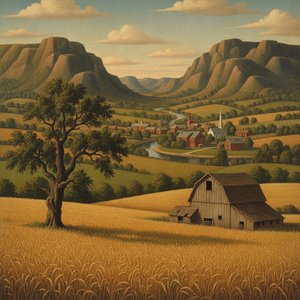 The Soul of the Heartland: A Reflective Journey Through American Regionalism and the Legacy of Grant Wood
The Genesis of a Movement: Responding to Modernity and the Great Depression Grant Wood & American Regionalism: Identity, Myth & the Rural Landscape The Genesis of Regionalism: A Response to Modernity Wikipedia: Regionalism (art) American Regionalism ...
Though the height of the movement passed with the end of World War II, the legacy of American Regionalism continues to resonate within the halls of art history and the hearts of collectors. The works of Grant Wood and his contemporaries remain some of the most recognizable images in the world, not merely for their technical skill, but for their ability to capture a universal truth about human resilience and the importance of place. They taught us that there is profound beauty to be found in the weathered wood of a porch, the furrowed fields of a farm, and the stoic expressions of those who tend them.
Today, we see the echoes of this movement in our continued fascination with authenticity and the preservation of heritage. The ability to find extraordinary meaning in the everyday remains a cornerstone of great art. Whether through the meticulous recreation of these historical landscapes or the modern "remixing" of classical styles, the spirit of Regionalism lives on, reminding us that our most cherished identities are often rooted in the very landscapes we call home.


