

The Historical Crucible: Counter-Reformation and the Birth of Baroque Emotion
 The Dramatic Flourish: Exploring the Baroque Movement's Enduring Legacy in Art History
The Genesis of Grandeur: Historical Context & The Counter-Reformation Wikipedia: Counter-Reformation The Counter-Reformation (Latin: Contrareformatio), also sometimes called the Catholic Revival, was the period of Catholic resurgence that was initiat...
To understand the breathtaking tension that vibrates within a Baroque canvas, one must first look beyond the pigment and into the fractured soul of seventeenth-century Europe. This was not merely a stylistic shift; it was an artistic earthquake born from profound religious and political upheaval. Following the Renaissance's emphasis on balance, harmony, and rational clarity, the world found itself transformed by the Protestant Reformation. The Catholic Church, reeling from this challenge to its authority, recognized the potent power of art as a tool for reaffirming its spiritual dominion. This period, known as the Counter-Reformation or the Catholic Revival, fueled an unprecedented demand for artworks that were not simply beautiful, but emotionally charged and dramatically persuasive.
The Church sought to re-engage the faithful through spectacle, employing artists who could translate complex theological concepts into visceral experiences. It was a time of intense spiritual fervor, reflected in dynamic compositions and rich colors that aimed to inspire awe, devotion, and ultimately, loyalty. This era of religious zeal coincided with the rise of absolute monarchies, where leaders like Louis XIV commissioned lavish works to project an image of divine right. Thus, the Baroque movement emerged as a grand visual counter-offensive, designed to move the viewer's heart through a theatricality that remains unparalleled in art history.
Chiaroscuro and Tenebrism: The Technical Mastery of Light and Shadow
 Chiaroscuro
In art, chiaroscuro (English: kee-AR-ə-SKOOR-oh, -SKURE-, Italian: [ˌkjaroˈskuːro]; lit. 'light-dark') is the use of strong contrasts between light and dark, usually bold contrasts affecting a whole composition. It is also a technical term used by a...
At the very heart of this dramatic era lies a technical revolution defined by the manipulation of light. While the term chiaroscuro—literally meaning "light-dark"—originated in the Renaissance, it reached its most profound and evocative expression during the Baroque period. It is the use of strong, bold contrasts between light and dark to achieve a sense of volume and three-dimensional modeling. When this technique is taken to its extreme, we encounter tenebrism, a method that plunges figures into deep, impenetrable darkness, leaving only key areas illuminated by a radiant, almost cinematic light source.
This interplay of shadow and illumination does far more than create depth; it directs the viewer's gaze with surgical precision. In the hands of a master, light becomes a character in itself, sculpting the faces of saints and the folds of heavy drapery. Consider how a single, unseen light source can highlight a furrowed brow or a trembling hand, pulling the subject out of the void and into our immediate consciousness. This technique creates an atmosphere of palpable tension, where the darkness is not merely an absence of light, but a heavy, meaningful presence that heightens the drama of the illuminated subject.
The Visceral Stage: Psychological Depth and Narrative Intensity in Portraiture
 Sts Peter and Paul
Guido Reni’s *Sts Peter and Paul*: A Baroque Masterpiece of Dramatic Emotion Guido Reni's *Sts Peter and Paul*, painted around the early 17th century, is a profoundly moving work that exemplifies the height of Baroque art. Measuring 197 x 140 cm, thi...
Baroque portraiture transcends mere representation; it serves as a visceral stage for the exploration of the human condition. Unlike the idealized, serene faces of earlier eras, Baroque portraits pulse with psychological depth and an almost overwhelming sense of movement. The goal was to capture the soul in a moment of transition—a breath held, a prayer whispered, or a realization dawning. This is evident in works like Guido Reni’s Sts Peter and Paul, where the arrangement of figures conveys a subtle tension between authority and discourse, using light to emphasize the distinct narratives of contemplation and passion.
The portraits of this era often utilize a three-quarter pose or dynamic gestures to suggest life in motion. The darkness surrounding the subject acts as a deliberate tool to intensify the impact of their expression, drawing us into an intimate encounter with their inner world. Whether it is the solemnity found in Simon Vouet’s Saint Guillaume d'Aquitaine or the quiet musical passion in Caravaggio’s The Lute Player, the focus remains on conveying profound emotion through visual representation. Every brushstroke serves to heighten the drama of the human and divine experience, making the viewer a participant in the subject's spiritual or emotional journey.
From Caravaggio to Vouet: A Lineage of Dramatic Visionaries
 The Lute Player
The Enchanting World of "The Lute Player" "The Lute Player," created by the masterful hand of Caravaggio in 1600, is a captivating example of Baroque art that invites viewers into an intimate moment of musical passion and quiet contemplation. This ex...
The brilliance of the Baroque era is best understood through the lineage of artists who dared to break from convention. The movement finds its revolutionary spark in Michelangelo Merisi da Caravaggio, whose mastery of tenebrism redefined the boundaries of realism and intrigue. His works, such as The Fortune Teller, introduced a sense of psychological depth and dramatic flair that would become the blueprint for generations to follow. Caravaggio’s ability to find the extraordinary within the ordinary—using gritty realism and stark lighting—set the stage for an era of intense emotional storytelling.
Following this path, artists like Simon Vouet brought a uniquely French elegance to the Baroque vision, blending Italian-inspired chiaroscuro with more opulent color palettes. His Saint Guillaume d'Aquitaine exemplifies this fusion, using warm hues and dramatic illumination to evoke reverence and piety. Similarly, the Belgian master Gérard de Lairesse drew inspiration from both Caravaggio and Rembrandt, blending dramatic light with a meticulous attention to detail. Even in the later years of the movement, figures like Václav Vavřinec Reiner continued to push the boundaries of spiritual ecstasy through bold, expressive brushwork. This lineage represents a continuous dialogue between light and shadow, technique and emotion.
The Enduring Legacy: How Baroque Grandeur Shapes Our Emotional Landscape
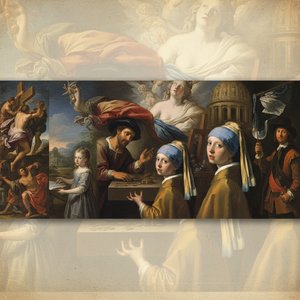 Baroque Masterpieces: 10 Paintings That Defined an Era |
Introduction To gaze upon the masterpieces of the Baroque is to step into a world ablaze with drama, emotion, and an almost overwhelming sense of grandeur. This wasn’t merely a style; it was a cultural earthquake, reshaping art, architecture, music, ...
The legacy of the Baroque movement extends far beyond the gilded frames of the seventeenth century. Its emphasis on the theatrical, the emotional, and the monumental has left an indelible mark on the history of Western art and our very perception of beauty. The movement taught us that art should not merely be observed, but felt; it should not just depict a scene, but evoke a response. This pursuit of grandeur and emotional resonance continues to inspire modern sensibilities, from the dramatic lighting in contemporary cinema to the profound psychological depth sought in modern portraiture.
Today, when we gaze upon these masterpieces, we are reminded of the power of art to act as a bridge between the earthly and the divine, the physical and the spiritual. The Baroque era remains a sanctuary of light and shadow, inviting us to lose ourselves in a world where history breathes alongside unparalleled artistry. It stands as a testament to human creativity's ability to transform the fractures of a changing world into a cohesive, breathtaking vision of eternal drama.
At TopImpressionists.com, we celebrate this enduring legacy by bringing the masters back to life. Our mission is to make fine art accessible to everyone through exquisite, 100% hand-painted oil reproductions on premium cotton canvas. Whether you wish to "remix" history by having a personal photo transformed into a Van Gogh-style masterpiece or seek a museum-quality reproduction of a Baroque icon, our academic artists are dedicated to preserving the soul of every brushstroke. Explore our vast library and discover how we can help you bring the drama of history into your own home.


