

The Genesis of Grandeur: The Counter-Reformation and the Birth of Baroque Emotion
 The Dramatic Flourish: Exploring the Baroque Movement's Enduring Legacy in Art History
The Genesis of Grandeur: Historical Context & The Counter-Reformation Wikipedia: Counter-Reformation The Counter-Reformation (Latin: Contrareformatio), also sometimes called the Catholic Revival, was the period of Catholic resurgence that was initiat...
To understand the visceral pull of the Baroque era, one must first look to the turbulent skies of 17th-century Europe. It was a period defined not by peace, but by a profound spiritual and political earthquake known as the Counter-Reformation. As the Protestant Reformation challenged the established foundations of the Catholic Church, the Church responded with a magnificent visual counter-offensive. This was not merely a change in doctrine, but a revolution of the senses. The goal was to move the faithful, to inspire an unshakeable awe, and to reaffirm the majesty of faith through art that felt palpably alive.
Moving away from the balanced, rational, and often detached harmonies of the High Renaissance, the Baroque movement sought a more direct connection with the human soul. The era demanded a new language—one of spectacle, grandeur, and intense emotional engagement. This was an age where art became a theatrical stage, designed to bridge the gap between the divine and the earthly. Through sweeping compositions and a newfound sense of movement, artists began to create works that did not simply ask for contemplation, but demanded a physical and emotional response from every viewer who stood before them.
Chiaroscuro and Tenebrism: Mastering the Language of Shadow and Light
 Chiaroscuro
In art, chiaroscuro (English: kee-AR-ə-SKOOR-oh, -SKURE-, Italian: [ˌkjaroˈskuːro]; lit. 'light-dark') is the use of strong contrasts between light and dark, usually bold contrasts affecting a whole composition. It is also a technical term used by a...
At the very heart of this dramatic transformation lies a technical mastery of light and dark that remains unparalleled in the history of Western art. We speak, of course, of chiaroscuro—the delicate use of strong contrasts to achieve a sense of volume and three-dimensional presence. While this technique had its roots in the Renaissance, the Baroque masters elevated it to a level of psychological intensity that felt almost supernatural. They understood that light does not merely illuminate; it selects, it emphasizes, and it reveals.
When this technique is pushed to its most extreme, we encounter tenebrism, a style where darkness becomes the dominant force of the composition. In tenebristic works, deep, impenetrable shadows swallow much of the scene, leaving only select figures or moments caught in a sudden, piercing shaft of light. This creates a profound sense of mystery and focus. The light acts as a spotlight on a darkened stage, guiding the eye to the most crucial emotional beats—a furrowed brow, a trembling hand, or the glint of a blade. Through this interplay of shadow and brilliance, the artists achieved a sculptural depth that made the figures seem to emerge from the canvas into our very reality.
Caravaggio’s Revolutionary Vision: From Street Realism to Spiritual Intensity
 Boy Peeling a Fruit
Michelangelo Merisi Da Caravaggio: A Master of Light and Emotion Caravaggio’s “Boy Peeling a Fruit,” painted circa 1592–1593, stands as an emblem of Baroque art—a testament to its profound ability to capture the immediacy of everyday life while simul...
No name is more synonymous with this era of shadows than Michelangelo Merisi da Caravaggio. His life, much like his art, was a tempest of brilliance and violence, marked by both profound loss and unparalleled creative triumph. Emerging from the streets of Milan and finding his voice in the vibrant, often unforgiving atmosphere of Rome, Caravaggio shattered the prevailing Mannerist traditions of artificial elegance. He rejected the idealized, polished perfection of his predecessors in favor of an uncompromising, almost brutal realism.
Caravaggio’s genius lay in his ability to find the divine within the mundane. He did not look to mythological gods or idealized saints for his models; instead, he turned to the people of the Roman streets—the laborers, the beggars, and the common folk. In works such as Boy Peeling a Fruit, we see an unparalleled sensitivity to the textures of everyday life, yet even in these simple genre scenes, there is a sense of spiritual weight. By populating his religious narratives with ordinary, weathered faces, he made the sacred feel immediate and accessible, imbuing biblical stories with a palpable, human truth that shocked and captivated his contemporaries.
The Theatre of the Canvas: Capturing Human Psychology through Dramatic Contrast
 Cardsharps
A Masterpiece of Suspense: Decoding Caravaggio’s Cardsharps Caravaggio's *Cardsharps*, painted around 1594, stands as an emblem of Baroque artistry—a testament to dramatic lighting and psychological depth that continues to captivate audiences centuri...
The Baroque canvas functions much like a theatrical stage, where every element is orchestrated to heighten suspense and emotional depth. Consider the masterful tension found in The Cardsharps. Here, Caravaggio uses light not just for volume, but for psychological interrogation. A single beam of light illuminates the central figure, drawing our attention to the subtle deceptions and strategic maneuvers of a game rife with trickery. The darkness surrounding the players does more than provide contrast; it creates an atmosphere of secrecy and tension, mirroring the very nature of the subject matter.
This mastery extends into the most profound moments of human suffering and ecstasy. In his depictions of biblical events, such as The Taking of Christ, the dramatic use of light serves to distill the narrative to its most essential emotional core. The shadows represent the encroaching chaos and betrayal, while the highlights capture the raw, visceral reality of the moment. This ability to capture fleeting, intense psychological states—the flicker of fear, the weight of sorrow, or the intensity of devotion—is what allows these paintings to transcend their era and continue to resonate with the human condition today.
An Endention Legacy: How Baroque Realism Reshaped the Soul of Western Art
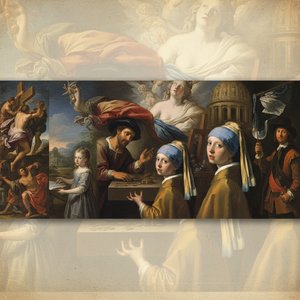 Baroque Masterpieces: 10 Paintings That Defined an Era |
Introduction To gaze upon the masterpieces of the Baroque is to step into a world ablaze with drama, emotion, and an almost overwhelming sense of grandeur. This wasn’t merely a style; it was a cultural earthquake, reshaping art, architecture, music, ...
The legacy of the Baroque movement is an enduring one, a permanent shift in the trajectory of artistic expression. The movement’s emphasis on emotion, realism, and the dramatic use of light fundamentally altered how artists approached the concept of truth on canvas. It broke the boundaries of the frame, inviting the viewer to participate in the drama rather than merely observe it from a distance. This era taught us that art could be both deeply personal and monumentally grand, capable of exploring the darkest corners of human experience while simultaneously reaching for the divine.
Even as subsequent movements sought new forms of beauty, they could never fully escape the gravitational pull of the Baroque. The techniques of chiaroscuro and the pursuit of psychological depth became foundational elements of the Western canon, influencing everyone from Rembrandt to the modern masters of cinematic lighting. As we gaze upon these masterpieces today, we are reminded that the struggle between light and shadow is a reflection of our own lives—a continuous journey through the complexities of joy, sorrow, and the eternal search for meaning in a world of beautiful, dramatic uncertainty.
At TopImpressionists.com, we share this profound passion for the masters who captured the soul of history. Our mission is to make these extraordinary legacies accessible to collectors worldwide through exquisite, hand-painted oil reproductions. Each piece is a labor of devotion, meticulously crafted by academic artists on fine cotton canvas to preserve the tactile depth and emotional resonance of the original works. Whether you seek to transform a space with a monumental Baroque masterpiece or wish to reimagine a personal memory in a classical style, our experts are here to guide your journey into the heart of art.


