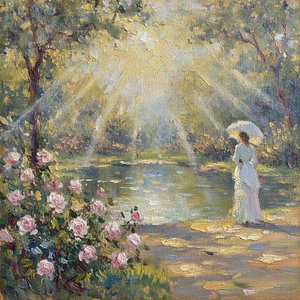
The Luminous Revolution: Breaking Free from Academic Shadows
 Capturing the Soul: The Most Emotionally Moving Impressionist and Post-Impressionist Masterpieces
The Luminous Revolution: How Impressionism Redefined the Art of Seeing Impressionistic Landscapes: 10 Masterpieces That Changed Art & Decor Introduction To gaze upon these ten canvases is to step directly into a world transformed by light, color, and...
To step into the world of the Impressionists is to leave behind the heavy, somber shadows of academic tradition and enter a realm bathed in dappled sunlight. In the mid-1800s, a group of courageous rebels in France sought to dismantle the rigid, suffocating constraints of the Salon, turning their gaze away from historical grandeur and toward the ephemeral beauty of the present moment. They were masters of the optical moment, capturing the way light dances across a river's surface or shimmers through a summer breeze before it inevitably changes. This was not merely a shift in technique; it was a revolution in perception, a bold declaration that reality is not a fixed, static entity, but rather a shimmering, subjective experience.
Before this seismic shift, the art world was dominated by meticulous realism and dark, studio-bound compositions. The Impressionists, however, embraced the invention of portable paint tubes, which allowed them to work en plein air—directly under the vast, changing sky. This freedom enabled them to capture the direct effects of atmosphere and movement with an immediacy that felt as fresh as a morning mist. Their canvases became windows into a world transformed by light, where colors dance and vibrate with an ethereal quality, inviting us to witness the beauty of a life lived in the light.
A Symphony of Light: The Impressionist Mastery of the Fleeting Moment
 La Poste at Cagnes
A Glimpse into Provençal Life: Pierre-Auguste Renoir’s *La Poste at Cagnes* Pierre-Auguste Renoir's *La Poste at Cagnes*, painted in 1905, is more than just a depiction of a rural scene; it’s an evocative distillation of the French Impressionist aest...
The essence of Impressionism lies in its devotion to the transient. When we gaze upon works like Pierre-Auguste Renoir’s La Poste at Cagnes, we are not merely looking at a rural scene; we are experiencing an evocative distillation of the French aesthetic. Painted in 1905, this work captures a sense of tranquility and contentment, reflecting Renoir’s fascination with the warmth of the sun on stone and the way light filters through lush greenery. He abandons meticulous detail in favor of capturing the impression—the overall atmosphere of a quiet afternoon in Provence.
This mastery is achieved through the brilliant use of broken color, where small strokes of pure pigment are applied side-by-side, allowing the viewer’s eye to blend them optically. This technique creates a luminous and vibrant effect that mimics the natural vibration of light. Similarly, Renoir’s White House captures a serene countryside at sunset, using warm hues of pink, orange, purple, and gold to evoke the fleeting beauty of twilight. Through loose, expressive brushwork, these artists invite us to experience the scene through a subjective, almost dreamlike lens, celebrating the sensory experience of being truly present.
Beyond the Surface: Post-Impressionism and the Language of Emotion
 Beyond the Light: Capturing Raw Emotion and Subjective Vision in Post-Impressionist Landscapes
The Impressionist Foundation: From Fleeting Light to Lasting Emotion Beyond Impressionism: The Emotional Depth and Vibrant Evolution of Post-Impressionist Landscapes The Impressionist Foundation: Capturing Light Before the Revolution Landscape painti...
As we move toward the close of the nineteenth century, a new generation of artists began to feel a growing restlessness. While they deeply admired the Impressionists’ focus on light and color, they found the purely optical concerns to be somewhat incomplete. They sought something more profound: an expression of inner emotion, symbolic meaning, and a deeper engagement with form. This was the dawn of Post-Impressionism—a movement that did not reject the brilliance of its predecessors but rather used it as a foundation to build a much more complex, subjective, and emotionally resonant architecture of vision.
Post-Impressionism emerged as a collective spirit of innovation, where artists like Paul Cézanne, Paul Gauguin, and Georges Seurat began to question the limitations of capturing only what is seen by the eye. They embraced subjective vision, using color and form to reflect not just the external world, but the internal landscape of the human soul. It was a period fueled by the complexities of modern life, where the canvas became a space for exploring spirituality, personal symbolism, and the raw intensity of human feeling.
The Texture of Feeling: Decoding Impasto and Bold Brushwork
 Self easel
A Window into the Soul: Van Gogh’s Self-Portrait This captivating self-portrait offers a profoundly intimate glimpse into the mind of Vincent van Gogh, rendered in his signature Post-Impressionistic style. More than just a likeness, it's a powerful s...
In the hands of Post-Impressionists, paint ceased to be a mere medium for representation and became a tactile language of its own. Consider the profound intimacy of Vincent van Gogh’s self-portraits. Here, we see a masterclass in impasto—a technique where paint is applied so thickly that it stands out from the canvas, creating a sculptural surface. This texture is not about precise likeness; it is about conveying the very essence of his inner turmoil and the intense energy of creation. The thick, directional brushstrokes guide the eye, contributing to an overwhelming sense of emotional intensity.
This expressive use of texture is echoed in the works of Theo van Rysselberghe, such as Olive Trees near Nice. In this Post-Impressionist masterpiece, the artist uses bold brushstrokes and vibrant colors to prioritize emotional impact over photographic accuracy. The energetic application of paint creates a palpable sense of movement, making the Mediterranean landscape feel alive. Whether it is the heavy, rhythmic strokes of Van Gogh or the carefully constructed meditations on light by his contemporaries, the physical presence of the paint serves as a direct conduit to the artist's passion and struggle.
Bringing the Masterpieces Home: Curating a World of Color and Serenity
 Post-Impressionism's 10 Defining Masterpieces: Art for Your Home |
Introduction Imagine stepping back in time to a world brimming with artistic revolution—a moment where painters dared to break free from the constraints of realism and embrace subjective vision. This is the essence of Post-Impressionism, a movement t...
For those of us who have spent decades admiring these works, we recognize that they do more than decorate a room; they transform it. To bring an Impressionist or Post-Impressionist piece into your home is to invite a sense of peace, light, and historical depth into your daily life. Whether you are drawn to the soft, sun-drenched landscapes of Renoir or the vibrant, emotional textures of Van Gogh, these works offer a timeless connection to the beauty of the natural world and the human spirit.
When selecting art for your collection, consider how the interplay of color and light can harmonize with your space. A wide wall might be beautifully transformed by a multi-panel arrangement, creating a modern architectural look that flows seamlessly across your home. At TopImpressionists.com, we specialize in preserving this legacy through exquisite, hand-painted reproductions. Our master artists, holding degrees from prestigious academies, meticulously recreate the visible brushstrokes and deep tonal ranges of the masters on 100% cotton canvas. We invite you to explore our curated collection and find the piece that speaks to your soul, allowing you to live every day surrounded by the luminous beauty of art history.