Beyond the Surface: A Journey into the Fragmented Beauty of Cubism
Explore the revolutionary world of Cubism. From Picasso’s fractured perspectives to Juan Gris’s mathematical precision, journey through the movement that redefined reality through geometric abstraction and fragmented beauty.
The Fracture of Perspective: The Birth of a Revolution Cubism - Tate --- title: Cubism | Tate author: Clarrie Wallis url: https://www.tate.org.uk/art/art-terms/c/cubism hostname: tate.org.uk description: Tate glossary definition for cubism: A revolut...
For centuries, the Western eye was trained to look through a window. Since the dawn of the Renaissance, the canvas served as a sacred portal into a three-dimensional reality, governed by the strict logic of linear perspective and a single, fixed viewpoint. We were taught to believe in the stability of the horizon, the depth of the landscape, and the illusion of a world that stood still for the observer. However, as we entered the twentieth century, the very fabric of this perceived reality began to fray. The rapid pulse of industrialization and the mind-bending scientific revelations of an era defined by Einstein suggested that the world was far more complex, fluid, and fragmented than a single vantage point could ever capture.
This seismic shift was not merely a change in style, but a profound rejection of the Impressionist obsession with fleeting light and the Fauvist embrace of unbridled color. The pioneers of Cubism sought something more permanent—a structural truth that resided beneath the surface of appearances. They realized that to truly represent an object, one must acknowledge its existence from every angle, capturing the essence of its form rather than just a momentary glance. It was a revolution of the intellect, where the traditional canvas was no longer a window to look at, but a space to reconstruct reality itself through the beautiful, fractured lens of geometric abstraction.
Architects of Abstraction: The Symbiotic Genius of Picasso and Braque
The Enduring Legacy of Pablo Picasso Pablo Ruiz y Picasso, a name synonymous with artistic revolution, was born in Málaga, Spain, on October 25, 1881. His very existence seemed destined for creative expression; legend has it his first uttered words w...
At the heart of this artistic upheaval stood two titans whose collaboration remains one of the most profound partnerships in art history: Pablo Picasso and Georges Braque. While their names are now etched into the annals of legend, their early work was a shared journey of discovery, often so intertwined that their Cubist canvases were nearly indistinguishable to the contemporary eye. Picasso, with his prodigious talent and restless spirit, brought an unparalleled emotional depth and a capacity for radical reinvention. Having moved from the somber, monochromatic depths of his Blue Period to the warmer tones of his Rose Period, he possessed a technical mastery that allowed him to dismantle the human figure with both grace and ferocity.
Beside him, Georges Braque provided a vital, grounding force. Raised in a family of house painters and decorators, Braque brought an inherent appreciation for form, structure, and the tactile nature of materials. His training at the École des Dat des Beaux-Arts instilled in him a technical precision that complemented Picasso’s expressive energy. Together, they moved away from the naturalistic depictions of their youth toward a shared language of planes and facets. Their dialogue was not merely one of competition, but of mutual evolution, as they navigated the transition from the influence of Cézanne’s late works to the creation of a completely new visual vocabulary that would forever alter the trajectory of modern art.
Analytical Precision: Deconstructing Reality into Geometric Planes
Portrait of Daniel-Henry Kahnweiler (Spanish: Retrato de Daniel-Henry Kahnweiler) is an oil on canvas painting by Pablo Picasso in the Analytical Cubism style. It was completed in the autumn of 1910 and depicts the prominent art dealer Daniel-Henry K...
As the movement matured into what we now recognize as Analytical Cubism, the artists began a rigorous process of deconstruction. The subject—be it a portrait, a musical instrument, or a simple tabletop arrangement—was analyzed, broken up, and reassembled in an abstract form. This was not an act of destruction, but one of profound investigation. By breaking the subject into a series of overlapping planes and intersecting lines, the artists sought to represent the object in a greater context, presenting multiple perspectives simultaneously.
In this phase, the palette often retreated into a more muted, monochromatic range of ochres, deep browns, and subtle grays. This was a deliberate choice; by stripping away the distraction of vibrant color, the viewer could focus entirely on the complex interplay of light, shadow, and volume. The eye is not permitted to rest upon a single, stable point; instead, it must navigate a labyrinth of geometric shapes that challenge our traditional perceptions of depth. In works like Picasso’s Portrait of Daniel-Henry Kahnweiler, we see this mastery in action, where the sitter is woven into the very architecture of the painting, creating a sense of presence that is both intimate and enigmatic.
The Symphony of Fragments: Exploring the Mathematical Grace of Juan Gris
A Symphony of Fragments: The Cubist Vision of Juan Gris In the quiet evolution of modern art, few moments are as intellectually arresting as the creation of Juan Gris’s “Glass and Ace of Clubs.” Completed in 1917, this masterpiece serves as a profoun...
While Picasso and Braque laid the foundation, it was artists like Juan Gris who brought a unique, almost mathematical precision to the Cubist vision. If the early pioneers were the explorers of this fragmented landscape, Gris was its architect. His work, particularly masterpieces such as Glass and Ace of Clubs, serves as a profound window into the heart of the movement, capturing a period when reality was being meticulously reconstructed. Drawing perhaps from his early training in engineering, Gris infused his compositions with a sense of structured power and rhythmic clarity.
In Gris’s hands, the Cubist subject becomes a symphony of fragments. He orchestrates a complex dance of light and geometry, where the transparency of a glass and the solid weight of a playing card exist within a shared, fractured space. His technique creates a sense of simultaneous perspective that feels both intellectually arresting and visually harmonious. There is a certain grace in his ability to use overlapping planes to suggest movement and transformation, inviting the viewer to look beyond the surface of the everyday and find the hidden order within the chaos of the modern world.
Beyond the Canvas: Cubism’s Lasting Legacy on Modern Visual Language
Cubism is an early-20th-century avant-garde art movement which began in Paris. It revolutionized painting and the visual arts, and sparked artistic innovations in music, ballet, literature, and architecture. Cubist subjects are analyzed, broken up, a...
The impact of Cubism extends far beyond the boundaries of the painted canvas. It was a movement that sparked artistic innovations across a multitude of disciplines, influencing music, ballet, literature, and architecture. The very concept of fragmentation and the use of collage—introducing real-world elements into the realm of high art—became a cornerstone of modern creative expression. From the rhythmic abstractions of Orphism to the bold structures of Constructivism, the echoes of Cubist thought can be heard in every movement that followed.
Today, we see the legacy of this revolution in our very way of perceiving the world. In an age of digital fragmentation and multi-layered information, the Cubist lesson—that truth is found in the synthesis of multiple perspectives—is more relevant than ever. For the art enthusiast, revisiting these works is not merely a study of history, but an invitation to rediscover the beauty in the broken, the profound in the complex, and the eternal in the abstract. It remains a testament to the power of art to redefine our reality, one fragment at a time.
For those who find themselves moved by the textures and histories explored here, TopImpressionists.com offers a curated collection of hand-painted oil reproductions that capture the soul of the masters. Whether you seek the light-drenched beauty of Monet or the structural depth of the Cubist era, our artists bring these timeless visions to life on 100% cotton canvas, ensuring that the brushstroke and the spirit of the original remain ever-present in your home.
Explore the revolutionary world of Cubist portraiture with our comprehensive guide. Discover Picasso, Braque, Gris & the movement's impact on modern art. Expert analysis for collectors and enthusiasts.
Explore the revolutionary world of Cubism. From Picasso's analytical deconstruction to Braque's geometric forms, master the history of fragmentation and modern art through this expert guide for students and collectors.
Explore the revolutionary world of Cubism with TopImpressionists. Discover Picasso & Braque's groundbreaking techniques, its philosophical roots, and lasting impact on modern art. Expert insights for collectors.
Explore the revolutionary world of Cubism. Discover how Pablo Picasso and Georges Braque dismantled perspective to redefine modern art through geometric innovation and analytical mastery. An essential guide for art students, collectors, and history enthusiasts.
Explore the revolutionary art of Georges Braque, a pioneer of Cubism alongside Picasso. Discover his artistic evolution, key works, and lasting impact on modern art. A guide for discerning collectors.


 Cubism Unveiled: How Picasso and Braque Redefined Reality Through Geometric Abstraction
 Pablo Picasso
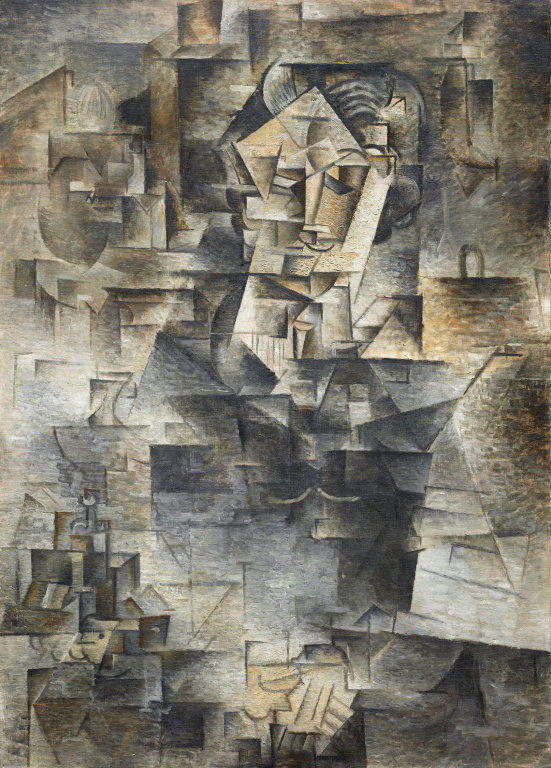 Daniel-Henry Kahnweiler (Picasso)
 Glass and Ace of Clubs
 Cubism


