

The Secular Revolution: Redefining Subject Matter in the Dutch Republic
 Dutch Golden Age Landscapes: The Epic Origin of Modern Visual Impact and Atmospheric Mastery
The Revolution of Realism: Breaking from Tradition to Capture the Everyday Dutch Golden Age painting Dutch Golden Age painting is the painting of the Dutch Golden Age, a period in Dutch history roughly spanning the 17th century, during and after the ...
The seventeenth-century Netherlands underwent a transformation driven by independence and economic expansion. Following the struggle for liberation from Spanish rule, the Dutch Republic emerged as a maritime power, propelled by trade and a growing merchant class. This shift in political and religious identity altered the purpose of painting. As the nation moved away from Catholic traditions and monarchical displays, the demand for large-scale religious iconography declined. In its place, a new market arose, fueled by private citizens who sought depictions of their own lived experiences.
This period favored the intimate and the everyday. The canvas shifted focus from celestial allegories to the quiet dignity of the earth itself. Painters found meaning in the texture of a brick wall, the ripple of a canal, or a coastal scene. This was a redirection of artistic intent—a movement where the mundane became a subject worthy of careful study. The landscape became a primary vessel for a new national identity, allowing artists to celebrate reclaimed land and maritime dominance through the depiction of local horizons.
In the present day, this focus on the tangible remains a cornerstone of classical appreciation. When we look at works like The Stone Bridge by Rembrandt van Rijn, we see an echo of this humanist ideal. Though his work belongs to the era of the Dutch Golden Age, the way he uses light to define physical form prioritizes observation and emotional response over mere representation. It carries that same quiet dignity found in the landscapes of the Republic, reminding us that the most profound subjects are often those found in the stillness of nature.
Chiaroscuro and the Psychological Interior: The Power of Light and Shadow
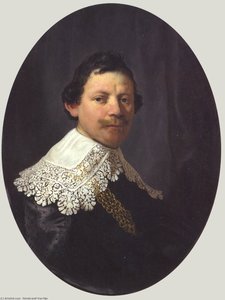 Portrait of Philips Lucasz.
Portrait of Philips Lucasz., Rembrandt van Rijn
If there is a rhythmic pulse within Dutch Golden Age painting, it is the interplay of light and shadow. This technique, known as chiaroscuro, or light-dark, became the definitive language of the era. It functioned as a psychological tool to sculpt form and direct attention. By utilizing strong contrasts, artists could reveal the inner essence of their subjects.
In the hands of Rembrandt van Rijn, light does not simply illuminate a scene; it reveals character. In his Portrait of Philips Lucasz, the dramatic use of shadow creates a sense of volume and presence, making the subject feel immediate. This method allows for a sense of mystery, where what remains hidden in the darkness is as significant as what is revealed by the light. The technique provides a way to navigate the complexities of human emotion through the manipulation of luminosity.
This mastery of contrast continues to influence how we perceive depth in art today. We see this same commitment to tonal range in Winter scene by Rembrandt van Rijn, where the use of chiaroscuro creates a palpable sense of atmosphere and temperature. The way light hits the snow-covered trees and the figures bundled in warm clothing demonstrates how shadow can be used to build a world that feels physically present.
Atmospheric Perspective: The Science of the Dutch Sky
 The Windmill at Wijk bij Duurstede (detail)
The Windmill at Wijk bij Duurstede: A Dutch Masterpiece of Light and Atmosphere Jacob Isaackszoon van Ruysdael’s “The Windmill at Wijk bij Duurstede” isn't merely a depiction of a rural scene; it’s a profound meditation on light, space, and the endur...
The Human Element: Portraiture as a Study of Character
 Frans Halsmuseum
A Window into Haarlem’s Golden Age: The Frans Hals Museum Nestled within two meticulously preserved historic buildings in the heart of Haarlem, Netherlands, the Frans Hals Museum is more than simply a repository of paintings; it's an immersive journe...
Materiality and Tradition: The Enduring Value of Classical Technique
 Nicolaes Keyser
Nicolaes Keyser: The Golden Weaver of Delft Nicolaes Keyser, a name often whispered in the halls of Dutch art history, remains an enigmatic figure despite his undeniable brilliance. Active primarily during the mid-17th century, he stands as one of De...


