A Vision of Cosmic Energy Celestial Vortex in Motion: A Monumental Study of Primal Color and Kinetic Energy is a breathtaking exploration of movement, capturing the raw, turbulent essence of an elemental storm. This contemporary abstract masterpiece ...
Movement is rarely a literal occurrence in the realm of fine art; rather, it is an intentional manipulation of perception. To encounter kinetic energy on a static surface is to witness the artist directing the eye through tension, rhythm, and color. This energy manifests through the deliberate arrangement of lines that guide a gaze across a composition, or through the use of weight and balance to suggest a state of flux. When we speak of movement in painting, we are discussing the way a viewer’s attention travels—caught by the vibration of a particular hue or the sudden, sharp trajectory of a brushstroke.
This concept finds its most fundamental expression in the very elements of design. A line may be horizontal, suggesting a tranquil repose, or angular and diagonal, conveying an immediate sense of instability. Texture, too, contributes to this perceived motion; the physical relief of impasto can create shadows that shift as one moves around a work, lending a sculptural quality to the pigment. The essence of a dynamic painting lies in its ability to break the silence of a room, replacing stillness with a visual pulse that feels perpetually active.
The Machine Age: Futurism and the Aesthetics of Speed
Futurism (Italian: Futurismo [futuˈrizmo]) was an artistic and social movement that originated in Italy, and to a lesser extent in other countries, in the early 20th century. It emphasized dynamism, speed, technology, youth, violence, and objects suc...
At the dawn of the twentieth century, the stability of the old world began to dissolve under the influence of rapid industrialization. The arrival of the automobile, the airplane, and the electric grid introduced a new, frantic tempo to human existence. The Italian Futurists were the first to embrace this upheaval, rejecting the stagnant reverence for classical antiquity in favor of the roar of engines and the blur of urban transit. For these artists, beauty was no longer found in pastoral stillness but in the aggressive energy of the machine.
This obsession with dynamism is perhaps best understood through the work of Giacomo Balla. In his 1913 creation, Swifts: Paths of Movement + Dynamic Sequences, we see a rhythmic explosion of lines that simulates the chaotic trajectories of birds in flight. This was not merely an attempt to depict motion but a desire to capture the very air displaced by it. The Futurists sought to liberate art from the weight of history, insisting that a speeding vehicle possessed more aesthetic merit than any ancient marble statue. Theirs was a movement of profound disruption, designed to reflect a world that had suddenly, and irrevocly, accelerated.
The Genesis of Motion: Deconstructing the Cubo-Futurist Synthesis Cubo-Futurism: The Dynamic Fusion of Geometry and Speed in Modern Art The Genesis of Motion: Deconstructing the Cubo-Futurist Synthesis Cubo-Futurism: The Sophisticated Intersection of...
As the twentieth century progressed, the raw energy of Italian Futurism encountered the analytical rigor of French Cubism. This intersection birtased Cubo-Futurism, a sophisticated movement that sought to marry the structural logic of fragmented planes with the vibrating pulse of progress. Where Cubism dismantled objects into geometric components to explore multiple perspectives, Cubo-Futurism utilized this fragmentation to record how those objects moved through space and time. It was a high-speed collision of two distinct visual languages.
The Russian avant-garde played a vital role in this synthesis, with artists like David Burliuk helping to centralize a movement that embraced experimentation. The Hylaea group, through manifestos such as A Slap in the Face of Public Taste, challenged conventional beauty by celebrating the untamed force of modernity. In these works, the stillness of geometry meets the vibration of progress, creating a sensory experience where the subject is deconstructed into a series of energetic, intersecting planes. This approach allowed the artist to capture not just what an object looked like, but the very essence of its momentum.
Invisible Forces: From Magnetic Fields to Sculptural Depth
A Pioneer of Kinetic Energy: The Life and Work of Takis Panayiotis Vassilakis, universally known as Takis, was a singular force in the landscape of post-war art, a Greek artist who transcended conventional boundaries to become a leading figure in kin...
Beyond the visible lines of painting, kinetic energy extends into the realm of physical movement and unseen forces. The mid-twentieth century saw artists moving away from representational subjects toward an investigation of the invisible energies that shape our world. This era brought a fascination with magnetism, electricity, and light, as artists sought to render the intangible tangible. The studio became a laboratory where science and art converged to explore the boundaries of gravity and space.
The Greek artist Panayiotis Vassilakis, known as Takis, stands as a primary figure in this evolution. His discovery of magnetism in 1959 allowed him to create works that appeared to defy gravity, utilizing magnetic fields to animate sculptures that floated within their environment. Similarly, the Stadtisches Museum in Gelsenkirchen holds one of Germany's most significant collections of kinetic art, showcasing how movement can be achieved through air currents and mechanical automata. These works do not merely sit in a space; they engage with it, responding to the subtle shifts in their surroundings and forcing the viewer to reconsider the relationship between form and force.
The Spontaneity of Action: Abstract Expression and Physicality
A Vision of Raw Energy Kinetic Chaos in Obsidian and Ochre: A Singular Study of Centrifugal Energy is a breathtaking exploration of movement, tension, and spontaneous creation. This piece serves as a fresh, modern evolution within the Abstract Expres...
In the post-war era, the focus shifted from the mechanical to the visceral. The movement known as Abstract Expressionism brought a new level of physicality to the canvas, where the act of painting itself became a record of energy. This was "action painting," a method where the artist’s gestures—splatters, drips, and heavy impasto—served as a direct trace of spontaneous movement. The canvas became an arena in which the artist grappled with tension, weight, and the beautiful instability of creation.
Works such as Laurent Lefèvre’s Kinetic Chaos in Obsidian and Ochre exemplify this tradition. Here, thick, viscous strokes collide with delicate filaments of color, creating a sense of centrifugal energy that erupts from a dense nucleus. This style relies on the tactile soul of the paint; the raised ridges of a palette knife and the gravity-driven descent of a drip provide a sculptural relief that demands attention. In this context, movement is not just depicted; it is physically embedded within the layers of pigment, capturing a single, frozen moment of unbridled spontaneity.
Curating Momentum: Integrating Dynamic Art into Modern Interiors
The Psychology of Movement: Enhancing Guest Experience through Kinetic Energy Kinetic art Kinetic art is art from any medium that contains movement perceivable by the viewer or that depends on motion for its effects. Canvas paintings that extend the ...
For the contemporary collector and designer, selecting art that embodies kinetic energy is a strategic decision in atmosphere curation. In high-end residential or hospitality environments, static imagery can sometimes feel disconnected from the fast-paced reality of modern life. By integrating works that suggest rotation, fluid transition, or rhythmic pulse, one can break the architectural silence of a room. A piece that captures pure motion acts as a visual focal point, injecting vitality into even the most minimalist settings.
The integration of such works requires an understanding of visual flow and composition. Whether it is the sweeping, curvilinear strokes of Christian Noiret’s Celestial Vortex in Motion or the high-contrast tension found in the works of Mario Rossi, these pieces demand engagement. They transform a transient corridor or a quiet lounge into a space of discovery. When curated with precision, art that reflects movement does more than decorate; it creates an environment that feels alive, responsive, and perpetually evolving, mirroring the very energy of the world it inhabits.
At TopImpressionists.com, we specialize in providing collectors with access to these profound expressions of energy. From hand-painted oil reproductions that capture the tactile depth of impasto to bespoke commissions that reimagine historical styles for modern spaces, our studio is dedicated to the preservation and celebration of artistic motion. Whether you are seeking a singular 1-of-1 original or a large-scale mural for a luxury hotel project, our expertise ensures that every acquisition becomes a lasting legacy of movement and light.
Explore the profound synergy of Cubo-Futurism, where geometric precision meets dynamic motion. Discover an expert analysis of this avant-garde movement, its historical impact on modern abstraction, and how to curate these powerful, kinetic masterpieces for your private collection.
Elevate hospitality interiors with dynamic, kinetic-inspired artworks. Our expert guide for hotel designers explores integrating motion, Futurism, and Op Art through high-quality, hand-painted oil reproductions and large-scale murals tailored for professional procurement.
Explore the revolutionary world of Futurism! Discover its key artists like Boccioni & Balla, defining principles, and lasting impact on modern art. A deep dive into this influential movement.


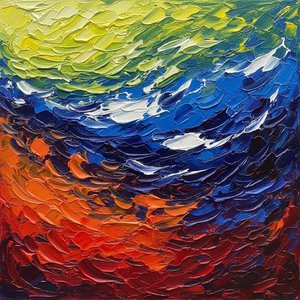 Celestial Vortex in Motion: A Monumental Study of Primal Color and Kinetic Energy
 Futurism
 Cubo-Futurism Explained: The Dynamic Fusion of Geometric Precision and Kinetic Energy in Modern Art
 Panayiotis Vassilakis
 Kinetic Chaos in Obsidian and Ochre: A Singular Study of Centrifugal Energy
 Capturing Motion: A Professional Guide to Integrating Kinetic Energy and Dynamic Artworks into Luxury Hotel Interiors


