The Dawn of Brilliance: Understanding the Early Netherlandish Revolution
 Early Netherlandish painting
Early Netherlandish painting is the body of work by artists active in the Burgundian and Habsburg Netherlands during the 15th- and 16th-century Northern Renaissance period, once known as the Flemish Primitives. It flourished especially in the cities ...
To step into the world of the 15th-century Low Countries is to witness a quiet, luminous revolution that forever altered the trajectory of Western art. Long before the sun-drenched landscapes of the Impressionists captured our hearts, the artists of the Burgundian and Habsburg Netherlands—once known as the Flemish Primitives—were busy redefining the very essence of reality. This was not a movement born of sudden, violent change, but rather an exquisite evolution that blossomed in the bustling centers of Bruges, Ghent, and Brussels. It was a period where the rigid, symbolic language of the Middle Ages began to soften, yielding to a profound fascination with the tangible world.
Unlike the Italian Renaissance, which sought beauty through mathematical perspective and classical humanism, the Early Netherlandish masters found their divinity in the minute. They looked closely at the way light pooled in a velvet fold, the way a single dewdrop clung to a petal, and the way a shadow deepened in the corner of a quiet room. This era marked a pivotal departure from Gothic stylization, moving toward an unprecedented naturalism. It was a time when art became a mirror held up to creation itself, capturing not just the grand narrative of saints and monarchs, and but the very texture of existence.
Jan van Eyck: The Alchemist of Light and Oil Glazes
 Jan van Eyck
A Life Illuminated: The World of Jan van Eyck Jan van Eyck, a name synonymous with the dawn of Early Netherlandish painting and the revolutionary use of oil paint, remains an enigmatic figure despite his monumental impact on art history. Born around ...
If there is an alchemist at the heart of this luminous era, it is undoubtedly Jan van Eyck. While history has occasionally simplified his legacy by calling him the inventor of oil painting, his true genius lay in his mastery of the medium's transformative potential. Van Eyck did not merely use oil; he breathed life into it. Through the meticulous application of thin, translucent glazes, he achieved a depth and luminosity that seemed to emanate from within the panel itself. His brushwork was so precise that it could capture the crystalline physics of light reflecting off a polished pearl or the subtle, moist sheen of a human eye.
Consider his intimate 1439 portrait of Margaret van Eyck. In this captivating work, we see his wife presented with a dignified, inward focus. The dark, undefined background serves as a stage, pushing her face and the exquisite textures of her attire into the viewer's immediate presence. There is a profound sense of intimacy here; her lowered gaze suggests a private moment of reflection, inviting us to share in her quietude. Through his revolutionary technique, Van Eyck could render skin tones with a breathtaking vitality and fabrics with such weight and luster that the boundary between the painted image and the physical world began to dissolve.
Rogier van der Weyden: Capturing the Tremor of the Human Soul
 25 Masterpieces by Rogier van der Weyden: The Pinnacle of Emotional Art
Introduction To step into the world of Rogier van der Weyden is to encounter the very heartbeat of the Early Netherlandish Renaissance. While his contemporary, Jan van Eyck, mastered the crystalline physics of light and reflection, it was Van der Wey...
While Jan van Eyck mastered the external physics of light, his contemporary, Rogier van der Weyden, turned his gaze inward to master the human soul. If Van Eyck’s work is a study in brilliance and reflection, Van der Weyden’s is a study in pathos. He was the architect of emotion, a painter whose brush did not merely capture the heavy fold of a velvet robe but the very weight of grief. To encounter his masterpieces is to walk through a quiet, candlelit cathedral where every pigment holds a prayer and every shadow tells a story of spiritual intensity.
Van der Weyden’s background in goldsmithing gifted him with a supernatural precision, yet he used this technical skill to serve the profound expression of human suffering and devotion. He moved beyond mere iconography to create scenes that felt visceral and deeply relatable. In his hands, the sorrow in a Madonna’s eyes or the trembling of a tear became universal symbols of empathy. His work bridges the gap between the medieval and the modern, offering a sanctuary of contemplation through the sheer power of human feeling. He taught us that art could be more than a window into the world; it could be a mirror for our own capacity to love and to mourn.
Symbolism in Every Thread: Decoding the Hidden Language of Northern Art
Early Netherlandish Painting: Its Origins and Character is a 1953 book on art history by Erwin Panofsky, derived from the 1947–48 Charles Eliot Norton Lectures. The book had a wide impact on studies of Renaissance art and Early Netherlandish painting...
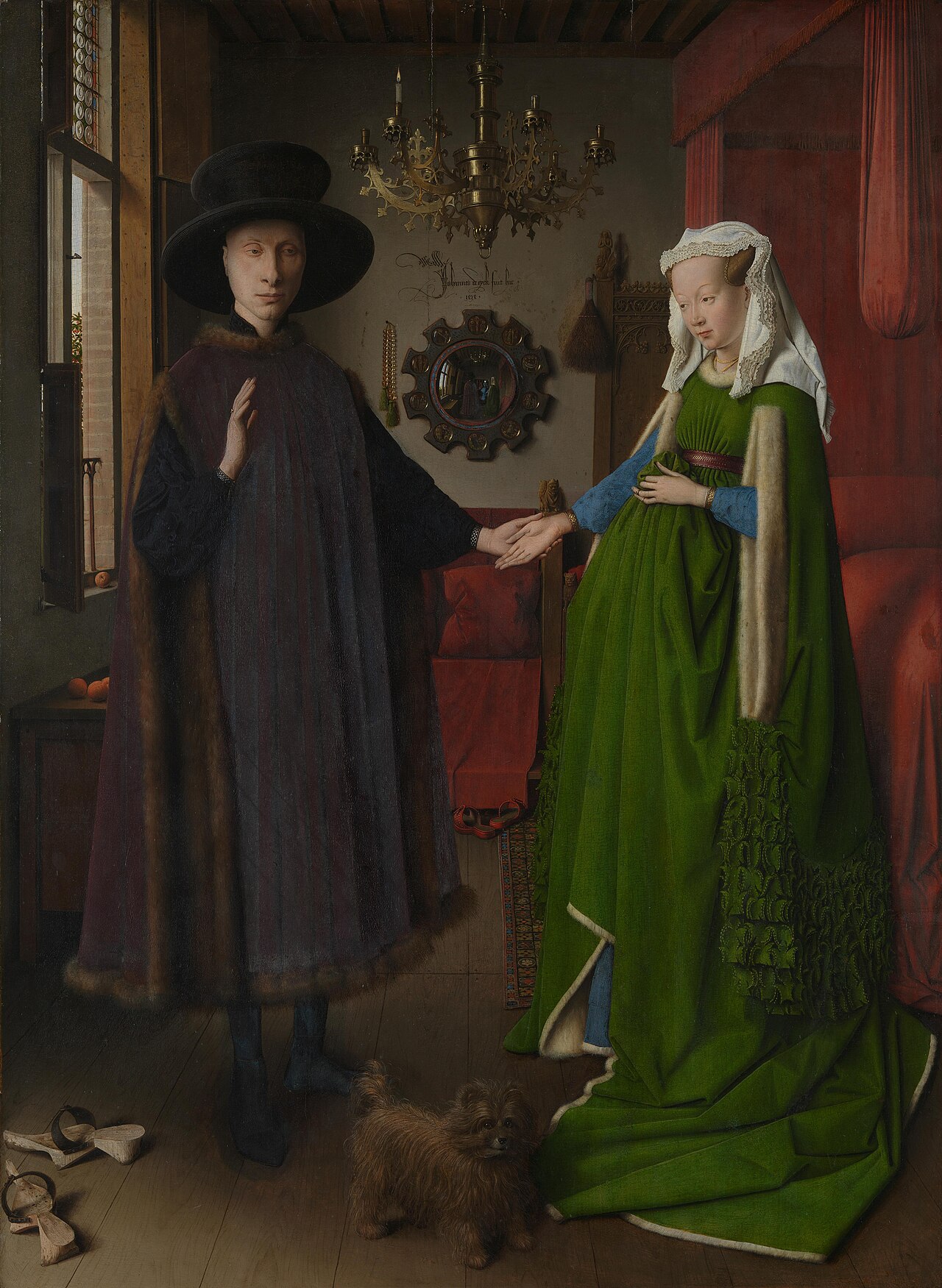
To the untrained eye, an Early Netherlandish painting may appear as a simple, hyper-realistic depiction of a scene. However, for the true enthusiast, these works are intricate puzzles of meaning, where every object serves as a silent messenger. This period was characterized by a complex iconography, where the mundane and the miraculous were inextricably linked. A dog placed at the feet of a couple was not merely a pet, but a profound symbol of fidelity; a single candle burning in a chandelier could represent the all-seeing eye of the Divine.
Even the attire of the subjects carried heavy symbolic weight. In the portrait of Margaret van Eyck, her elegant red dress signifies not only wealth and status but also a certain social dignity. The elaborate, horned headdress she wears has sparked centuries of debate among historians, with interpretations ranging from symbols of marital devotion to allusions to contemporary religious motifs. This layering of meaning ensures that the viewer's journey never truly ends; every time we return to these panels, we find new layers of truth waiting to be uncovered beneath the luminous glazes.
From Medieval Devotion to Renaissance Realism: A Shift in Perspective
--- title: Painting in Oil in the Low Countries and Its Spread to Southern Europe - The Metropolitan Museum of Art author: Susan Jones url: https://www.metmuseum.org/essays/painting-in-oil-in-the-low-countries-and-its-spread-to-southern-europe hostna...
The transition from the late Gothic period to the Northern Renaissance was a movement toward a more grounded, human-centric reality. This shift did not abandon religious devotion but rather repositioned it within the context of the everyday. The sacred was no longer relegated to an abstract, golden void; instead, it was brought into the domestic sphere. We see the birth of Christ or the adoration of saints occurring in rooms filled with recognizable objects—brass basins, linen cloths, and wooden furniture—all rendered with such startling realism that the divine feels tangibly present.
This evolution allowed for a new kind of spiritual engagement. By rendering religious narratives with extraordinary detail and naturalistic light, artists like Robert Campin and Jan van Eyck made the miraculous feel accessible. The landscape, while often relegated to a background detail in the early years, began to grow in importance, providing a rich, descriptive setting that anchored the spiritual drama in the physical world. It was a period of profound intellectual and artistic expansion, where the boundaries between the earthly and the heavenly were blurred by the sheer beauty of human craftsmanship.
Preserving the Legacy: Bringing the Flemish Masters into the Modern Home
The enduring power of these masterpieces lies in their ability to transcend time. The textures, the light, and the profound emotional resonance of the Early Netherlandish masters continue to offer a sense of permanence in our increasingly digital and fleeting age. For those of us who find solace in the tactile depth of a well-executed oil painting, there remains a deep desire to surround ourselves with this level of artistry.
At TopImpressionists.com, we celebrate this enduring legacy by offering high-quality, handmade oil reproductions that honor the spirit of these masters. Our artists, trained in the finest academic traditions, use the same meticulous layering techniques—applying glazes on 100% cotton canvas—to ensure that the visible brushstrokes and deep tonal ranges of the original era are preserved. Whether you seek to transform a personal memory through our custom portrait services or wish to bring the luminous atmosphere of the Northern Renaissance into your own sanctuary, we invite you to experience the profound beauty of art history, reimagined for the modern collector.